Docker Design System
Docker's site in Repro display and Inter body on near-white, with electric blue on every interactive state and 4–8px corners. For React and AI tools.
- Primary color
- #2560ff
- Typeface
- Inter
- Shape
- Sharp
- Base radius
- 8px
- Colors
- 16
- Type tokens
- 11
- Components
- 16
- Spacing values
- 8
About Docker DESIGN.md
Curated by Dov Azencot, updated May 18, 2026. Source docker.com (opens in a new tab).
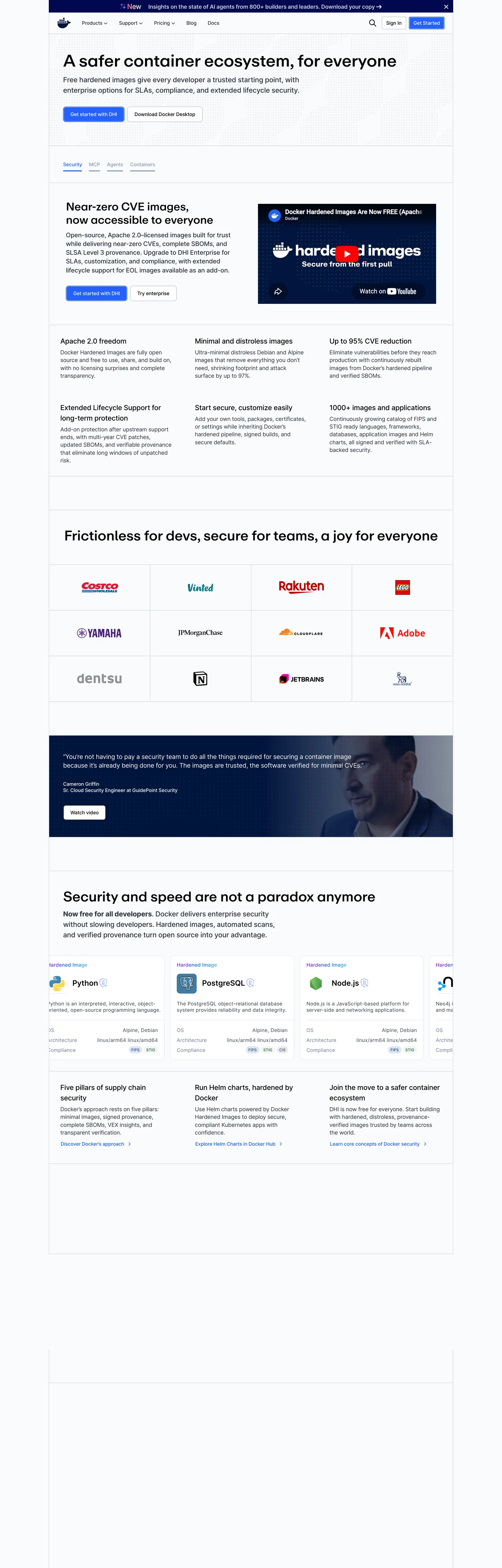
Docker's marketing homepage is not trying to win a design award. The hero is a white surface with a black 48px headline ("A safer container ecosystem, for everyone"), a two-paragraph body explanation, and a side-panel screenshot showing "Hardened Images" with a metric counter. Below the fold: a partner-logo wall (Salesforce, Rakuten, HelloFresh, Adobe, Atlassian), a two-column security feature block, and a testimonial quote. The decorative budget is zero. Where Cloudflare fills the hero canvas with saturated orange and AWS runs spectral gradient thumbnails, Docker gives you a statement and gets out of the way. The entire chromatic system rests on one electric-blue (#2560ff) voltage wired to 30+ CSS custom properties — button fills, link colors, icon fills, tab borders, input focus rings, table accents — and a deep navy-to-dark-slate prose palette.
The typographic split is the system's most distinctive move: **Repro** (a proprietary display sans) carries the 24–48px headline tier at weight 500, while **Inter** carries everything below — body paragraphs at 16–18px, nav links at 14px, labels at 12–14px in weight 400–500. The display/body split means the two faces share weight and rhythm but differ in optical warmth. Repro reads slightly cooler and more geometric at large sizes; Inter reads neutral and trustworthy at small. The combination signals "product company with engineering discipline" without the austerity of a purely monospace system (Bun, Warp) or the editorial weight of a grotesk system (Cloudflare, Docker's own enterprise competitor VMware).
The radius story is binary-conservative: 4px on buttons and interactive chips, 8px on cards. No 12px, 16px, or pill tier. Every surface rounds just enough to not be sharp. This is the opposite of Spline's generous-soft 16px default or Cloudflare's binary small-step-plus-pill — Docker's rounding says "tool, not toy."
What makes it distinct
5 highlights
- Single electric-blue voltage#2560ff wired to --buttonPrimaryBackground, --linkColor, --iconColor, and 30+ other CSS custom properties
- Two-family typographyRepro (proprietary) for display headings, Inter for body, labels, and nav links
- Conservative rounding4px on buttons and chips, 8px on cards; no generous pill scale, no 16px default
- Security-metric credibility layerThe hero section names CVE counts and partner logos rather than using decorative brand illustration
- High-frequency dark slate ink#2c333f (644 occurrences) handles label, subhead, and copy roles simultaneously
Live at docker.com
Docker in production, as captured. Scroll the window to see the whole page.
16 colors
Docker's system runs on #2560ff as its primary voltage, used in 2 of 16 components. Type is set in Inter across 11 tokens from 12px to 48px, weights 400–500. Shape language is sharp — components average 4px corner radius, favoring crisp rectangles.
Brand & Accent
Sparing, CTA-only voltage · 3
Surface
Page and card backgrounds · 3
Text
Headlines, body, captions · 4
Borders & Hairlines
Dividers, outlines, rules · 2
Semantic
Status, errors, success, links · 4
11 type tokens
Set in Inter across 11 tokens, from 12px to 48px, weights 400–500. Shown in its own stack: where the font isn't installed, the fallback the file names stands in.
- display-xl48px · weight 500 · lh 57.6px · tracking -0.6pxThe quick brown fox jumps over the lazy dog
- display-lg40px · weight 500 · lh 48px · tracking -0.5pxThe quick brown fox jumps over the lazy dog
- display-md32px · weight 500 · lh 38.4px · tracking -0.4pxThe quick brown fox jumps over the lazy dog
- display-sm24px · weight 500 · lh 28.8px · tracking -0.3pxThe quick brown fox jumps over the lazy dog
- heading-lg20px · weight 500 · lh 30px · tracking -0.25pxThe quick brown fox jumps over the lazy dog
- heading-md18px · weight 500 · lh 25.2px · tracking -0.225pxThe quick brown fox jumps over the lazy dog
- body-lg18px · weight 400 · lh 25.2px · tracking -0.225pxThe quick brown fox jumps over the lazy dog
- body-md16px · weight 400 · lh 22.4px · tracking -0.2pxThe quick brown fox jumps over the lazy dog
- body-sm14px · weight 400 · lh 18.2px · tracking -0.15pxThe quick brown fox jumps over the lazy dog
- label-md14px · weight 500 · lh 18.2px · tracking -0.15pxThe quick brown fox jumps over the lazy dog
- caption12px · weight 500 · lh 15.6px · tracking -0.15pxThe quick brown fox jumps over the lazy dog
Radii and spacing
4 corner radii and 8 spacing values. Shape language: sharp, on a 8px base radius.
Radii4
- none0px
- xs4px
- sm8px
- full9999px
Spacing8
- xs6px
- sm8px
- md12px
- base20px
- lg24px
- xl32px
- 2xl40px
- 3xl48px
16 components
Each rendered from its tokens (color, type, radius, padding) on Docker's own canvas.
- Button PrimaryButton Primarybutton-primary
- Button SecondaryButton Secondarybutton-secondary
- Button TertiaryButton Tertiarybutton-tertiary
- Top NavTop Navtop-nav
- Nav LinkNav Linknav-link
- Hero HeadingHero Headinghero-heading
- Section HeadingSection Headingsection-heading
- Body ParagraphBody Paragraphbody-paragraph
- Body Paragraph MutedBody Paragraph Mutedbody-paragraph-muted
- CardCardcard
- Card AccentCard Accentcard-accent
- Type here…Text Inputtext-input
- Tab ActiveTab Activetab-active
- Tab InactiveTab Inactivetab-inactive
- Logo ChipLogo Chiplogo-chip
- FooterFooterfooter
The system, in use
Docker's tokens on the kind of product it builds.
The fastest way to build and ship software
Deploy from git in seconds, scale on demand and keep every environment in sync.
1import { createClient } from "./client";23const client = createClient({ region: "us-east", retries: 3 });45export async function deploy(app: string) {6 const build = await client.builds.create({ app });7 // Stream the logs until the build is live8 for await (const line of build.logs()) {9 console.log(line);10 }11 return build.url;12}
Docker design system FAQ
Docker's tokens, its components and how to use this DESIGN.md in your project.
Related reading
Specs, directories and component libraries that pair with this design system.
- Browse all design systemsThe full directory of DESIGN.md files on shadcn.io, with live mockups for each.shadcn.io
- Docker — official siteDocker's public marketing site — the source of truth for the live tokens captured in this file.docker.com (opens in a new tab)
- The DESIGN.md specificationGoogle Labs' open spec for machine-readable design system files — the format this page is built on.github.com (opens in a new tab)
Use Docker in your project
One machine-readable file. Drop it into Claude Code, Cursor, VS Code or any AI tool that reads DESIGN.md.
Download the DESIGN.md
One machine-readable file: every color, type, radius, spacing, and component token of Docker.
Feed it to your AI tool
Drop it into Claude, Cursor, or GitHub Copilot. The agent writes React components and Tailwind classes that match Docker's visual language.
Reference the tokens directly
Or paste the values into your Tailwind config, CSS variables, or component library: every color, size and radius is a quoted, ready-to-copy value.
Read the full DESIGN.md overview, rationale, do’s and don’ts
Overview
Docker's marketing homepage does not attempt to impress with color or decoration. Single-Voltage Technical Credibility. The hero is a white surface, a 48px Repro headline, a metric counter showing CVE reduction, and a partner-logo wall. Where Cloudflare announces its brand with a full-canvas orange hero and Vercel uses matte black, Docker uses white and lets the security numbers do the persuasion. The system is built around a single electric-blue voltage (#2560ff) wired to 30+ CSS custom properties — buttons, links, icons, focus rings, tab borders, table accents — making it visually consistent without being visually exciting. This is the same restraint discipline Stripe uses, but without Stripe's serif headlines or mesh gradients.
The two-family typography — Repro for 24–48px display, Inter for everything below — divides responsibility clearly: Repro signals brand identity at the moment of first contact (headline, section h2), Inter carries the reading work (body, labels, nav). Unlike Cloudflare, which uses FT Kunst Grotesk across all tiers, Docker's split acknowledges that a single display family optimized for large sizes is rarely optimal at 14px body.
Conservative-technical rounding: 4px buttons, 8px cards. No pill. No 16px default. The conservatism is a positioning signal — Docker's nearest peer in the dev-tools category, Kubernetes, uses 8px as its only radius; Docker's tighter 4px CTA matches the "tooling" register.
Key Characteristics:
- Pure white canvas (
{colors.canvas}— #f9fafb) with{colors.surface-1}(#efefef) for card and code-block backgrounds. - Single electric-blue voltage (
{colors.primary}— #2560ff) across 29 rendered occurrences — the only chromatic brand element. - High-frequency dark-slate ink (
{colors.ink-slate}— #2c333f, 644 occurrences) as the label, subhead, and copy workhorse. - Repro display family at 24–48px / weight 500–700; Inter body family at 12–20px / weight 400–500.
- Conservative binary rounding: 4px buttons, 8px cards. No larger radius tier.
- 8px base spacing. Section padding at 48×40px. Button at 8×12px.
- Security-credibility positioning: partner-logo grid (Salesforce, Rakuten, HelloFresh, Adobe, Atlassian) and CVE-count metrics rather than decorative illustration.
- Semantic color set fully declared: error red (#ff5757), warning amber (#f8b60f), success green (#38bd7d) — all zero occurrences on the captured marketing surface but live in CSS variables.
Colors
Brand
- Primary (
{colors.primary}— #2560ff): frequency 29. Used as text (12), background (8), border (9). The single brand voltage — wired as--buttonPrimaryBackground,--linkColor,--iconColor,--highlightColor,--headlineHighlightedColor,--tabActiveAnimationColor, and 20+ more. Every interactive state on the page resolves to this blue. - Primary Dark (
{colors.primary-dark}— #003db5): frequency 7, all border. The button's 1.5px border color wired as--buttonPrimaryBorder. Creates visible definition on the blue-fill CTA without a separate shadow. - Primary Hover (
{colors.primary-hover}— #0d4df2): declared as--tableHighlightBorderColor. Slightly deeper than the primary voltage — used on hover/focus table row borders.
Text
- Ink (
{colors.ink}— #000000): frequency 79. Used as text (42), border (35). Pure black — deployed on headlines and the heavy-contrast tab border. Wired across dozens of focus and active state variables. - Ink Slate (
{colors.ink-slate}— #2c333f): frequency 644 — the dominant body tone. Used as text (343) and border (301). Wired as--labelColor,--subheadColor,--copyColor. The workhorse color: darker than typical body gray but not pure black. - Ink Secondary (
{colors.ink-secondary}— #434c5f): frequency 0 (rendered), declared. Carries--standardCopy,--menuLinkDescriptionColor, disabled button text. - Ink Muted (
{colors.ink-muted}— #6c7e9d): frequency 0 (rendered), declared. Secondary metadata text — input descriptions, placeholder values, card secondary labels.
Surface
- Canvas (
{colors.canvas}— #f9fafb): frequency 105. The near-white page floor and default card/button background. Not pure white — the slight off-white reading reduces glare on a page with zero decorative color. - Surface-1 (
{colors.surface-1}— #efefef): frequency 1. Code-block background, secondary section background. Wired as--codeBoxBackgroundColor,--backgroundSecondary. - Surface-2 (
{colors.surface-2}— #e5f2fc): light blue-tinted surface. Used for quote backgrounds and the nav mega-menu button fill. Wired as--quoteBackground,--menuLinkButtonBackgroundColor.
Hairlines
- Hairline (
{colors.hairline}— #c8cfda): frequency 13, all border. Card outlines, table borders, tab toggle borders. The dominant separation color. - Hairline Soft (
{colors.hairline-soft}— #a9b4c6): frequency 8, all border. Secondary button border, disabled input border, slider track.
Semantic
- Error (
{colors.error}— #ff5757): declared as--inputErrorBorder,--inputRequiredAsteriskColor. Zero rendered occurrences on the marketing surface. - Warning (
{colors.warning}— #f8b60f): declared as--warningCopy,--warningIconFill. Zero rendered occurrences. - Success (
{colors.success}— #38bd7d): declared as--successIconFill,--successCopy. Zero rendered occurrences. - Error Background (
{colors.error-bg}— #fddfdf): declared as--dangerBackground. Zero rendered occurrences.
Typography
Font Families
Two voices: Repro for the display tier (24–48px), carrying the editorial brand identity; Inter for the body tier (12–20px), carrying the reading work. The Repro fallback stack walks Helvetica, Arial, sans-serif; the Inter stack walks Helvetica, Arial, sans-serif identically — the two families share the same fallback, meaning in environments where neither is loaded the page degrades gracefully to system sans.
The split is sharper than Cloudflare's (which uses a single grotesk across all tiers) and more conventional than Spline's (which uses Spline Sans across all tiers). Docker uses one face to signal brand, one face to reduce eye-strain at reading sizes.
Hierarchy
| Token | Size | Weight | Line Height | Letter Spacing | Use |
|---|---|---|---|---|---|
{typography.display-xl} | 48px | 500 | 57.6px | -0.6px | Hero h1 ("A safer container ecosystem, for everyone") |
{typography.display-lg} | 40px | 500 | 48px | -0.5px | Section h2 |
{typography.display-md} | 32px | 500 | 38.4px | -0.4px | Sub-section h2 |
{typography.display-sm} | 24px | 500 | 28.8px | -0.3px | h2 card title |
{typography.heading-lg} | 20px | 500 | 30px | -0.25px | h4 feature-cell heading |
{typography.heading-md} | 18px | 500 | 25.2px | -0.225px | Sub-heading |
{typography.body-lg} | 18px | 400 | 25.2px | -0.225px | Hero sub-paragraph, lead copy |
{typography.body-md} | 16px | 400 | 22.4px | -0.2px | Default running text |
{typography.body-sm} | 14px | 400 | 18.2px | -0.15px | Nav links, captions |
{typography.label-md} | 14px | 500 | 18.2px | -0.15px | Button labels, tab labels, chips |
{typography.caption} | 12px | 500 | 15.6px | -0.15px | Small labels and metadata |
Principles
Repro display tops out at 48px / 500 in the hero. A 48px / 700 variant appears on h2 section headings in the extraction — Docker uses bold weight selectively at the section level rather than the hero level. Inter body at 400 carries the reading register. The negative letter-spacing values (-0.15px to -0.6px) scale proportionally with font size — a standard optical correction that tightens the spacing as size increases.
Note on Font Substitutes
Repro is a proprietary display family. The closest open-source substitute is DM Sans at equivalent weights (the proportions match at 32–48px); Geist is another close option with slightly tighter cap height. Inter is already open-source and requires no substitution.
Layout
Spacing System
- Base unit: 8px (60 occurrences — the dominant module).
- Tokens:
{spacing.xs}6px ·{spacing.sm}8px ·{spacing.md}12px ·{spacing.base}20px ·{spacing.lg}24px ·{spacing.xl}32px ·{spacing.2xl}40px ·{spacing.3xl}48px. - Section padding: 48×40px on major editorial sections (from
6px 12pxbutton →48px 40pxsection: a 1:40 ratio). - Button padding: 8×12px — notably compact compared to Cloudflare (12×24px) or Spline (16×24px).
- Card padding: 24px internal padding on content cards.
Grid & Container
- Max content width: ~1080px for the hero and feature sections.
- Hero layout: left column (headline + body + CTA), right column (product screenshot/metric panel). Split roughly 55/45.
- Partner logo wall: horizontal strip of 6–8 partner logos at uniform grayscale treatment below the hero.
- Feature grid: 3-column grid for "Docker Scout," "Docker Build," "Docker Desktop" feature panels with
{rounded.sm}8px cards. - Security section: 2-column alternating layout — text block left or right, screenshot or metric visual on the opposite side.
Rhythm
The page alternates between editorial prose (headline + 2-3 paragraph body, white canvas) and proof-point grid (logo wall, metric counter, partner testimonial). Unlike Cloudflare's alternating generous/dense bands, Docker's rhythm is more uniform — sections sit at approximately the same vertical cadence, with less dramatic density contrast between bands.
Elevation
The system uses light shadow on interactive elements rather than hairline-only:
- Card hover:
{colors.canvas}background shifts to a slightly elevated tone; shadow appears via CSS on--cardBackgroundHover/--shadowColorHover(hsla(0,0%,100%,.25)). - Nav shadow:
--shadowColor:hsla(0,0%,100%,.08)— a very subtle white-glow for the nav bar on dark contexts. - Focus outline:
--buttonPrimaryFocusOutline:{colors.surface-2}— the sky-blue focus ring on primary button focus states. Not visible on the resting marketing surface. - Tooltip:
--tooltipBackgroundColor:{colors.ink}(#000000) — a pure-black tooltip fill.
Shapes
The radius scale is conservative-binary: 4px for interactive elements, 8px for content surfaces.
{rounded.none}0px — only for nav borders and inlined typography.{rounded.xs}4px — primary and secondary buttons, input fields, small chips. The tightest functional radius, used on all tap targets.{rounded.sm}8px — content cards, feature panels, nav mega-menu surfaces. The dominant card radius.{rounded.full}9999px — reserved for circular avatar marks and toggle switch thumbs; not used on any marketing-surface CTA.
No 12 / 16 / 20px middle tier. No pill CTA. The entire button vocabulary — primary, secondary, tertiary — uses {rounded.xs} 4px. This is the sharpest CTA rounding in the dev-tools segment; even Kubernetes, which has a similarly technical aesthetic, uses 8px on its buttons. Docker's 4px is a deliberate signal.
Components
button-primary — Electric-blue {colors.primary} fill, canvas text, {rounded.xs} 4px radius, 8×12px padding, 36px height, 1.5px {colors.primary-dark} border. "Get Started" in the top nav is the canonical instance.
button-secondary — Canvas fill, ink text, {rounded.xs} 4px radius, 8×12px padding, 36px height, 1.5px {colors.hairline-soft} border. Used for secondary nav actions and "Learn more" card CTAs.
button-tertiary — Canvas fill, {colors.primary} text, no border, {rounded.xs} 4px. Ghost-button style for inline tertiary actions.
top-nav — Canvas {colors.canvas} surface, slate {colors.ink-slate} link text in {typography.label-md} (14px / 500), 58px height, 20×16px nav-link padding. Houses the Docker whale logo, product nav (Products, Developers, Open Source, Pricing), and right-aligned "Sign in" + "Get Started" cluster.
nav-link — Transparent fill, slate ink, 14px / 500, 20×16px padding. Hover state not captured on the resting surface.
hero-heading — Pure-black {colors.ink} text, {typography.display-xl} (48px / 500). Left-aligned on a white canvas with no background color — the hero is a typographic statement, not a visual scene.
section-heading — Pure-black text, {typography.display-lg} (40px / 500) or {typography.display-md} (32px / 500) depending on section weight.
body-paragraph — {colors.ink-slate} text at {typography.body-lg} (18px / 400) for lead paragraphs; {typography.body-md} (16px / 400) for running text.
card — Canvas fill, {colors.hairline} 1px border, {rounded.sm} 8px radius, 24px padding. Default content card for the feature grid.
card-accent — {colors.surface-2} (#e5f2fc) light-blue tinted fill, {rounded.sm} 8px. Used for highlighted feature tiles and the quote background.
text-input — Canvas fill, ink-slate text, {rounded.xs} 4px radius, 8×12px padding, 36px height, 1px {colors.hairline-soft} border.
tab-active — {colors.ink} (pure black) fill, canvas text, no radius, 12×0px padding. The active tab indicator in the product-feature tabbed panel uses a pure-black fill — a deliberate contrast against the blue button primary.
tab-inactive — Transparent fill, {colors.ink-muted} text, no radius.
logo-chip — Canvas fill, partner logo at {rounded.sm} 8px, 12×20px padding. All partner logos rendered in full color (unlike Cloudflare's monochrome-white logo wall or Spline's monochrome treatment).
footer — Canvas fill, muted text, 48×40px padding, {colors.surface-1} top border. The footer continues the white canvas — no dark reversal like AWS's pitch-black footer.
Do's and Don'ts
Do use {colors.primary} (#2560ff) for every interactive state — button fill, link color, icon fill, focus ring, tab border. The system's internal consistency depends on this voltage appearing exclusively as the interactive signal; splitting it into an accent fill AND a neutral interactive color creates ambiguity.
Do keep the button radius at {rounded.xs} 4px for primary and secondary CTAs. Bumping to 8px blurs the distinction between buttons (4px) and cards (8px). Bumping to a pill loses the "tool, not toy" signal entirely.
Do use Repro (or a DM Sans substitute) only for the 24px+ display tier. Below 24px, Inter's optical warmth at small sizes outperforms Repro's geometric proportions; switching Repro into body text reduces readability.
Do treat the testimonial or partner-logo section as a credibility anchor rather than a design moment. Docker's logo wall renders partner marks in full color (not monochrome) — each partner brand retains its own visual identity, signaling that Docker integrates with real enterprise stacks rather than absorbing them.
Don't introduce a 16px or pill radius tier. The binary 4/8px scale is the system's shape signature; a 16px card or a pill CTA imports a consumer aesthetic that contradicts Docker's dev-tool positioning.
Don't use {colors.surface-2} (#e5f2fc) as a hero background. It is a quote-background and nav-accent tone — applying it to the hero surface makes the page feel like a product highlight rather than an editorial statement.
Don't use weight 700 in Repro above 48px. The largest captured instance at 700 weight is 48px on a section h2; the hero h1 uses 500. Inverting this — 700 on the hero, 500 on the section — breaks the hierarchy.
Don't add a shadow to cards on the resting (non-hover) state. Docker's card system uses hairline borders, not shadows, for the resting elevation. Shadows appear only on hover — adding them to all cards makes the page feel webby rather than native-tool.
Known Gaps
- Hero illustration / screenshot: the right-side panel in the captured hero shows a Docker-branded "Hardened Images" UI. The component renders as a screenshot rather than a tokenized component — its internal colors, typography, and layout are product-surface tokens not exposed on the marketing page.
- Hover and focus state matrix: only the resting state is fully captured. Focus rings (
{colors.surface-2}— the sky-blue--buttonPrimaryFocusOutlinestop), disabled tints ({colors.hairline}on disabled button background), and active shadow states are declared in CSS but not rendered in the captured surface. - Dark-variant nav: CSS exposes
--menuAltBackgroundColor: #002978(midnight navy) and--menuAltCopyColor: hsla(0,0%,100%,.8)for an alternate dark navigation state (likely the mega-menu or a sticky scroll variant). This surface is not represented in the resting capture. - Mobile breakpoints: the marketing page at desktop (1280px+) uses a two-column hero layout and a 3-up feature grid. Below 768px both collapse to single-column; responsive token overrides are not captured.
- Product surfaces (Docker Desktop, Docker Hub): this DESIGN.md captures the marketing site only. Docker Desktop's Electron UI and Docker Hub's web dashboard each carry their own design systems distinct from the marketing surface.
- Animation: section entries appear to animate on scroll (fade-in + translate); easing curves and duration values are not in the extracted static tokens.
More systems like this
Algolia, Astro, Biome and 67 more in Developer Tools & IDEs: each brand's colors, type and components in one file your AI agent builds from.
Build it with Pro
The DESIGN.md files are free. Pro adds 6,000+ blocks, premium templates and the MCP server, so your AI editor builds in your system for you.
4.9/5 out of 5 · 150+ reviewsfrom 150+ founders and developers.
Billing
Billed once a year in USD. Cancel anytime.
- How many people can use the license.
- Client work, SaaS products and anything you charge for.
- Page sections in 56 categories, from heroes and pricing tables to dashboards and settings, on every framework and UI library, in your theme.
- Complete Next.js sites for startups, SaaS, agencies and portfolios, every page designed, ready to ship.
- Your AI agent searches, previews and installs any component, block, icon or DESIGN.md from a prompt: 22 tools in Claude Code, Cursor, VS Code and 35 more clients.
- Buttons with motion and states of their own, from an arrow that slides in to a burst of confetti.
- Typewriters, scrambles, counters and more, for headlines, labels and numbers.
- Animated backgrounds for heroes, sections and cards, from a soft aurora to a flock that flees the cursor. Most are pure CSS.
- WebGPU shaders, from a slow aurora to a black hole, each drawing only while it's on screen.
- One design and one theme on all four: the components, blocks and effects are built for each framework.
- React on Base UI, Radix UI, React Aria or Ark UI: install the version for the library your project already uses. Vue, Svelte and Solid run on Ark UI.
- From a button to a date picker, a color picker or a guided tour: accessible, typed in TypeScript, each with live demos.
- Real-world patterns built from the components, in 53 galleries: forms, tables, menus, dialogs and more.
- Area, bar, line, pie, radar and radial charts on TanStack Charts, on every framework. React also gets the Recharts originals.
- Debounce, local storage, media queries and more: each hook is one typed file you own.
- From 222 libraries, Lucide, Heroicons, Tabler and Material Symbols among them, as SVG or a React component in one command.
- Stripe, Linear, Apple and 497 more: a brand's colors, typography and components in one file your AI agent builds from.
- Restyle every component and block at once: 8 styles, 8 grays, 18 colors and 5 radii, shared as a shadcn preset code.
- Priority requests are answered first.
Individual
For personal projects & open source
$32instead of $49/mo
$389 billed yearly
- Seats: 1 seat
- Commercial use: Personal & open source only
- Blocks: All 6,181 blocks
- Templates: All 14 templates
- MCP server: 38 AI clients
- Animated buttons: All 35 buttons
- Text effects: All 97 effects
- Backgrounds: All 100 backgrounds
- Shaders: All 100 shaders
- Frameworks: React, Vue, Svelte, Solid
- UI libraries: Base UI, Radix, Aria, Ark
- Components: All 174 components
- Examples: All 1,103 examples
- Charts: All 70 charts
- React hooks: All 35 hooks
- Icons: 294k+ icons
- DESIGN.md files: All 500 brands
- Theme builder: 8 styles × 18 colors
- Support: Standard
Team
Most popularFor freelancers, agencies & startups
$66instead of $99/mo
$789 billed yearly · ≈ $13/dev/mo
- Seats: Up to 5 seats
- Commercial use: Included
- Blocks: All 6,181 blocks
- Templates: All 14 templates
- MCP server: 38 AI clients
- Animated buttons: All 35 buttons
- Text effects: All 97 effects
- Backgrounds: All 100 backgrounds
- Shaders: All 100 shaders
- Frameworks: React, Vue, Svelte, Solid
- UI libraries: Base UI, Radix, Aria, Ark
- Components: All 174 components
- Examples: All 1,103 examples
- Charts: All 70 charts
- React hooks: All 35 hooks
- Icons: 294k+ icons
- DESIGN.md files: All 500 brands
- Theme builder: 8 styles × 18 colors
- Support: Priority
Organization
For companies with larger teams
$132instead of $199/mo
$1,589 billed yearly
- Seats: Unlimited seats
- Commercial use: Included
- Blocks: All 6,181 blocks
- Templates: All 14 templates
- MCP server: 38 AI clients
- Animated buttons: All 35 buttons
- Text effects: All 97 effects
- Backgrounds: All 100 backgrounds
- Shaders: All 100 shaders
- Frameworks: React, Vue, Svelte, Solid
- UI libraries: Base UI, Radix, Aria, Ark
- Components: All 174 components
- Examples: All 1,103 examples
- Charts: All 70 charts
- React hooks: All 35 hooks
- Icons: 294k+ icons
- DESIGN.md files: All 500 brands
- Theme builder: 8 styles × 18 colors
- Support: Priority
Billed once a year in USD. Cancel anytime.
Individual
For personal projects & open source
$32instead of $49/mo
$389 billed yearly
- How many people can use the license.Seats: 1 seat
- Client work, SaaS products and anything you charge for.Commercial use: Personal & open source only
- Page sections in 56 categories, from heroes and pricing tables to dashboards and settings, on every framework and UI library, in your theme.Blocks: All 6,181 blocks
- Complete Next.js sites for startups, SaaS, agencies and portfolios, every page designed, ready to ship.Templates: All 14 templates
- Your AI agent searches, previews and installs any component, block, icon or DESIGN.md from a prompt: 22 tools in Claude Code, Cursor, VS Code and 35 more clients.MCP server: 38 AI clients
- Buttons with motion and states of their own, from an arrow that slides in to a burst of confetti.Animated buttons: All 35 buttons
- Typewriters, scrambles, counters and more, for headlines, labels and numbers.Text effects: All 97 effects
- Animated backgrounds for heroes, sections and cards, from a soft aurora to a flock that flees the cursor. Most are pure CSS.Backgrounds: All 100 backgrounds
- WebGPU shaders, from a slow aurora to a black hole, each drawing only while it's on screen.Shaders: All 100 shaders
- One design and one theme on all four: the components, blocks and effects are built for each framework.Frameworks: React, Vue, Svelte, Solid
- React on Base UI, Radix UI, React Aria or Ark UI: install the version for the library your project already uses. Vue, Svelte and Solid run on Ark UI.UI libraries: Base UI, Radix, Aria, Ark
- From a button to a date picker, a color picker or a guided tour: accessible, typed in TypeScript, each with live demos.Components: All 174 components
- Real-world patterns built from the components, in 53 galleries: forms, tables, menus, dialogs and more.Examples: All 1,103 examples
- Area, bar, line, pie, radar and radial charts on TanStack Charts, on every framework. React also gets the Recharts originals.Charts: All 70 charts
- Debounce, local storage, media queries and more: each hook is one typed file you own.React hooks: All 35 hooks
- From 222 libraries, Lucide, Heroicons, Tabler and Material Symbols among them, as SVG or a React component in one command.Icons: 294k+ icons
- Stripe, Linear, Apple and 497 more: a brand's colors, typography and components in one file your AI agent builds from.DESIGN.md files: All 500 brands
- Restyle every component and block at once: 8 styles, 8 grays, 18 colors and 5 radii, shared as a shadcn preset code.Theme builder: 8 styles × 18 colors
- Priority requests are answered first.Support: Standard
Team
Most popularFor freelancers, agencies & startups
$66instead of $99/mo
$789 billed yearly · ≈ $13/dev/mo
Everything in Individual, plus
- How many people can use the license.Seats: Up to 5 seats
- Client work, SaaS products and anything you charge for.Commercial use: Included
- Priority requests are answered first.Support: Priority
Organization
For companies with larger teams
$132instead of $199/mo
$1,589 billed yearly
Everything in Team, plus
- How many people can use the license.Seats: Unlimited seats
- Secure checkout via Stripe
- Code lives in your repo
- Keep what you've shipped if you cancel
- License terms
4.9 out of 5 from 150+ developers


Your system, built for you
Every block, template and icon, installed by your AI agent in your design system. The DESIGN.md files stay free.
- Cancel anytime
- Keep what you've shipped