Skip to content

Medium Design System

Medium's reading-first homepage as a DESIGN.md: cream #f7f4ed canvas, GT Super serif at 120px, Söhne UI and pill CTAs, for React and AI coding tools.

Primary color
#191919
Typeface
sohne
Shape
Sharp
Base radius
0px
Colors
18
Type tokens
9
Components
16
Spacing values
8

About Medium DESIGN.md

Curated by Dov Azencot, updated May 13, 2026. Source medium.com (opens in a new tab).

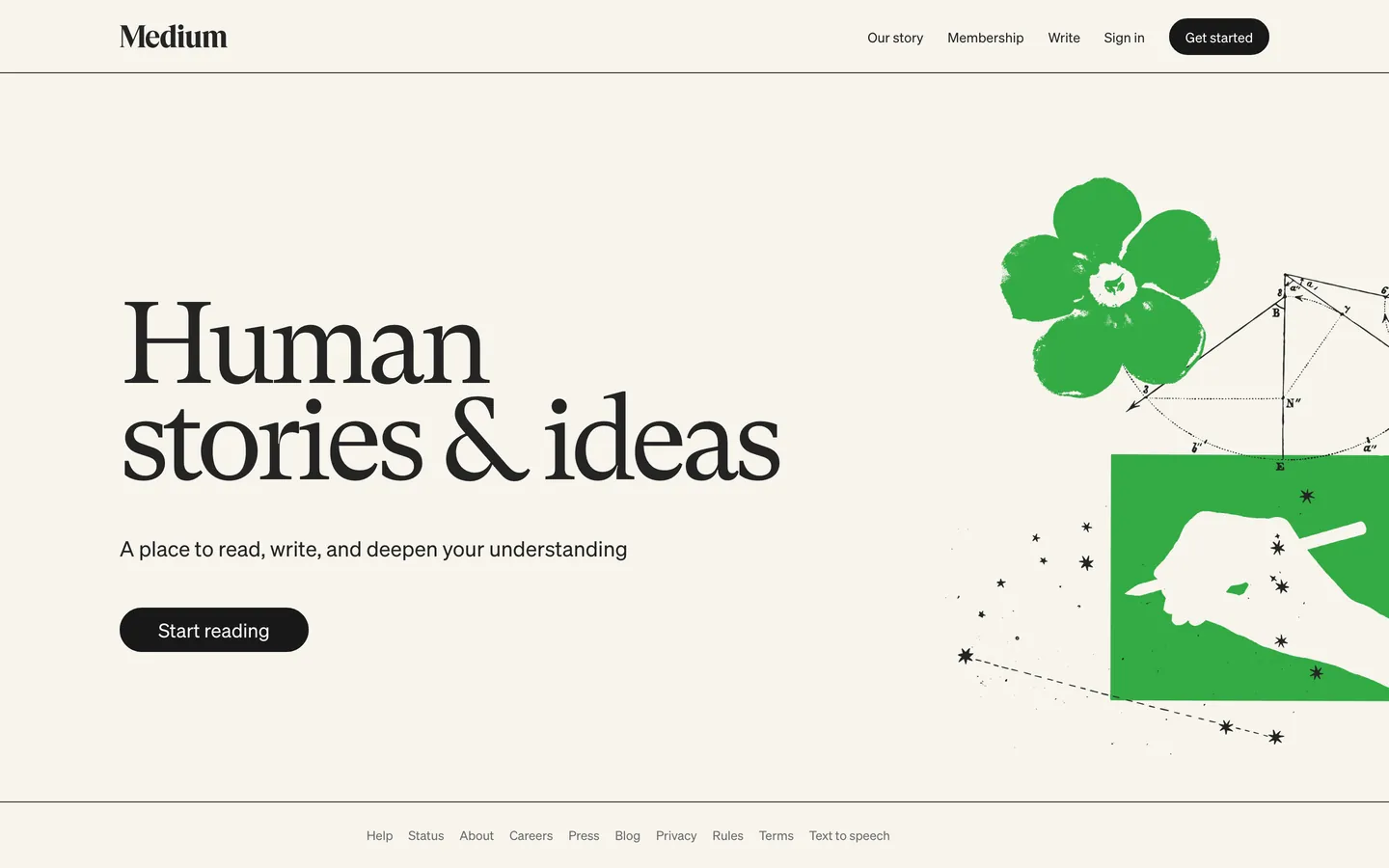
Medium's homepage is a reading room rendered as a webpage. The canvas is a warm cream ("#f7f4ed") rather than pure white — close enough to feel like cheap newsprint, far enough from beige to avoid the vintage-tea-stain trap. The hero is four words of GT Super serif set at 120px ("Human stories & ideas"), and that single typographic gesture is the entire identity. There is no gradient, no abstract product illustration, no SaaS-template feature grid below the fold — the page ends where it begins, with one headline, one dek, one pill button, and a hand-screened green illustration occupying the right half.

This DESIGN.md file packages the homepage system into a structured spec: 18 colors tokens covering the cream-and-ink monochrome plus the editorial green, 9 typography tokens spanning GT Super display (28–120px) and Söhne UI (13–22px), a 2-step radius scale where the pill ("1386px") swallows every button and the rectangle ("0px") owns everything else, an 8-step spacing scale, and 16 components specifications covering the nav, hero, CTA pill, footer link rail, and the surface treatments for both reading body and metadata layers. The format follows the Google Labs DESIGN.md specification.

Feed the file to Claude, Cursor, or any agent that reads structured tokens and it produces Medium's exact reading-first voice — cream paper, oversize literary serif, monochrome ink, a single pill CTA. Unlike most publishing brands that stack a feature grid below a 64px headline, Medium commits the entire first viewport to one sentence — that restraint is the design. Reference the tokens directly in Tailwind config, paste the hex values into CSS variables, or use the spec as an audit checklist when reviewing whether a long-form reading surface feels like a magazine page or a SaaS landing.

What makes it distinct

5 highlights

  1. Cream canvas#f7f4ed warm off-white reads as printed paper rather than screen, set against #242424 ink for newspaper-grade contrast
  2. GT Super at 120px / weight 400A literary serif treated at billboard scale with -6.6px tracking, where most publishing brands cap display at 64px
  3. Single near-black pill CTA#191919 fill at 1386px radius, paired with a 38px height that reads more like a chip than a button
  4. Two-family stackGT Super serif for the hero word, Söhne sans for every nav link, byline, and button label, with zero blended weights
  5. Hand-screened editorial illustrationA stamped green flower and pencil hand occupy the right column, the only color voltage in an otherwise monochrome page

Live at medium.com

Medium in production, as captured. Scroll the window to see the whole page.

Medium's website at medium.com

18 colors

Medium's system runs on #191919 as its primary voltage, used in 1 of 16 components. Type is set in sohne across 9 tokens from 12px to 120px, weights 400–400. Shape language is sharp — components average 0px corner radius, favoring crisp rectangles.

Surface

Page and card backgrounds · 2

Text

Headlines, body, captions · 12

Borders & Hairlines

Dividers, outlines, rules · 3

Other

Specialty colors · 1

9 type tokens

Set in sohne across 9 tokens, from 12px to 120px, weights 400–400. Shown in its own stack: where the font isn't installed, the fallback the file names stands in.

  • display-hero120px · weight 400 · lh 0.83 · tracking -6.6pxThe quick brown fox jumps over the lazy dog
  • display-lg80px · weight 400 · lh 0.95 · tracking -3pxThe quick brown fox jumps over the lazy dog
  • display-md56px · weight 400 · lh 1.05 · tracking -1.5pxThe quick brown fox jumps over the lazy dog
  • dek-serif28px · weight 400 · lh 1.2 · tracking -0.5pxThe quick brown fox jumps over the lazy dog
  • heading-sm22px · weight 400 · lh 1.27 · tracking 0The quick brown fox jumps over the lazy dog
  • button-md20px · weight 400 · lh 1.4 · tracking 0The quick brown fox jumps over the lazy dog
  • body-md14px · weight 400 · lh 1.43 · tracking 0The quick brown fox jumps over the lazy dog
  • body-sm13px · weight 400 · lh 1.54 · tracking 0The quick brown fox jumps over the lazy dog
  • caption12px · weight 400 · lh 1.5 · tracking 0The quick brown fox jumps over the lazy dog

Radii and spacing

3 corner radii and 8 spacing values. Shape language: sharp, on a 0px base radius.

Radii3

  • none0px
  • pill1386px
  • full9999px

Spacing8

  • xxs4px
  • xs8px
  • sm12px
  • md16px
  • base20px
  • lg24px
  • xl25px
  • section48px

16 components

Each rendered from its tokens (color, type, radius, padding) on Medium's own canvas.

  • Top Nav
    Top Navtop-nav
  • Nav Link
    Nav Linknav-link
  • Nav Link Hover
    Nav Link Hovernav-link-hover
  • Wordmark
    Wordmarkwordmark
  • Button Primary
    Button Primarybutton-primary
  • Button Primary Hover
    Button Primary Hoverbutton-primary-hover
  • Button Secondary
    Button Secondarybutton-secondary
  • Hero Headline
    Hero Headlinehero-headline
  • Hero Dek
    Hero Dekhero-dek
  • Body Paragraph
    Body Paragraphbody-paragraph
  • Byline
    Bylinebyline
  • Page Divider
    Page Dividerpage-divider
  • Footer Rail
    Footer Railfooter-rail
  • Footer Link
    Footer Linkfooter-link
  • Link Inline
    Link Inlinelink-inline
  • Illustration Frame
    Illustration Frameillustration-frame

The system, in use

Medium's tokens on the kind of product it builds.

Marketing heroThe homepage: its nav, a headline and the main call to action.
Medium
Subscribe

The stories that shape the world, told well

Reporting, analysis and opinion from journalists around the world, every day.

SubscribeToday's edition
MediumSubscribe
WorldPoliticsBusinessScienceCulture
Climate

The cities racing to adapt before the next flood

Coastal planners are rewriting the rules for how and where we build. Not everyone agrees on who should pay for it.

Medium staff · 12 min read

We are designing for water we have not seen yet. The people who build the places we live are starting to plan for decades, not seasons, and the work is already changing what gets made.

Medium design system FAQ

Medium's tokens, its components and how to use this DESIGN.md in your project.

What are the color tokens in the Medium DESIGN.md?

Medium's DESIGN.md has 18 color tokens: canvas (#f7f4ed), ink (#242424), ink-strong (#191919), ink-pure (#000000), ink-muted (#6b6b6b), surface-card (#ffffff) and 12 more. Every value is a quoted hex you can copy.

What is Medium's primary color hex code?

The color token `ink-strong` is #191919, used by 1 component. The surface behind it is `canvas` (#f7f4ed).

How do I use Medium's colors in Tailwind CSS?

Map the tokens to your CSS variables: `ink-strong` (#191919) to `--primary`, `canvas` (#f7f4ed) to `--background`, `ink` (#242424) to `--foreground`. shadcn/ui's Tailwind setup maps them to classes such as `bg-primary` and `text-foreground`, so they then use Medium's palette.

What is Medium's primary brand color?

Medium does not use a chromatic brand color in the conventional sense. The system is anchored on a cream canvas at #f7f4ed paired with near-black ink at #242424 and a slightly darker pill CTA at #191919. The only saturated color on the homepage is a hand-screened green illustration of a flower and a pencil-wielding hand, which functions as editorial art rather than a brand token — there is no green button, no green link, no green background fill anywhere else. The brand voltage is the cream-and-ink monochrome itself, with the green stamp working as a single editorial moment.

Does Medium have a dark mode for this surface?

The marketing homepage extracted here is light-only — cream canvas #f7f4ed with near-black ink. Logged-in reading surfaces on Medium do support a reader-controlled dark mode that inverts the cream to a deep gray-black canvas with off-white ink, but that surface is not part of the extracted spec. If you derive a dark variant from these tokens, invert canvas to #1a1a18 (a warm dark to match the cream's warmth rather than a cool slate) and shift ink to #f1ede4 — pure black on pure white would lose the printed-paper feel that defines the light surface.

Use Medium in your project

One machine-readable file. Drop it into Claude Code, Cursor, VS Code or any AI tool that reads DESIGN.md.

Download DESIGN.md
  1. Download the DESIGN.md

    One machine-readable file: every color, type, radius, spacing, and component token of Medium.

  2. Feed it to your AI tool

    Drop it into Claude, Cursor, or GitHub Copilot. The agent writes React components and Tailwind classes that match Medium's visual language.

  3. Reference the tokens directly

    Or paste the values into your Tailwind config, CSS variables, or component library: every color, size and radius is a quoted, ready-to-copy value.

Read the full DESIGN.md overview, rationale, do’s and don’ts

Overview

Medium's homepage is a reading room rendered as a webpage. The canvas is Cream Newsprint ({colors.canvas} — #f7f4ed) — a warm off-white that reads as cheap printed paper rather than screen, set against Ink ({colors.ink} — #242424) for the hero headline and Ink Strong ({colors.ink-strong} — #191919) for the pill CTA. There is no chromatic brand color in the conventional sense. The only saturated voltage on the homepage is a hand-screened green editorial illustration of a stamped flower and a pencil-wielding hand, which behaves as commissioned art rather than a tokenized brand color.

Reading-room restraint: where most publishing brands stack a feature grid, testimonial wall, and feature-comparison band below a 64px hero headline, Medium commits the entire first viewport to four words of GT Super serif set at 120px in regular weight 400 with -6.6px tracking. That single gesture is the homepage. Below the fold there is a horizontal hairline, a footer link rail at 12px, and nothing else. The platform trusts its serif voice to carry the page without typographic muscle — bold display weights are absent from the homepage entirely.

The shape language is binary. Every interactive surface is either a fully rounded pill ({rounded.pill} — 1386px, which resolves to a fully rounded chip at the 38px button height) or a sharp rectangle ({rounded.none} — 0px). There is no 4px, no 8px, no 12px middle ground. The CTA reads more like a magazine subscription chip than a SaaS conversion button — it is 104px wide by 38px tall, sized for one phrase, not for a value proposition.

Key Characteristics:

  • Cream Newsprint canvas ({colors.canvas} — #f7f4ed): warm off-white that anchors every surface. Pure white (#ffffff) appears only inside the pill CTA as text fill.
  • Ink-only voltage: the system uses three ink shades (#242424, #191919, #000000) for every text, border, and button surface. Chromatic saturation lives only inside the editorial illustration.
  • GT Super at billboard scale: hero serif at 120px in weight 400 with -6.6px tracking — the single loudest typographic move on the page, executed without bold weight.
  • Two-family stack: GT Super serif for the hero word and dek, Söhne sans for every nav link, byline, button label, and footer item. Zero blended weights between families.
  • Pill-or-rectangle geometry: every button is 1386px rounded, every text block and image frame is 0px sharp. Nothing in between.
  • One ruled line: a 1px horizontal divider in #000000 sits below the top nav. That is the entire elevation system — no shadows, no surface ladder, no inset rings.
  • Hand-screened illustration: a stamped green flower and pencil-hand fills the right column. The only saturated color on the homepage, treated as commissioned editorial art rather than a brand token.
  • Static hover treatment: nav links shift from #242424 to #191919 on hover — a four-point ink darkening that reads as paper-ink response, not a UI animation.

Colors

Surface

  • Cream Newsprint ({colors.canvas} — #f7f4ed) — frequency 3 (bg). The warm off-white canvas across the entire homepage. Sits at OKLCH lightness 0.97 with a faint warm chroma (0.01 at hue 87) — just enough warmth to read as printed paper rather than OLED off-white. The defining brand decision.
  • Pure White ({colors.surface-card} — #ffffff) — frequency 3 (2 text, 1 bg). Appears only as the text fill inside the pill CTA and rare card surfaces. Not a canvas color in this system.

Ink

  • Ink ({colors.ink} — #242424) — frequency 24 (12 text, 12 border). The default text color for the hero headline, nav links, and body copy. Not pure black — a near-black with a faint warmth that prevents the printed-paper canvas from looking like a screen.
  • Ink Strong ({colors.ink-strong} — #191919) — frequency 4 (2 bg, 2 border). The pill CTA fill. Slightly darker than the text ink, creating a one-shade depth between body type and button surface without introducing a second hue.
  • Ink Pure ({colors.ink-pure} — #000000) — frequency 120 (60 text, 60 border). The wordmark and the page-divider rule. The most frequent color on the page by raw count — used for the Medium wordmark glyph, the 1px ruled line below the nav, and high-contrast accent border treatments. Reserved for elements that need to read as printed mark rather than rendered pixel.
  • Ink Muted ({colors.ink-muted} — #6b6b6b) — frequency 20 (10 text, 10 border). The mid-gray that anchors the footer link rail, bylines, and timestamps. The only neutral between cream and ink.

Text

  • Text Primary ({colors.text-primary} — #242424): hero headline, nav links, dek, inline reading body.
  • Text Secondary ({colors.text-secondary} — #6b6b6b): footer links, captions, byline metadata.
  • Text Inverse ({colors.text-inverse} — #ffffff): the pill CTA label. The only place white type appears.

Interactive

  • CTA Fill ({colors.cta-fill} — #191919): the pill button background.
  • Link Default ({colors.link-default} — #242424): inline links inherit the ink color — no underline, no chromatic accent.
  • Link Hover ({colors.link-hover} — #191919): hover darkens the ink by four points. The full extent of the link hover response — no underline, no color shift to blue.

Rule

  • Border Rule ({colors.border-rule} — #000000): the 1px horizontal ruled line below the top nav. The only structural rule on the page.
  • Border Strong ({colors.border-strong} — #191919): the 1px secondary-button outline.

Gradient System

Medium uses zero gradients. Every surface is a flat single-hex fill. The cream canvas does not fade into anything; the pill CTA does not glow; the wordmark does not have a glyph gradient. The hand-screened green illustration is the closest the page comes to chromatic depth, and even there the green is applied as a single flat ink layer mimicking a rubber-stamp print rather than a CSS gradient.

Typography

Font Family

Two families do the work, with no overlap. GT Super (Grilli Type, fallback Georgia / Cambria / Times) is the editorial serif — used exclusively for the hero headline, secondary display tiers, and the serif dek. Söhne (Klim Type Foundry, fallback Helvetica Neue / Helvetica / Arial) is the UI workhorse — every nav link, button label, byline, footer item, and reading body uses Söhne at regular weight 400. There is no italic in the homepage, no bold in either family, and no third family — not a monospace, not a script, not a fallback display sans.

Hierarchy

TokenSizeWeightLine HeightLetter SpacingUse
{typography.display-hero}120px4000.83-6.6pxHero headline ("Human stories & ideas")
{typography.display-lg}80px4000.95-3pxSecondary feature headlines (responsive scale-down tier)
{typography.display-md}56px4001.05-1.5pxTablet hero size and section heads on inner pages
{typography.dek-serif}28px4001.2-0.5pxSerif sub-dek beneath the hero, sized to one phrase
{typography.heading-sm}22px4001.270Wordmark glyph and section sub-heads
{typography.button-md}20px4001.40Secondary button labels
{typography.body-md}14px4001.430Nav links, primary button label, the homepage dek
{typography.body-sm}13px4001.540Reading body, footer rail items, bylines
{typography.caption}12px4001.50Microcopy and timestamp metadata

Principles

Weight 400 as signature: every type token on the homepage runs at weight 400. Where most publishing brands command attention with weight 700 display and weight 500 sub-heads, Medium holds every tier at regular — confidence by typographic restraint. Bold serif at this scale would read as a CNN headline; regular serif at 120px reads as a magazine title page.

Negative tracking is the display signal: GT Super at 120px takes -6.6px of tracking — roughly -0.055em. The negative spacing tightens the literary serif into a compact word-cluster rather than letting the words breathe at billboard distance. Below 56px, tracking returns to 0. The negative scale is reserved exclusively for display tiers.

Söhne never carries display: the sans family caps out at 22px on the homepage. It exists to label, not to announce. Every moment that would be display in a SaaS system — the dek, the section head, the wordmark — is either GT Super or absent.

Note on Font Substitutes

GT Super at 120px with 0.83 line-height and -6.6px tracking assumes the proprietary GT Super Display face from Grilli Type. If you substitute with Tiempos Headline, Newsreader Display, Source Serif 4 Display, or Fraunces, hold the regular weight 400 and match the negative tracking proportionally (-0.055em works as a substitute for the explicit -6.6px at 120px). Loosen line-height by approximately +0.05 (0.83 → 0.88) if the substitute has taller ascenders. Söhne substitutes (Inter, Hanken Grotesk, DM Sans, Söhne Schmal) work at the token values without adjustment.

Layout

Spacing System

  • Base unit: 4px with an 8px primary step.
  • Tokens: {spacing.xxs} 4px · {spacing.xs} 8px · {spacing.sm} 12px · {spacing.md} 16px · {spacing.base} 20px · {spacing.lg} 24px · {spacing.xl} 25px · {spacing.section} 48px.
  • Nav padding: 24px vertical, 48px horizontal. The top nav sits at 76px total height.
  • Hero cluster padding: the headline and dek share a vertical gap of roughly 24px; the dek and pill share roughly 32px. Generous breathing room — the cluster is not crowded.
  • Footer rail padding: 24px vertical, items separated by 16px inline gaps. Sits at the page floor with the same cream canvas, no separator beyond the 1px black rule under the top nav.

Grid & Container

  • Max content width: ~1280–1440px with the page extending to the viewport edge — there is no centered container card.
  • Column patterns: a two-column hero where text occupies the left 50% and the green illustration occupies the right 50%. The footer link rail collapses to a single centered row of 8 items.
  • Outer padding: 48px on desktop, scaling to 24px on mobile.

Whitespace Philosophy

The page is the inverse of an editorial maximalist — Medium uses whitespace as the primary structural device. Roughly half the homepage by area is empty cream canvas. The hero cluster sits anchored low-left, the illustration anchors center-right, and the top-left and bottom-right corners are deliberately empty. Where most publishing brands fill every quadrant with a story tile, Medium leaves the canvas to breathe.

Border Radius Scale

  • {rounded.none} 0px: every text block, image frame, illustration container, and surface.
  • {rounded.pill} 1386px: the primary CTA — resolves to a fully rounded chip at the 38px button height.
  • {rounded.full} 9999px: alias for pill, available for any button or chip that needs the same geometry.

Two radii is unusually few for a 16-component system, and it is deliberate. The binary pill-or-rectangle vocabulary treats every interactive surface as either a chip or a printed text block — there is no notched, slightly-softened middle.

Elevation

Medium's depth philosophy is flat ink-on-paper. There are zero box shadows, zero atmospheric blurs, and zero surface ladders on the homepage.

LevelTreatmentUse
0No border, no shadowDefault cream canvas text
11px #000000 horizontal ruleThe single page-divider line below the top nav
21px #191919 outlineSecondary outlined buttons (if used)
3#191919 saturated fill on cream canvasThe pill CTA — depth via fill weight, not shadow

When something needs to stand out, it does not get a shadow — it gets either the near-black pill fill or sits inside the ink-only type ladder. The cream canvas stays perfectly flat throughout. No gradients, no glows, no inset rings, no atmospheric darkening anywhere.

Components

Buttons

button-primary — Ink Strong (#191919) fill, white text, Söhne 14px / 400, {rounded.pill} 1386px radius, 8px 16px padding, 38px total height. The only primary CTA on the homepage — usually "Get started". Hover state darkens the fill to pure black #000000 with no scale, no glow, no ring.

button-primary-hover — Pure black #000000 fill, same white text and pill geometry. Color-only response.

button-secondary — Transparent fill with a 1px #191919 outline, Ink text, Söhne 20px / 400, {rounded.pill} 1386px radius, 8px 20px padding. Used for "Sign in" and other ghost-pill calls.

Editorial Display

hero-headline — The signature Medium move. GT Super 120px regular weight 400 with -6.6px tracking and 0.83 line-height, Ink (#242424) on cream canvas. Sized for one phrase, anchored to the left column. Below 768px the size collapses to roughly 56–72px while keeping the regular weight pinned.

hero-dek — Söhne 22px / 400 in Ink. Sits beneath the headline at roughly 24px vertical gap. Sans-serif voice deliberately contrasts the serif headline — the dek is UI text labeling the editorial display above it, not an extension of the serif voice.

Navigation

top-nav — Cream canvas (#f7f4ed) bar at 76px height with the Medium wordmark left-aligned and four UI-sans nav links plus a single pill CTA pinned right. Padding: 24px vertical / 48px horizontal. Below the bar sits a 1px #000000 ruled line — the only ruled line on the page.

wordmark — The Medium logo set in Söhne 22px / 400 with 0 tracking, rendered in pure black #000000. Treated as a glyph, not a decorative mark.

nav-link — Söhne 14px / 400 in Ink (#242424). No underline at rest. Hover shifts the color to Ink Strong (#191919) — a four-point darkening that reads as paper-ink response rather than a UI animation. No background fill on hover.

nav-link-hover — Ink Strong text color, no underline, no background.

Editorial Bits

body-paragraph — Söhne 14px / 400 with 1.43 line-height in Ink. The reading body voice across the homepage and footer.

byline — Söhne 13px / 400 in Ink Muted (#6b6b6b). Used for author names and timestamps on article cards (off-homepage but extracted from the type ladder).

page-divider — 1px #000000 horizontal rule. Sits below the top nav. The single ruled line on the page.

link-inline — Inherits the Ink (#242424) color of body type with no underline at rest, no color accent. Inline links read as bolded printed words rather than as web links — readers click them because of context, not because of chrome.

Footer

footer-rail — Cream canvas footer band with 24px vertical padding, holding 8 footer links centered in a single row. Each link in Söhne 13px / 400 with #6b6b6b ink muted text. No background change, no rule above the rail — the cream canvas continues uninterrupted.

footer-link — Söhne 13px / 400 in Ink Muted. Hover behavior matches the nav link — color darkens to Ink Strong, no underline.

Illustration

illustration-frame — Transparent background, no border, no radius. Contains the hand-screened green flower and pencil-wielding hand SVG illustration. The illustration occupies roughly the right 40% of the hero band and bleeds to the viewport edge without a frame or shadow.

Do's and Don'ts

Do

  • Hold every type tier at weight 400. GT Super at 120px works because the weight is regular — moving to 600 or 700 collapses the magazine-title-page feel into a tabloid headline.
  • Use 1386px (or 9999px) for the pill CTA and 0px for everything else. The binary geometry is the system's shape signature.
  • Keep the 1px #000000 rule below the top nav. It is the only ruled line on the page and it does the entire elevation job.
  • Apply the green only as commissioned illustration. Treat any saturated color the same way — a single stamped editorial moment, never a button fill or hover state.
  • Pair GT Super for display, Söhne for everything else, and stop there. A third family breaks the two-family discipline.

Don't

  • Don't underline links. Both link-inline and nav-link render with zero text-decoration. The four-point ink darkening on hover (#242424 → #191919) is the entire response — adding an underline reads as broken-link CSS reset.
  • Don't use #6b6b6b (Ink Muted) for headlines or buttons. It is a metadata-layer ink only (frequency 20, used entirely on captions, footer links, and timestamps). Use #242424 for headline-rank text instead.
  • Don't introduce 4px, 8px, or 12px border-radius on any surface. The system is binary — pill or sharp rectangle, nothing in between. A 8px rounded card breaks the printed-page voice entirely.
  • Don't add box-shadows to the pill CTA. Medium's depth comes from fill weight (#191919 sitting on #f7f4ed), not from atmospheric blur. A 0 2px 6px rgba(0,0,0,0.1) would import a SaaS-button signal into a chip vocabulary.
  • Don't scale GT Super display to bold weights even on mobile. When the hero collapses from 120px to 56–72px on small screens, the weight stays at 400. Bold display is not in the system at any breakpoint.
  • Don't fill the right column with a product screenshot. The green illustration occupies that real estate as commissioned art, not as a feature visual. Replacing it with a UI mockup turns the homepage into a SaaS landing.

Known Gaps

  • Article-detail reading view: the long-form article surface past the homepage uses a different type ladder (GT Super body at 21px, wider measure, drop-cap variants) that is not captured in this homepage-only spec.
  • Membership paywall surface: the subscribe flow has its own cream-on-cream card stack with reader-facing pricing chrome — not in scope.
  • Dark mode tokens: the reader-controlled dark mode on logged-in surfaces is not extracted. A derived dark variant would invert canvas to a warm dark (~#1a1a18) rather than a cool slate to preserve the printed-paper warmth.
  • Author profile and publication pages: these surfaces add follow-button chrome, avatar treatments, and tag pills not present on the homepage.
  • Hand-screened illustration set: the green stamped flower and pencil-hand is one of a small editorial illustration family on the marketing site; the others (different motifs, same printing voice) are not tokenized here.
  • Motion and transition timings: the four-point ink darkening on hover is documented, but transition duration and easing curves are not captured in the extracted CSS.

More systems like this

BuzzFeed, Financial Times, Ghost and 25 more in News & Publishing: each brand's colors, type and components in one file your AI agent builds from.

Build it with Pro

The DESIGN.md files are free. Pro adds 6,000+ blocks, premium templates and the MCP server, so your AI editor builds in your system for you.

4.9/5 out of 5 · 150+ reviewsfrom 150+ founders and developers.

Billed once a year in USD. Cancel anytime.

Individual

For personal projects & open source

$32instead of $49/mo

$389 billed yearly

  • How many people can use the license.Seats: 1 seat
  • Client work, SaaS products and anything you charge for.Commercial use: Personal & open source only
  • Page sections in 56 categories, from heroes and pricing tables to dashboards and settings, on every framework and UI library, in your theme.Blocks: All 6,181 blocks
  • Complete Next.js sites for startups, SaaS, agencies and portfolios, every page designed, ready to ship.Templates: All 14 templates
  • Your AI agent searches, previews and installs any component, block, icon or DESIGN.md from a prompt: 22 tools in Claude Code, Cursor, VS Code and 35 more clients.MCP server: 38 AI clients
  • Buttons with motion and states of their own, from an arrow that slides in to a burst of confetti.Animated buttons: All 35 buttons
  • Typewriters, scrambles, counters and more, for headlines, labels and numbers.Text effects: All 97 effects
  • Animated backgrounds for heroes, sections and cards, from a soft aurora to a flock that flees the cursor. Most are pure CSS.Backgrounds: All 100 backgrounds
  • WebGPU shaders, from a slow aurora to a black hole, each drawing only while it's on screen.Shaders: All 100 shaders
  • One design and one theme on all four: the components, blocks and effects are built for each framework.Frameworks: React, Vue, Svelte, Solid
  • React on Base UI, Radix UI, React Aria or Ark UI: install the version for the library your project already uses. Vue, Svelte and Solid run on Ark UI.UI libraries: Base UI, Radix, Aria, Ark
  • From a button to a date picker, a color picker or a guided tour: accessible, typed in TypeScript, each with live demos.Components: All 174 components
  • Real-world patterns built from the components, in 53 galleries: forms, tables, menus, dialogs and more.Examples: All 1,103 examples
  • Area, bar, line, pie, radar and radial charts on TanStack Charts, on every framework. React also gets the Recharts originals.Charts: All 70 charts
  • Debounce, local storage, media queries and more: each hook is one typed file you own.React hooks: All 35 hooks
  • From 222 libraries, Lucide, Heroicons, Tabler and Material Symbols among them, as SVG or a React component in one command.Icons: 294k+ icons
  • Stripe, Linear, Apple and 497 more: a brand's colors, typography and components in one file your AI agent builds from.DESIGN.md files: All 500 brands
  • Restyle every component and block at once: 8 styles, 7 grays, 18 colors and 5 radii, shared as a shadcn preset code.Theme builder: 8 styles × 18 colors
  • Priority requests are answered first.Support: Standard

Team

Most popular

For freelancers, agencies & startups

$66instead of $99/mo

$789 billed yearly · ≈ $13/dev/mo

Everything in Individual, plus

  • How many people can use the license.Seats: Up to 5 seats
  • Client work, SaaS products and anything you charge for.Commercial use: Included
  • Priority requests are answered first.Support: Priority

Organization

For companies with larger teams

$132instead of $199/mo

$1,589 billed yearly

Everything in Team, plus

  • How many people can use the license.Seats: Unlimited seats
  • Secure checkout via Stripe
  • Code lives in your repo
  • Keep what you've shipped if you cancel
  • License terms

4.9 out of 5 from 150+ developers

Your system, built for you

Every block, template and icon, installed by your AI agent in your design system. The DESIGN.md files stay free.

Get Pro
  • Cancel anytime
  • Keep what you've shipped