Vercel Inspired Design System
Ink #171717 on near-white, a cyan-blue-pink-amber mesh gradient at hero scale, and Geist with Geist Mono: Vercel's look for React, Next.js and AI tools.
- Primary color
- #171717
- Typeface
- Geist
- Shape
- Soft
- Base radius
- 8px
- Colors
- 36
- Type tokens
- 14
- Components
- 40
- Spacing values
- 12
About Vercel Inspired DESIGN.md
Curated by Dov Azencot, updated May 12, 2026. Source vercel.com (opens in a new tab).
Vercel's design language is the dashboard marketing surface for a developer platform, written for engineers who already know the syntax. The page operates with one of the strictest stark systems on the web: a near-white #fafafa body, ink-near-black #171717 for type, and a 200-step gray scale where every divider, border, and disabled state lives on its own deliberate step. There is no brand-blue or marketing accent — the ink IS the brand. Conversion targets, dark bands, code mockups, and primary CTAs all share the same #171717 tone, polarity-flipped onto white when a section needs depth.
This DESIGN.md packages the system into a single machine-readable file. Inside: 36 colors tokens (including the three-pair Develop / Preview / Ship gradient stack), 15 typography styles across Geist and Geist Mono, 9 corner radii (from 0px to 9999px, with the 100px pill as the marketing-CTA signature), 12 spacing values stepping from 4px to a 192px section gap, and 40+ components from `nav-bar` to `pricing-card-featured` to the polarity-flipped `showcase-band-dark`. The format follows the Google Labs DESIGN.md spec — colors, typography, rounded, spacing, components, all token-referenced.
Feed the file to Claude, Cursor, or Copilot when you need a React component that reads as Vercel rather than as a generic shadcn theme. The agent picks up the discipline — 100px pill CTAs, sentence-case headlines with -2.4px tracking, mono eyebrows above geometric-sans body, stacked shadows instead of heavy drops. Reference the tokens directly in Tailwind config, or use the spec as an audit checklist. The system is worth studying because of what it refuses: no second accent color, no display weight above 600, no gradient miniaturization. Restraint is the product.
What makes it distinct
5 highlights
- Single ink primary#171717 carries every CTA, never softened to a brand-blue or secondary accent
- One mesh gradientCyan #50e3c2, blue #007cf0, pink #ff0080, amber #f9cb28 fused, used only at hero scale
- Two pill scales coexist100px marketing CTAs and 6px nav buttons, never mixed inside one screen
- Geist display caps at weight 600Aggressive -2.4px tracking carries voice instead of heavier weights
- Stacked shadows over single drops4-12% black opacity layered with an inset hairline ring on every card
Live at vercel.com
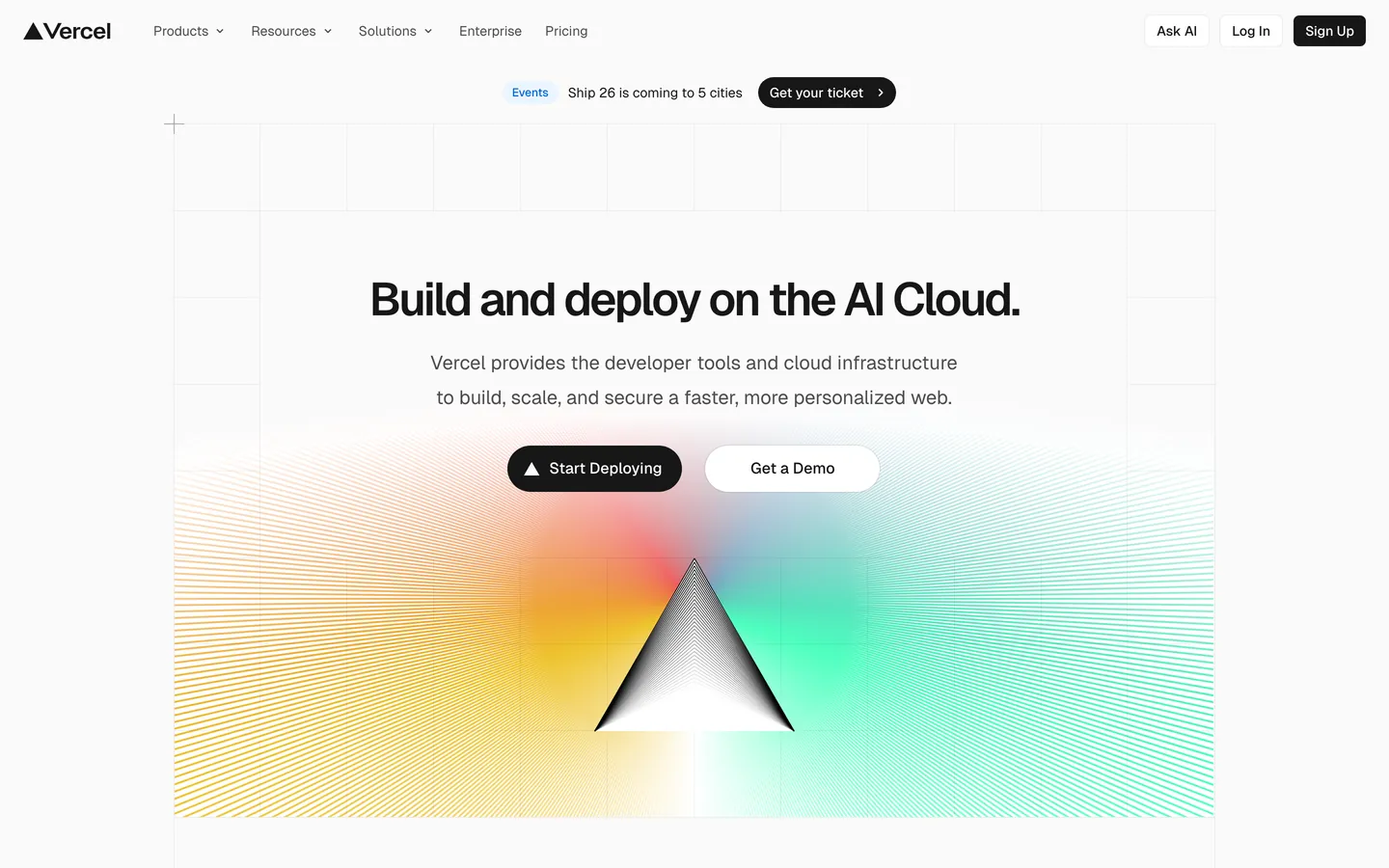
Vercel in production, as captured. Scroll the window to see the whole page.
36 colors
Vercel's system runs on #171717 as its primary voltage, used in 7 of 40 components. Type is set in Geist across 14 tokens from 12px to 48px, weights 400–600. Shape language is soft — components average 24px corner radius, with no sharp interactive edges.
Brand & Accent
Sparing, CTA-only voltage · 1
Surface
Page and card backgrounds · 3
Text
Headlines, body, captions · 9
Borders & Hairlines
Dividers, outlines, rules · 2
Semantic
Status, errors, success, links · 10
Other
Specialty colors · 11
14 type tokens
Set in Geist across 14 tokens, from 12px to 48px, weights 400–600. Shown in its own stack: where the font isn't installed, the fallback the file names stands in.
- display-xl48px · weight 600 · lh 48px · tracking -2.4pxThe quick brown fox jumps over the lazy dog
- display-lg32px · weight 600 · lh 40px · tracking -1.28pxThe quick brown fox jumps over the lazy dog
- display-md24px · weight 600 · lh 32px · tracking -0.96pxThe quick brown fox jumps over the lazy dog
- display-sm20px · weight 600 · lh 28px · tracking -0.6pxThe quick brown fox jumps over the lazy dog
- body-lg18px · weight 400 · lh 28px · tracking 0pxThe quick brown fox jumps over the lazy dog
- body-md16px · weight 400 · lh 24pxThe quick brown fox jumps over the lazy dog
- body-md-strong16px · weight 500 · lh 24pxThe quick brown fox jumps over the lazy dog
- body-sm14px · weight 400 · lh 20px · tracking -0.28pxThe quick brown fox jumps over the lazy dog
- body-sm-strong14px · weight 500 · lh 20px · tracking -0.28pxThe quick brown fox jumps over the lazy dog
- caption12px · weight 400 · lh 16pxThe quick brown fox jumps over the lazy dog
- caption-mono12px · weight 400 · lh 16pxThe quick brown fox jumps over the lazy dog
- code13px · weight 400 · lh 20pxThe quick brown fox jumps over the lazy dog
- button-md14px · weight 500 · lh 20pxThe quick brown fox jumps over the lazy dog
- button-lg16px · weight 500 · lh 24pxThe quick brown fox jumps over the lazy dog
Radii and spacing
9 corner radii and 12 spacing values. Shape language: soft, on a 8px base radius.
Radii9
- none0px
- xs4px
- sm6px
- md8px
- lg12px
- xl16px
- pill-sm64px
- pill100px
- full9999px
Spacing12
- xxs4px
- xs8px
- sm12px
- md16px
- lg24px
- xl32px
- 2xl40px
- 3xl48px
- 4xl64px
- 5xl96px
- 6xl128px
- section192px
40 components
Each rendered from its tokens (color, type, radius, padding) on Vercel's own canvas.
- Nav BarNav Barnav-bar
- Nav LinkNav Linknav-link
- Nav Cta SignupNav Cta Signupnav-cta-signup
- Nav Cta LoginNav Cta Loginnav-cta-login
- Nav Cta Ask AiNav Cta Ask Ainav-cta-ask-ai
- Button PrimaryButton Primarybutton-primary
- Button SecondaryButton Secondarybutton-secondary
- Button Primary SmButton Primary Smbutton-primary-sm
- Button Secondary SmButton Secondary Smbutton-secondary-sm
- Tab GhostTab Ghosttab-ghost
- Icon Button Circularicon-button-circular
- Card MarketingCard Marketingcard-marketing
- Card Marketing LargeCard Marketing Largecard-marketing-large
- Card SoftCard Softcard-soft
- Template CardTemplate Cardtemplate-card
- Code Editor MockupCode Editor Mockupcode-editor-mockup
- Form InputForm Inputform-input
- Form Input SmForm Input Smform-input-sm
- Form Input LgForm Input Lgform-input-lg
- Badge SecondaryBadge Secondarybadge-secondary
- Pricing CardPricing Cardpricing-card
- Pricing Card FeaturedPricing Card Featuredpricing-card-featured
- Logo StripLogo Striplogo-strip
- Hero BandHero Bandhero-band
- Feature Mesh BandFeature Mesh Bandfeature-mesh-band
- Showcase Band LightShowcase Band Lightshowcase-band-light
- Showcase Band DarkShowcase Band Darkshowcase-band-dark
- FooterFooterfooter
- Link InlineLink Inlinelink-inline
- Banner MarketingBanner Marketingbanner-marketing
- Ex Pricing TierEx Pricing Tierex-pricing-tier
- Ex Pricing Tier FeaturedEx Pricing Tier Featuredex-pricing-tier-featured
- Ex Product SelectorEx Product Selectorex-product-selector
- Ex Cart DrawerEx Cart Drawerex-cart-drawer
- Ex App Shell RowEx App Shell Rowex-app-shell-row
- Ex Data Table CellEx Data Table Cellex-data-table-cell
- Ex Auth Form CardEx Auth Form Cardex-auth-form-card
- Ex Modal CardEx Modal Cardex-modal-card
- Ex Empty State CardEx Empty State Cardex-empty-state-card
- Ex ToastEx Toastex-toast
The system, in use
Vercel's tokens on the kind of product it builds.
The fastest way to build and ship software
Deploy from git in seconds, scale on demand and keep every environment in sync.
Vercel design system FAQ
Vercel's tokens, its components and how to use this DESIGN.md in your project.
Vercel's DESIGN.md has 36 color tokens: primary (#171717), on-primary (#ffffff), ink (#171717), body (#4d4d4d), mute (#888888), hairline (#ebebeb) and 30 more. Every value is a quoted hex you can copy.
The color token `primary` is #171717, used by 7 components. The surface behind it is `canvas` (#ffffff).
Map the tokens to your CSS variables: `primary` (#171717) to `--primary`, `canvas` (#ffffff) to `--background`, `ink` (#171717) to `--foreground`. shadcn/ui's Tailwind setup maps them to classes such as `bg-primary` and `text-foreground`, so they then use Vercel's palette.
Vercel's primary is #171717 — a near-black ink, resolved from the `--ds-gray-1000` token. It carries every Sign Up pill, every marketing CTA, the polarity-flipped dark band, and most heading text on light surfaces. The brand has no traditional brand-blue accent; the link blue #0070f3 only surfaces inside inline body links and form-state semantics.
The signature decoration is a three-pair gradient stack: Develop (#007cf0 to #00dfd8), Preview (#7928ca to #ff0080), and Ship (#ff4d4d to #f9cb28). The three pairs fuse into a single multi-color mesh that floats behind the hero band and inside feature-band atmospheric backdrops. Treat it as one unified object — never crop to a single hue, never miniaturize to an icon, never reorder the stops. It lives at hero scale only.
Vercel's DESIGN.md sets its type in Geist and Geist Mono. The first family is the one most tokens use.
14 type tokens, such as `display-xl`, from 12px to 48px, in weights 400 to 600. Each token carries its family, size, weight, line height and letter spacing.
Geist is Vercel's main family and may be proprietary or need its own license. Keep the sizes, weights, line heights and letter spacing from the file and swap the family for an open font of similar proportions, such as a font from Google Fonts, set in `--font-sans`.
The system runs Geist for display, body, button, and label, and Geist Mono for terminal mockups, code blocks, and technical eyebrows. Geist sits at weights 400 / 500 / 600 only — the display ceiling is 600, never 700+. Display sizes track aggressively negative (-2.4px at 48px hero, -1.28px at 32px section). If Geist is unavailable, Inter with `font-feature-settings: 'ss01', 'ss02'` is the closest geometric-sans substitute; JetBrains Mono at 12–13px stands in for Geist Mono.
40 components, among them `nav-bar`, `nav-link`, `nav-cta-signup`, `nav-cta-login` and `nav-cta-ask-ai`. Each lists properties such as its background, text color, type token and corner radius as references to the other tokens.
9 corner radii: none (0px), xs (4px), sm (6px), md (8px), lg (12px) and 4 more. 12 spacing values: xxs (4px), xs (8px), sm (12px), md (16px), lg (24px) and 7 more. The file reads as soft in shape.
Vercel deliberately runs two pill scales side by side. Marketing CTAs (`button-primary`, `button-secondary`) use a 100px radius — fully pilled, ~48px tall. In-app nav buttons (`nav-cta-signup`, `nav-cta-login`, `nav-cta-ask-ai`) use a 6px square-ish radius — the brand's `--geist-radius`. The two scales never mix on the same screen; marketing surfaces stay pilled, app surfaces stay squared. Picking one and sticking with it is part of the voice.
The system stacks small shadows rather than dropping a single heavy one. Every elevated card combines an inset 1px hairline ring (`0 0 0 1px #00000014` inset) with 2–3 stacked offsets at 4–12% black opacity. The result is a card that reads as sitting on the page without feeling material-heavy. Five levels are documented — flat, inset hairline, subtle drop, soft stack, float stack, modal — each adds one more offset rather than blurring further.
Copy the color and radius tokens into your `globals.css`: Vercel's `primary` (#171717) becomes `--primary`, and `md` (8px) becomes `--radius`. The shadcn/ui components read those variables, so they change with the file.
Download Vercel's DESIGN.md (or copy it as Markdown) and put it in your project, or paste it into the chat. Then ask Claude Code, Cursor or another agent to build a page "in the style of the Vercel DESIGN.md": it reads the tokens and writes matching components.
Yes. The file is free to download or copy, with no account, from the buttons at the top and bottom of this page. The raw Markdown is also at `/design/vercel/raw`.
Vercel's page describes the look of its public website (vercel.com), curated from what is visible there: the colors, type and components. It is an interpretation, which is why the file is named "Inspired".
No. The Vercel DESIGN.md describes the look of a public website. It is not official, and Vercel has not endorsed or reviewed it. The name and logo belong to Vercel.
Yes — the file is structured for direct ingestion by Claude, Cursor, or any AI tool that reads token-based design specs. The agent will reproduce Vercel's restraint (ink-only primary, mesh gradient at hero scale only, Geist at weight 600 max) instead of inventing a generic shadcn theme. Every color hex, typography size, radius, and spacing value is a quoted token you can paste straight into Tailwind config, CSS variables, or a custom component library.
Related reading
Specs, directories and component libraries that pair with this design system.
Use Vercel Inspired in your project
One machine-readable file. Drop it into Claude Code, Cursor, VS Code or any AI tool that reads DESIGN.md.
Download the DESIGN.md
One machine-readable file: every color, type, radius, spacing, and component token of Vercel Inspired.
Feed it to your AI tool
Drop it into Claude, Cursor, or GitHub Copilot. The agent writes React components and Tailwind classes that match Vercel Inspired's visual language.
Reference the tokens directly
Or paste the values into your Tailwind config, CSS variables, or component library: every color, size and radius is a quoted, ready-to-copy value.
Read the full DESIGN.md overview, rationale, do’s and don’ts
Overview
Vercel is a developer-platform brand — the page is a deployment dashboard's marketing surface, written for engineers who already know the syntax. It earns that posture with one of the cleanest stark systems on the web: near-white {colors.canvas-soft} (#fafafa) body background, ink-near-black {colors.ink} (#171717) text, a 200-step gray scale that gives every divider, border, and disabled state its own deliberate step. The only place the brand introduces color at marketing scale is the multi-stop mesh gradient ({colors.gradient-develop-start} #007cf0 → {colors.gradient-preview-end} #ff0080 → {colors.gradient-ship-start} #ff4d4d → {colors.cyan} #50e3c2 / magenta / amber) that floats in atmospheric backdrops, never miniaturized to a swatch. That gradient is the entire decoration system.
Type is the second decisive voice. The brand's own custom geometric sans (Geist) carries display, body, button — everything narrative — at weight 600 for display, 500 for buttons, 400 for body. A matching monospaced face (Geist Mono) carries technical labels: terminal mockups, code blocks, sometimes filename captions. Headlines are sentence-case with aggressive negative letter-spacing (-2.4px at 48 px hero) — the brand never letter-spaces positively, never goes uppercase outside of mono labels.
Surfaces use a four-step ladder: {colors.canvas} (#ffffff pure white for cards), {colors.canvas-soft} (#fafafa 98% — the page body), {colors.canvas-soft-2} (#f5f5f5 95% occasional inset region), {colors.primary} (#171717 deep ink-near-black used as the polarity-flipped band when a section needs the dark mode treatment). Shadows are exceptionally subtle — every elevated card carries a stacked shadow built from 0px 1px 1px #00000005 + 0px 2px 2px #0000000a + an inset border. Cards never float on heavy drop-shadow; they sit on the page held by hairline + soft glow.
Key Characteristics:
- A single black-ink primary CTA
{colors.primary}(#171717) carries every conversion target, paired with white-on-whitebutton-secondaryfor the secondary action. The brand uses 100 px pill shape for marketing CTAs and a tight 6 px square shape for in-app nav buttons. - A multi-stop mesh gradient (cyan-blue-magenta-amber) is the only decorative chrome — used at hero scale and inside feature-band atmospheric backdrops. It is the brand.
- Every section eyebrow and small label uses the monospace face
{typography.caption-mono}or{typography.code}; everything else is in the geometric sans. - Subtle stacked-shadow elevation — three offsets layered with 4-12 % black opacity — never a single heavy drop-shadow.
- A complete 100–1000 gray + blue + red + amber + green + teal + purple + pink color scale exists as a system token set, but the marketing surface uses only the
100,1000, and700-level tones; the rest stay in the design-system tokens for in-product surfaces. - An "Active CPU" pricing rhythm:
pricing-cardlays out 3-up on the pricing page withpricing-card-featured(Pro tier) polarity-flipped to{colors.primary}(#171717) against white-card siblings.
Colors
Brand & Accent
- Ink (
{colors.primary}—#171717): The single primary CTA color. Black-near-pure ink that carries every Sign Up pill, every footer CTA, the dark-band polarity-flip. Used as text color throughout the page on light surfaces. (Resolved from--ds-gray-1000.) - Cyan (
{colors.cyan}—#50e3c2): A signature mint-cyan used in the brand gradient and inside Geist-system spotlight tokens. Visible inside the hero gradient stops. - Highlight Pink (
{colors.highlight-pink}—#ff0080): The brand's highlight magenta, used as the high-saturation stop in the preview-gradient pair. - Violet (
{colors.violet}—#7928ca): The deep purple used as the start of the preview-gradient and inside developer-console highlights. - Link Blue (
{colors.link}—#0070f3): The brand's primary link color and the legacy--geist-successsemantic.
Surface
- Canvas (
{colors.canvas}—#ffffff): The pure-white card / dialog / modal surface. - Canvas Soft (
{colors.canvas-soft}—#fafafa): The default page background — 98 % white. Almost every section sits on this tone. - Canvas Soft 2 (
{colors.canvas-soft-2}—#f5f5f5): A slightly deeper inset surface for "code editor inner background", template-card hover states, and dropdown menus. - Hairline (
{colors.hairline}—#ebebeb): 1 px dividers — table rows, card borders, input borders. - Hairline Strong (
{colors.hairline-strong}—#a1a1a1): The 500-level gray, used as the slightly-stronger divider on light bands and as the deemphasized text color.
Text
- Ink (
{colors.ink}—#171717): Every heading and body paragraph on light surfaces. - Body (
{colors.body}—#4d4d4d): Secondary text — sub-headings, body captions, nav-link inactive text, footer column body. - Mute (
{colors.mute}—#888888): Lowest-priority text — placeholder text, fine print, low-key labels. - On Primary (
{colors.on-primary}—#ffffff): All text on{colors.primary}(#171717) surfaces.
Semantic
- Success / Link (
{colors.success}—#0070f3): The brand's legacy success indicator doubles as the primary link color. Visible underline-on-hover for inline body links. - Link Deep (
{colors.link-deep}—#0761d1): The pressed / visited tone for inline links. - Link Bg Soft (
{colors.link-bg-soft}—#d3e5ff): Soft pastel blue fill for "what's new" pill banners and informational badges. - Error (
{colors.error}—#ee0000): Validation red for destructive actions and form errors. - Error Soft (
{colors.error-soft}—#f7d4d6): Soft pastel red for destructive-state backgrounds. - Error Deep (
{colors.error-deep}—#c50000): Pressed / deep destructive state. - Warning (
{colors.warning}—#f5a623): Caution / pending status indicator. - Warning Soft (
{colors.warning-soft}—#ffefcf) / Warning Deep ({colors.warning-deep}—#ab570a): Background + pressed variants.
Brand Gradient
The brand's signature decoration is a three-pair gradient stack:
- Develop (
{colors.gradient-develop-start}#007cf0→{colors.gradient-develop-end}#00dfd8) — the blue-to-teal pair used to mark the "deploy" / "develop" rhythm. - Preview (
{colors.gradient-preview-start}#7928ca→{colors.gradient-preview-end}#ff0080) — the violet-to-pink pair used for "preview" surfaces. - Ship (
{colors.gradient-ship-start}#ff4d4d→{colors.gradient-ship-end}#f9cb28) — the coral-to-amber pair used for "ship" surfaces.
The three pairs collapse into a single multi-color mesh gradient when used as the hero atmospheric backdrop. Treat the gradient as one unified object — do not crop down to a single color, do not reorder the stops, and do not miniaturize. Used at hero scale only.
Typography
Font Family
Two custom faces carry the entire system:
- A custom geometric sans (extracted as
Geist) for every display, body, button, link, and label. Weights 400 / 500 / 600 are the working set; the face never appears in 700 or heavier. Display sizes are tracked aggressively negative (-2.4 pxat 48 px hero,-1.28 pxat 32 px section); body stays at neutral or slightly-negative tracking. - A custom monospaced face (extracted as
Geist Mono) for terminal mockups, code blocks, and small mono-caption labels — anything that wants to signal "technical." Weight 400 only at 12 – 13 px. Tracking neutral.
A condensed display sans (Space Grotesk) is loaded as a third face for occasional editorial moments but does not render as the primary face anywhere in the captured surfaces.
Hierarchy
| Token | Size | Weight | Line Height | Letter Spacing | Use |
|---|---|---|---|---|---|
{typography.display-xl} | 48px | 600 | 48px | -2.4px | Hero headline ("Build and deploy on the AI Cloud."). |
{typography.display-lg} | 32px | 600 | 40px | -1.28px | Section headlines ("Your frontend, delivered.", "A compute model for all workloads."). |
{typography.display-md} | 24px | 600 | 32px | -0.96px | Card-cluster headlines, pricing-tier names. |
{typography.display-sm} | 20px | 600 | 28px | -0.6px | Inline display micro-headings. |
{typography.body-lg} | 18px | 400 | 28px | 0 | Lead paragraphs under section headlines. |
{typography.body-md} | 16px | 400 | 24px | 0 | Default body paragraph. |
{typography.body-md-strong} | 16px | 500 | 24px | 0 | Bolded inline body. |
{typography.body-sm} | 14px | 400 | 20px | -0.28px | Secondary body, nav-link text, button-md labels. |
{typography.body-sm-strong} | 14px | 500 | 20px | -0.28px | Nav CTA labels, table-row emphasis. |
{typography.caption} | 12px | 400 | 16px | 0 | Footer secondary lines, badge labels. |
{typography.caption-mono} | 12px | 400 | 16px | 0 | Section eyebrows and label captions that want a technical voice. |
{typography.code} | 13px | 400 | 20px | 0 | Inline code, terminal mockups, command snippets. |
{typography.button-md} | 14px | 500 | 20px | 0 | Small / nav-scale button labels. |
{typography.button-lg} | 16px | 500 | 24px | 0 | Marketing-scale pill button labels. |
Principles
- Negative tracking is part of the voice. Display sizes use aggressive
-2.4to-0.6px tracking. Reverting to default tracking breaks the brand. - Sentence-case headlines, period-terminated. Headlines like "Build and deploy on the AI Cloud." end with a deliberate period — that punctuation is part of the brand's voice.
- Mono for the technical layer only. Section eyebrows, code blocks, terminal mockups. Body paragraphs never set in mono.
- Weight 600 is the display ceiling. The geometric sans never appears at 700 / 800. The brand reads as a calmer system because of this.
Note on Font Substitutes
The two primary faces are proprietary (custom-cut for the brand). Open-source substitutes:
- Geometric sans — Inter (400 / 500 / 600) is the closest stylistic match;
font-feature-settings: "ss01", "ss02"enables the geometric alternates. Satoshi is a passable second choice. - Monospace — JetBrains Mono (400) at 12 – 13 px matches the technical voice. IBM Plex Mono is the second-best option.
Layout
Spacing System
- Base unit: 4 px. The brand's
--geist-spacetoken is exactly 4 px and every captured value is a multiple of 4. - Tokens:
{spacing.xxs}4 px ·{spacing.xs}8 px ·{spacing.sm}12 px ·{spacing.md}16 px ·{spacing.lg}24 px ·{spacing.xl}32 px ·{spacing.2xl}40 px ·{spacing.3xl}48 px ·{spacing.4xl}64 px ·{spacing.5xl}96 px ·{spacing.6xl}128 px ·{spacing.section}192 px. - Section padding: marketing bands use
{spacing.4xl}to{spacing.5xl}top/bottom. Hero bands stretch to{spacing.section}to give the mesh gradient room to breathe. - Card interior padding: marketing cards sit at
{spacing.lg}to{spacing.xl}; template-grid cards stay tighter at{spacing.md}because they sit in a denser grid. - Inline gap: button rows, nav rows, and chip rows use
{spacing.sm}to{spacing.md}between siblings. The brand's--geist-gapis exactly 24 px.
Grid & Container
- Max width: ~1400 px (
--ds-page-width); the legacy--geist-page-widthis 1200 px and still appears on some marketing surfaces. Content centers with horizontal gutters of{spacing.lg}24 px on desktop,{spacing.md}16 px on mobile. - Column patterns:
- Three-feature row: 3-up at desktop, 1-up at mobile (rows like "Web Apps / Composable Commerce / Multi-tenant Platforms").
- Tab pill row: 5-up centered row of
tab-ghostpills. - Template-grid cluster: 5-up at desktop, scaling to 1-up at mobile.
- Pricing tier grid: 3-up at desktop with the middle tier polarity-flipped.
- Logo strip: ~5 logos wide, single row.
Whitespace Philosophy
The mesh gradient does most of the heavy decorative lifting; whitespace separates the bands. Section spacing is generous — {spacing.4xl} to {spacing.5xl} between bands lets the gradient breathe. Inside a card, the headline/paragraph stack is tight ({spacing.xs} 8 px gap), then a wider gap before the CTA cluster. The page reads as engineered — large gaps + tight interior, never the other way around.
Responsive Strategy
Breakpoints
| Name | Width | Key Changes |
|---|---|---|
| Mobile | < 600px | Hero stacks; nav collapses to hamburger; 3-up feature grids drop to 1-up; tab pill row enables horizontal scroll. |
| Tablet | 600–959px | 3-up grids drop to 2-up; nav still horizontal. |
| Desktop | 960–1199px | Full 3-up grids; pricing 3-up. |
| Wide | 1200–1399px | Container caps at 1400 px content width. |
| Ultra-wide | ≥ 1400px | Content stays centered at 1400 px; bands stretch edge-to-edge in color but content holds the max-width. |
Touch Targets
The button-primary pill renders at ~32 px tall in nav and ~48 px tall in marketing contexts. Marketing CTAs comfortably meet WCAG AAA at all breakpoints; nav buttons inflate touch area through {spacing.xs} padding on mobile to meet the 44 × 44 px floor.
Collapsing Strategy
- Nav: full link row + Ask AI / Log In / Sign Up pills at desktop. Collapses to logo + hamburger at mobile with the menu opening as a full-overlay.
- Hero: mesh gradient stays centered; headline + body stack vertically at all breakpoints (the brand doesn't use a split-hero pattern).
- Three-feature row: 3-up → 2-up → 1-up at the breakpoints above; cards keep their
{rounded.md}8 px shape across all viewports. - Pricing card grid: 3-up at desktop, vertical stack at mobile with
pricing-card-featuredalways sitting in the middle. - Template grid: 5-up → 3-up → 2-up → 1-up. Each
template-cardkeeps its 16:9 aspect on the image.
Image Behavior
- Mesh gradient: rendered as inline SVG or canvas-painted gradient; scales fluidly with the hero container; never crops, never tiles.
- Customer logos: rendered as monochrome SVGs in the logo strip; consistent 24 px height.
- Code editor mockup: dark
{colors.primary}(#171717) rectangle with mono text rendered inside; treated as an image at the layout level. - Template thumbnails: 16:9 landscape inside
{rounded.md}card chrome; lazy-loaded; consistent grayscale palette in the placeholder state.
Elevation & Depth
| Level | Treatment | Use |
|---|---|---|
| Level 0 — Flat | No shadow, no border. | Full-bleed hero bands and the polarity-flipped dark sections. |
| Level 1 — Inset Hairline | 0 0 0 1px #00000014 inset 1 px border. | Default card chrome — the brand's universal "you can see this card" cue. |
| Level 2 — Subtle Drop | 0px 1px 1px #00000005, 0px 2px 2px #0000000a plus inset hairline. | Slightly elevated cards (template-grid, marketing-card). |
| Level 3 — Soft Stack | 0px 2px 2px #0000000a, 0px 8px 8px -8px #0000000a plus inset hairline. | The "medium" elevation — feature-grid cards. |
| Level 4 — Float Stack | 0px 2px 2px #0000000a, 0px 8px 16px -4px #0000000a plus inset hairline. | "Large" elevation — pricing cards, callout panels. |
| Level 5 — Modal | 0px 1px 1px #00000005, 0px 8px 16px -4px #0000000a, 0px 24px 32px -8px #0000000f plus inset hairline. | Modal / dialog surfaces and dropdown menus. |
The brand uses STACKED shadows — multiple small offsets layered to fake natural light — never a single 8-px-blur generic drop. Inset hairline rings are always added so the card edge stays crisp.
Decorative Depth
- Mesh gradient as atmospheric depth: the hero's multi-stop gradient is the brand's only "atmospheric" effect — applied as a flat 2-D backdrop rather than a 3-D illustration.
- Polarity-flipped dark band as section-depth: switching the surface from
{colors.canvas-soft}(#fafafa) to{colors.primary}(#171717the deep ink) is the brand's chief depth cue between bands. - Inset-shadow + drop-shadow combo: the cards' combination of an inset 1 px ring and a multi-stop drop produces a "card sits on the page" effect without ever feeling material-heavy.
Shapes
Border Radius Scale
| Token | Value | Use |
|---|---|---|
{rounded.none} | 0px | Full-bleed hero / footer bands. |
{rounded.xs} | 4px | Tightest inline pill — the nav-cta-signup 6-px-radius button (mapped to xs/sm). |
{rounded.sm} | 6px | The brand's --geist-radius token — base UI radius for in-app buttons, form inputs, dropdown menus. |
{rounded.md} | 8px | The brand's --geist-marketing-radius token — feature cards, template cards. |
{rounded.lg} | 12px | Slightly larger card chrome (pricing-card variants). |
{rounded.xl} | 16px | Largest card chrome — when a card hosts a hero image cap. |
{rounded.pill-sm} | 64px | Tab-ghost pills inside the "AI Apps / Web Apps / Ecommerce / Marketing / Platforms" row. |
{rounded.pill} | 100px | The marketing CTA pill — button-primary, button-secondary, "Start Deploying" pill. |
{rounded.full} | 9999px | Icon-button circular containers, nav-link ghost pills. |
Photography Geometry
- Mesh gradient: full-bleed 2-D atmospheric backdrop, never cropped to a frame; treated as the page's wallpaper.
- Customer logos: monochrome SVG, consistent 24 px height in a flex row.
- Code editor mockup: 16:10 dark rectangle,
{rounded.md}corners. - Template thumbnails: 16:9 landscape inside
{rounded.md}chrome. - Showcase imagery: 2:1 or 16:9 inside
{rounded.lg}to{rounded.xl}chrome with a stacked shadow.
Components
Buttons
button-primary — the canonical 100-px-radius black pill, marketing scale.
- Background
{colors.primary}(#171717), text{colors.on-primary}(#ffffff), label set in{typography.button-lg}, padding0px {spacing.sm}12 px, shape{rounded.pill}100 px. Renders ~48 px tall when paired with the marketing flex layout.
button-secondary — the white pill paired with the black primary inside marketing bands.
- Background
{colors.canvas}(#ffffff), text{colors.ink}(#171717), same typography + padding asbutton-primary, shape{rounded.pill}.
button-primary-sm — the smaller-scale primary pill used inside nav and pricing-card CTAs.
- Background
{colors.primary}(#171717), text{colors.on-primary}(#ffffff), label set in{typography.button-md}(14 px / 500), shape{rounded.pill}.
button-secondary-sm — the smaller-scale white pill paired with button-primary-sm.
- Background
{colors.canvas}(#ffffff), text{colors.ink}(#171717), same typography + shape asbutton-primary-sm.
tab-ghost — the centered-row tab pill ("AI Apps / Web Apps / Ecommerce / Marketing / Platforms").
- Background
{colors.canvas}(#ffffff), text{colors.ink}(#171717), label set in{typography.body-sm}, padding0px {spacing.md}, shape{rounded.pill-sm}64 px.
icon-button-circular — the circular icon container (often a "?" or arrow inside).
- Background
{colors.canvas}(#ffffff), dark icon, 1 px solid hairline border, shape{rounded.full}.
Nav CTAs:
nav-cta-signup — the small black "Sign Up" button in the nav row.
- Background
{colors.primary}(#171717), text{colors.on-primary}(#ffffff), label{typography.body-sm-strong}, padding0px {spacing.xs}, height 28 px, shape{rounded.sm}6 px (the brand's--geist-radius).
nav-cta-login — the white "Log In" button in the nav.
- Background
{colors.canvas}(#ffffff), text{colors.ink}(#171717), same typography / height / shape asnav-cta-signup.
nav-cta-ask-ai — the small "Ask AI" button with a faint border.
- Background
{colors.canvas}(#ffffff), text{colors.ink}(#171717), 1 px solid{colors.hairline}(#ebebeb) border (extracted as0px solid rgb(235, 235, 235)), same typography / height / shape.
Cards & Containers
card-marketing — the canonical marketing feature card (3-up section cards).
- Background
{colors.canvas}(#ffffff), text{colors.ink}(#171717), padding{spacing.lg}24 px, shape{rounded.md}8 px (the--geist-marketing-radius). Carries Level 3 soft-stack shadow.
card-marketing-large — the larger marketing card used for "compute model" / "AI Gateway" callouts.
- Background
{colors.canvas}(#ffffff), text{colors.ink}(#171717), padding{spacing.xl}, shape{rounded.lg}12 px. Carries Level 4 float-stack shadow.
card-soft — the soft-tinted card used inside cluster groups (lighter than canvas-soft).
- Background
{colors.canvas-soft}(#fafafa), text{colors.ink}(#171717), padding{spacing.lg}, shape{rounded.md}.
template-card — the deploy-template card in the "Deploy your first app" grid.
- Background
{colors.canvas}(#ffffff), text{colors.ink}(#171717), padding{spacing.md}16 px, shape{rounded.md}8 px. Hosts a 16:9 thumbnail at the top.
code-editor-mockup — the dark code-preview surface inside marketing bands.
- Background
{colors.primary}(#171717), text{colors.on-primary}(#ffffff), body in{typography.code}(13 px / Geist Mono), padding{spacing.lg}24 px, shape{rounded.md}8 px.
pricing-card — the default pricing-tier card.
- Background
{colors.canvas}(#ffffff), text{colors.ink}(#171717), padding{spacing.xl}32 px, shape{rounded.lg}12 px. Inside: tier name in{typography.display-md}, price in{typography.display-xl}, feature list in{typography.body-md}rows, CTA at the bottom.
pricing-card-featured — the polarity-flipped "Pro" tier card.
- Background
{colors.primary}(#171717), text{colors.on-primary}(#ffffff), same shape + padding aspricing-card. CTA inverts tobutton-secondary-sm(white pill on black card).
Inputs & Forms
form-input — the canonical text input.
- Background
{colors.canvas}(#ffffff), text{colors.ink}(#171717), 1 px solid{colors.hairline}(#ebebeb) border, body in{typography.body-sm}(14 px), padding0px {spacing.sm}, height 40 px (the brand's--geist-form-height), shape{rounded.sm}6 px.
form-input-sm — small-height variant (32 px tall) for tight forms.
- Same as
form-inputbut height 32 px (the--geist-form-small-height).
form-input-lg — large-height variant (48 px tall) for hero CTAs.
- Same as
form-inputbut height 48 px (the--geist-form-large-height); body in{typography.body-md}16 px.
Navigation
nav-bar — the sticky top nav.
- Background
{colors.canvas}(#ffffff), text{colors.ink}(#171717), height 64 px (the brand's--header-height), padding{spacing.sm} {spacing.lg}. Layout: logo left, link row center, "Ask AI / Log In / Sign Up" cluster right.
nav-link — the centered link row inside nav-bar.
- Text
{colors.body}(#4d4d4d), set in{typography.body-sm}, padding{spacing.xs} {spacing.sm}, shape{rounded.full}(ghost pill — visible only on hover or active, but the radius is documented).
footer — the bottom 4-column nav.
- Background
{colors.canvas}(#ffffff), text{colors.body}(#4d4d4d), padding{spacing.4xl} {spacing.lg}. Eyebrow column labels in{typography.caption-mono}(uppercase mono effect); link rows in{typography.body-sm}.
Signature Components
hero-band — the white hero with the mesh gradient backdrop.
- Background
{colors.canvas}(#ffffff) (or{colors.canvas-soft}#fafafaon some surfaces), text{colors.ink}(#171717), padding{spacing.4xl} {spacing.lg}. Inside: a small mono badge above the headline, the headline in{typography.display-xl}(sentence-case, period-terminated), a body lead in{typography.body-lg}, then a CTA row withbutton-primary+button-secondary. The mesh gradient sits behind, scaled to occupy roughly the top half of the band.
feature-mesh-band — the secondary section that hosts a mesh-gradient atmospheric backdrop with feature copy on top.
- Background
{colors.canvas}(#ffffff), text{colors.ink}(#171717), padding{spacing.5xl} {spacing.lg}. Section headline in{typography.display-lg}; supporting body in{typography.body-md}.
showcase-band-light — a soft-canvas section ("Deploy your first app in seconds").
- Background
{colors.canvas-soft}(#fafafa), text{colors.ink}(#171717), padding{spacing.5xl} {spacing.lg}.
showcase-band-dark — the polarity-flipped dark band ("A compute model for all workloads").
- Background
{colors.primary}(#171717), text{colors.on-primary}(#ffffff), padding{spacing.5xl} {spacing.lg}. Section headline in{typography.display-lg}(white on black). Often contains acode-editor-mockupflush with the band.
logo-strip — the customer-logo wrapping row near the top of the page.
- Background
{colors.canvas}(#ffffff), text{colors.body}(#4d4d4d), padding{spacing.lg} {spacing.xl}. Logos rendered as monochrome SVGs at consistent height.
badge-secondary — the small inline metadata pill ("New", "Beta", "Live").
- Background
{colors.canvas-soft}(#fafafa), text{colors.body}(#4d4d4d), body in{typography.caption}, padding0px {spacing.xs}, shape{rounded.full}.
banner-marketing — the "Introducing X" announcement pill at the top of pages.
- Background
{colors.canvas-soft}(#fafafa), text{colors.body}(#4d4d4d), body in{typography.body-sm}, padding{spacing.xs} {spacing.sm}, shape{rounded.full}.
link-inline — body-copy inline links.
- Text
{colors.link}(#0070f3), body in{typography.body-md}, underlined.
Examples (illustrative)
Auto-derived kit-mirror demonstration surfaces (
scripts/derive-examples-block.mjs). Eachex-*entry references brand-native primitives so downstream consumers (/preview-design,/generate-kit) re-skin the same 10 surfaces consistently.TO_FILLmarkers indicate missing primitives — resolve in the LLM judgment pass.
ex-pricing-tier — Default Pricing tier card. Re-uses feature-card chrome with brand canvas-soft surface.
- Properties:
backgroundColor,textColor,borderColor,rounded,padding
ex-pricing-tier-featured — Featured/highlighted tier — polarity-flipped surface (dark fill + light text in light mode, light fill + dark text in dark mode).
- Properties:
backgroundColor,textColor,rounded,padding
ex-product-selector — What's Included summary card — re-purposed for SaaS / B2B verticals (NOT a literal product gallery).
- Properties:
backgroundColor,rounded,padding
ex-cart-drawer — Subscription summary — re-purposed for SaaS / B2B (line items per add-on, not literal cart).
- Properties:
backgroundColor,rounded,padding,item-divider
ex-app-shell-row — Sidebar nav row inside the App Shell example. Active state uses brand primary as the indicator.
- Properties:
backgroundColor,activeIndicator,rounded,padding
ex-data-table-cell — Default data-table th + td chrome. Header uses mono-caps eyebrow typography; body uses body-sm.
- Properties:
headerBackground,headerTypography,bodyTypography,cellPadding,rowBorder
ex-auth-form-card — Sign-in / sign-up card. Re-uses feature-card chrome with text-input primitives inside.
- Properties:
backgroundColor,rounded,padding
ex-modal-card — Modal dialog surface — same chrome as feature-card with elevated shadow.
- Properties:
backgroundColor,rounded,padding
ex-empty-state-card — Empty-state illustration frame.
- Properties:
backgroundColor,rounded,padding,captionTypography
ex-toast — Toast notification surface — feature-card shape + medium shadow.
- Properties:
backgroundColor,rounded,padding,typography
Known Gaps
- Hover-state colors: The brand uses subtle hover transitions on nav links and cards (typically a faint background fill shift toward
{colors.canvas-soft-2}#f5f5f5), but precise per-component hover tokens are not captured here. - Focus rings: Form inputs darken their border on focus, but the exact focus-ring color and width (whether
{colors.link}#0070f3or an ink-tinted ring) is not documented. - Loading skeletons: Vercel's skeleton placeholders (used in dashboard tables and template grids) shimmer in
{colors.canvas-soft-2}#f5f5f5to{colors.hairline}#ebebeb, but the animation timing and stop tokens are not captured. - Dashboard / in-product surfaces: This DESIGN.md covers the public marketing page. The Vercel dashboard's denser inner surfaces — deployment tables, log viewers, project sidebars — use the same
{colors.primary}#171717+ Geist Mono vocabulary but with tighter spacing and additional gray-scale steps not captured here. - Full gray scale: The 100–1000 gray scale (and the parallel blue / red / amber / green / teal / purple / pink scales) exists as a system token set, but only the marketing-surface tones (
100,1000,700-level) are documented; the in-product step values are not.
More systems like this
Bitbucket, Coolify, DigitalOcean and 15 more in Web Infrastructure & Hosting: each brand's colors, type and components in one file your AI agent builds from.
Build it with Pro
The DESIGN.md files are free. Pro adds 6,000+ blocks, premium templates and the MCP server, so your AI editor builds in your system for you.
4.9/5 out of 5 · 150+ reviewsfrom 150+ founders and developers.
- Secure checkout via Stripe
- Code lives in your repo
- Keep what you've shipped if you cancel
- License terms
4.9 out of 5 from 150+ developers


Your system, built for you
Every block, template and icon, installed by your AI agent in your design system. The DESIGN.md files stay free.
Get Pro