UUID generator.
Generate UUIDs in version 4, 7, 1, 6, 5 or 3, one or a thousand at a time, in the form your code expects, and validate any UUID's version and embedded time. From the browser's randomness.
UUID generator.
Need the UI around it? With Pro, your AI agent builds the form, the result card and the rest of the page from a prompt.
Get ProHow it works
3 steps, no account. It runs in your browser and nothing is uploaded.
Pick a version
v4 for most things, v7 for sortable database keys, v5 for ids derived from a name.
Choose the form and the count
Lower or upper case, without hyphens, in braces or as a URN; one to a thousand.
Copy, download or validate
Copy or download the set, or paste UUIDs to read their version and time.
Related tools
More security and dev tools. Every one free, in the browser.
Pricing
Build it with Pro
The tool is free. Pro adds 6,000+ blocks, premium templates and the MCP server, so your AI editor builds the product around it.
4.9/5 out of 5 · 150+ reviewsfrom 150+ founders and developers.
- Secure checkout via Stripe
- Code lives in your repo
- Keep what you've shipped if you cancel
- License terms
Questions and answers
Before you trust the result: what to know about the format, the limits, your data and the tools next to it.
A 128-bit identifier written as 32 hex digits in five groups, made so that anyone can mint one anywhere with no chance of a clash. Database keys, request ids, file names and API resources all use them.
v4 is 122 random bits and the default everywhere. v7 puts a millisecond timestamp first, then random bits, so keys sort by creation time, which databases index better; it is the current recommendation for new primary keys (RFC 9562).
Name-based: the same namespace and name always give the same UUID, v5 from a SHA-1 hash and v3 from MD5. Use them to derive a stable id from a URL or a domain name without storing a mapping.
From crypto.getRandomValues, the browser's cryptographic generator, the same source a server-side library would use. A v1 or v6 here uses a random node with the multicast bit set, as RFC 9562 allows, never your MAC address.
Nil is all zeros and max is all ones, both defined by RFC 9562 as sentinels: a placeholder for not yet assigned and an upper bound for range queries.
Pick the version, the form and how many, from one to a thousand; a set is generated at once and Generate again draws another. Copy the lot or download it as a text file, one per line.
Lower case with hyphens is the canonical form. Upper case, no hyphens, braces ({…}) and the urn:uuid: prefix are the forms older Windows APIs, URLs and XML ask for, all the same bytes.
Paste one or many, one per line, into the validator: each is marked valid or not, with its version, variant and, for v1, v6 and v7, the time inside it. Any of the five forms is accepted.
No. Generation and validation are byte arithmetic in your browser, and the page makes no request.
No. The UUID generator is free and opens without a sign-in, an account or an install.
Nothing. The UUID generator holds your input in the page's memory, so closing or reloading the tab clears it, and it saves nothing in this browser.
v4 · random, v7 · time-ordered, v1 · time-based, Nil, and Max. The default is v4, with 122 random bits.
One, 5, 10 or 50 at a time, as a list you can copy in one go. Every one is a fresh random draw, so they never repeat in practice.
No. A v1 UUID here uses a random node id, never your network card's MAC address, so it doesn't identify your machine.
A GUID is Microsoft's name for the same 128-bit identifier. The generator writes it in braces, among its other forms, when you pick the braces format, and a v4 from it is a valid GUID.
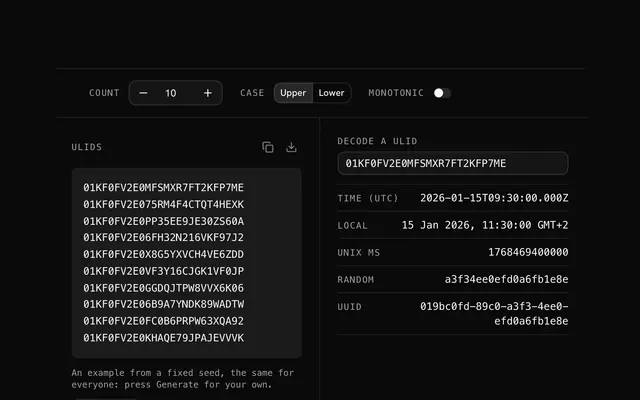
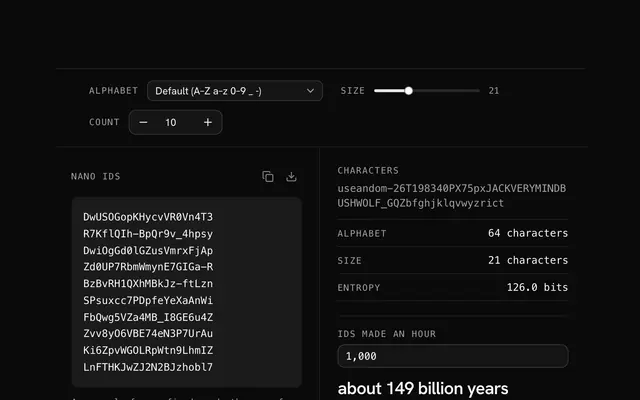
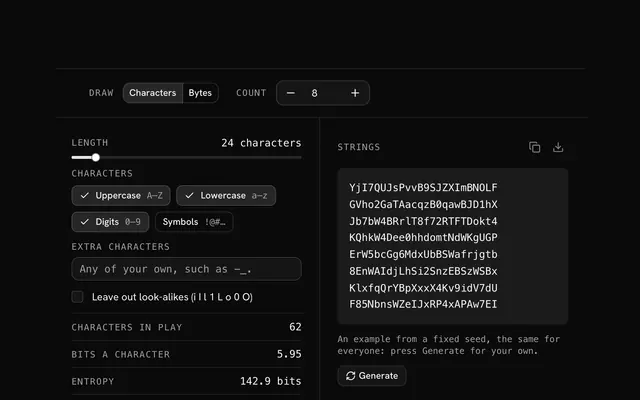
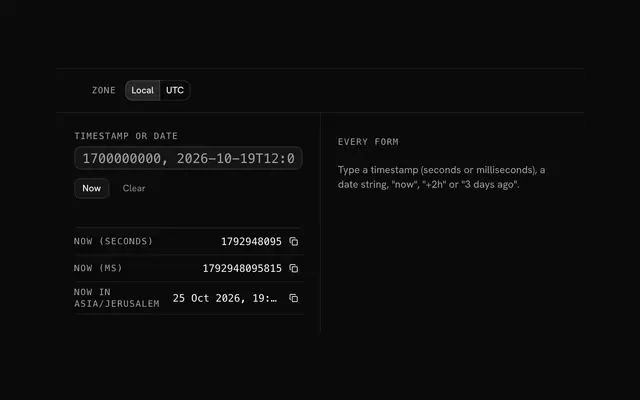
Closest to the UUID generator: ULID generator, Nano ID generator, Random string generator, Unix timestamp converter. Each opens on its own page, free and in the browser.
The UUID generator is one of 20 in its group. The group's page, /tools/security, lists them all.
The tool is free. Its interface is built from shadcn.io's own components (Button, Input, Slider and the rest of the registry under /ui), which come in React, Vue, Svelte and Solid. Pro adds the blocks and templates for the product around it.
4.9 out of 5 from 150+ developers


Build the product around it
Every block, template and icon, installed by your AI agent in your theme. The tools stay free.
Get Pro