Hash generator.
Paste text or drop a file and read its MD5, SHA-1, SHA-256, SHA-384 or SHA-512 digest as you type, keyed with HMAC if you need it. Everything runs in your browser.
Hash generator.
Need the UI around it? With Pro, your AI agent builds the form, the result card and the rest of the page from a prompt.
Get ProHow it works
3 steps, no account. It runs in your browser and nothing is uploaded.
Enter text or a file
Type or paste anything, or drop a file onto the input.
Pick the algorithm
SHA-256 is the default; MD5 and SHA-1 are there for legacy checksums.
Read, key or verify the digest
Hex or Base64, HMAC with a key, and a pasted checksum to verify.
Related tools
More security and dev tools. Every one free, in the browser.
Pricing
Build it with Pro
The tool is free. Pro adds 6,000+ blocks, premium templates and the MCP server, so your AI editor builds the product around it.
4.9/5 out of 5 · 150+ reviewsfrom 150+ founders and developers.
- Secure checkout via Stripe
- Code lives in your repo
- Keep what you've shipped if you cancel
- License terms
Questions and answers
Before you trust the result: what to know about the format, the limits, your data and the tools next to it.
A fixed-length fingerprint of any input: the same bytes always give the same digest and a one-bit change gives an unrelated one. Checksums, signatures, content addressing and integrity checks all lean on that.
SHA-256 for anything that matters: it is unbroken, fast and everywhere. SHA-512 is faster on 64-bit CPUs for long input. MD5 and SHA-1 are broken for collisions and belong only to legacy checksums and old formats.
Both have public collisions: two different inputs with the same digest, found for MD5 in 2004 and SHA-1 in 2017. They still detect accidental corruption, which is why they linger in checksums, but nothing an attacker could touch should rely on them.
None of these. They are fast by design and a password needs a slow, salted hash: bcrypt, scrypt or Argon2id. This tool is for integrity checks, signatures and content addressing.
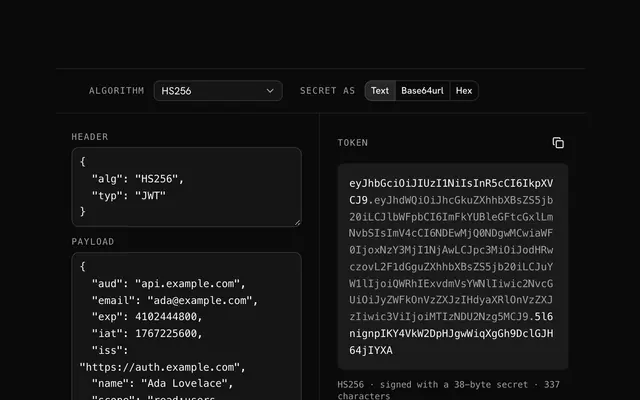
A keyed hash: the secret is mixed into the computation so only someone with the key can produce or check the value. Webhooks, JWT HS256 tokens and signed API requests use it. Turn on HMAC and enter the secret.
Type or paste text, or drop a file; the digest updates as you type. SHA-1, SHA-256, SHA-384 and SHA-512 come from the Web Crypto API built into your browser, MD5 from a small WebAssembly module loaded the first time you pick it.
Hex is the usual form; Base64 and Base64url write the same bytes shorter, as JWTs and Subresource Integrity do. Paste a published checksum into the Verify field to compare it with the digest in any form.
No. Text is hashed as UTF-8 bytes and files are read in your browser; the page makes no request with either. Files up to 1 GB work, as the whole file has to fit in memory.
No. The Hash generator is free and opens without a sign-in, an account or an install.
Nothing. The Hash generator holds your input in the page's memory, so closing or reloading the tab clears it, and it saves nothing in this browser.
MD5, SHA-1, SHA-256, SHA-384 and SHA-512, opening on SHA-256. The SHA family runs on the browser's Web Crypto API, and MD5 on a WebAssembly build loaded the first time you use it.
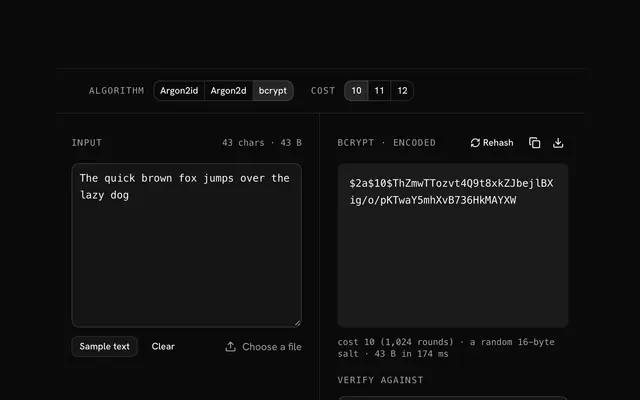
The full hash generators have a page for each of the others: SHA-3, Keccak, BLAKE, RIPEMD-160, Whirlpool, SM3, CRC, Adler-32 and xxHash, plus bcrypt and Argon2 for passwords.
Files up to 1 GB, which is read into memory in your browser. A larger file is declined with a message that names the limit.
Paste the published digest into the Verify field. It accepts hex in either case, with spaces, colons or dashes between bytes, a 0x prefix, or Base64 and Base64url.
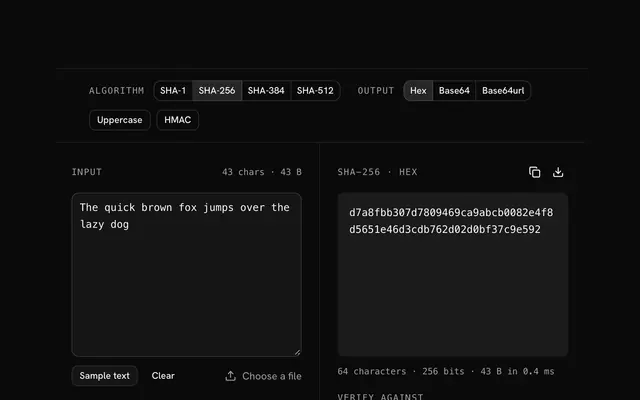
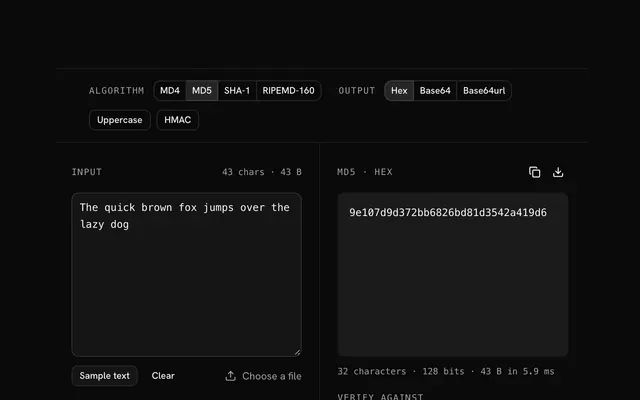
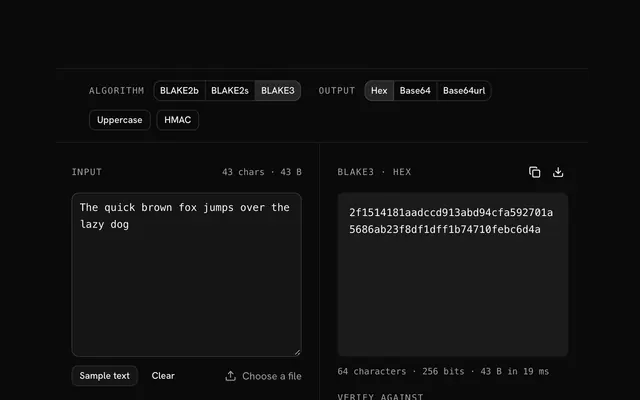
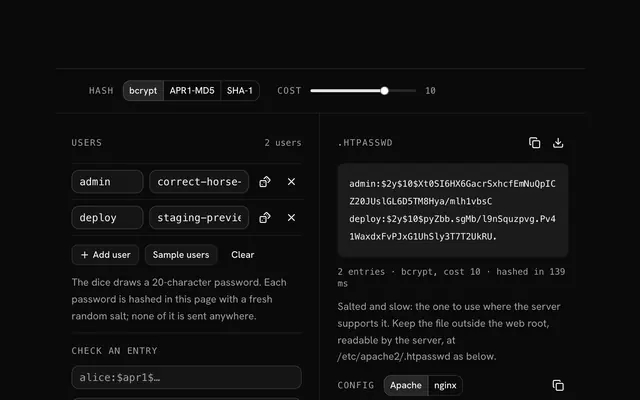
Closest to the Hash generator: SHA-256 hash generator, MD5 hash generator, BLAKE3 hash generator, .htpasswd generator. Each opens on its own page, free and in the browser.
The Hash generator is one of 20 in its group. The group's page, /tools/security, lists them all.
The tool is free. Its interface is built from shadcn.io's own components (Button, Input, Slider and the rest of the registry under /ui), which come in React, Vue, Svelte and Solid. Pro adds the blocks and templates for the product around it.
4.9 out of 5 from 150+ developers


Build the product around it
Every block, template and icon, installed by your AI agent in your theme. The tools stay free.
Get Pro