Unix timestamp converter.
Type a Unix timestamp, a date, now or 3 days ago and read that instant in every form, in any time zone; or turn a date into a timestamp. In your browser.
Unix timestamp converter.
Need the UI around it? With Pro, your AI agent builds the form, the result card and the rest of the page from a prompt.
Get ProHow it works
3 steps, no account. It runs in your browser and nothing is uploaded.
Type a timestamp or a date
Seconds, milliseconds, an ISO or any date string, now, +2h or 3 days ago.
Read it in every form
Seconds, milliseconds, ISO 8601, RFC 2822, the zone you pick, and the relative time.
Or go the other way
Set a date and time to read its timestamp.
Related tools
More security and dev tools. Every one free, in the browser.
Pricing
Build it with Pro
The tool is free. Pro adds 6,000+ blocks, premium templates and the MCP server, so your AI editor builds the product around it.
4.9/5 out of 5 · 150+ reviewsfrom 150+ founders and developers.
- Secure checkout via Stripe
- Code lives in your repo
- Keep what you've shipped if you cancel
- License terms
Questions and answers
Before you trust the result: what to know about the format, the limits, your data and the tools next to it.
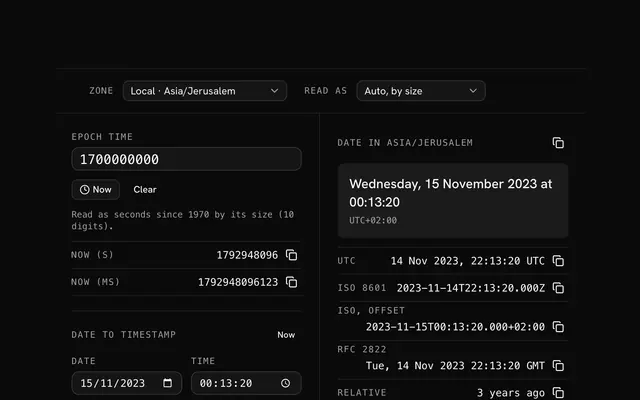
The number of seconds since 1 January 1970 at midnight UTC, the epoch. It is how Unix, databases, JWTs and most APIs store a moment: one integer, no zone, no format. 1,700,000,000 was 14 November 2023.
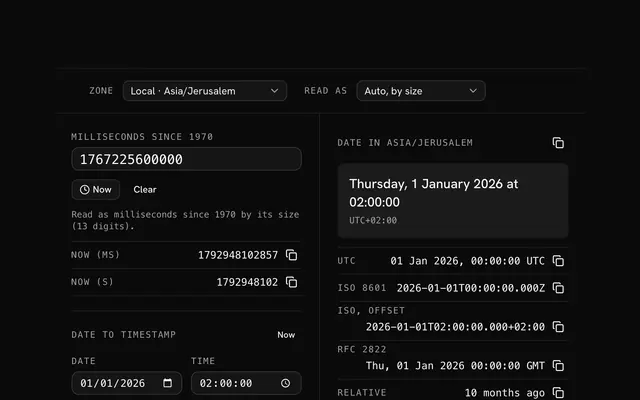
By size: up to 11 digits is seconds (until the year 5138), 12 to 14 milliseconds (what Date.now() returns), 15 to 17 microseconds and more nanoseconds. The status line says which reading was used, and the unit choice overrides it.
ISO 8601 (2026-10-19T12:00:00Z) is the machine form every language parses; RFC 2822 (Mon, 19 Oct 2026 12:00:00 GMT) is the email and HTTP form. Both are shown, plus the time in the zone you pick.
32-bit signed seconds overflow on 19 January 2038 at 03:14:07 UTC. Nothing here uses them: the arithmetic is 64-bit, and dates far past 2038 convert fine.
A timestamp in seconds, milliseconds, microseconds or nanoseconds, any date string your browser can read, now, +2h, -30m, in 3 days or 2 hours ago. Every form of that instant is listed, each with a copy button.
Set the date and time in the Date to timestamp fields, in the zone chosen in the bar, and read the timestamp in seconds and milliseconds.
No. The conversion is Date arithmetic in your browser and the page makes no request with your input.
No. The Unix timestamp converter is free and opens without a sign-in, an account or an install.
Nothing. The Unix timestamp converter holds your input in the page's memory, so closing or reloading the tab clears it, and it saves nothing in this browser.
The instant in every form at once: seconds, milliseconds, ISO 8601, RFC 2822, a relative phrase such as 3 hours ago, the weekday, the day of the year and the ISO week.
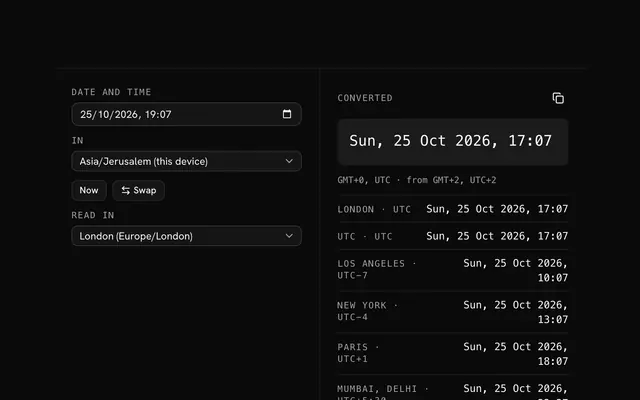
Choose your local zone or UTC in the bar. The timestamp itself is the same in every zone; only the clock reading changes.
Yes: a negative number is read as seconds before 1 January 1970, so -86400 is the day before. A decimal is read as seconds with a fraction.
Yes: the current time is shown in seconds, in milliseconds and as a clock in the chosen zone, and it ticks every second.
Closest to the Unix timestamp converter: Epoch converter, Milliseconds to date converter, Time zone converter, Cron expression parser. Each opens on its own page, free and in the browser.
The Unix timestamp converter is one of 20 in its group. The group's page, /tools/security, lists them all.
The tool is free. Its interface is built from shadcn.io's own components (Button, Input, Slider and the rest of the registry under /ui), which come in React, Vue, Svelte and Solid. Pro adds the blocks and templates for the product around it.
4.9 out of 5 from 150+ developers


Build the product around it
Every block, template and icon, installed by your AI agent in your theme. The tools stay free.
Get Pro