Sentri Inspired Design System
Developer-tools design with a wink: midnight violet canvas, lime keyword chips, Rubik and Monaco type, and Sentri's components for React and AI tools.
- Primary color
- #150f23
- Typeface
- Rubik
- Shape
- Mixed
- Base radius
- 8px
- Colors
- 21
- Type tokens
- 16
- Components
- 21
- Spacing values
- 8
About Sentri Inspired DESIGN.md
Curated by Dov Azencot, updated May 12, 2026. Source sentry.io (opens in a new tab).
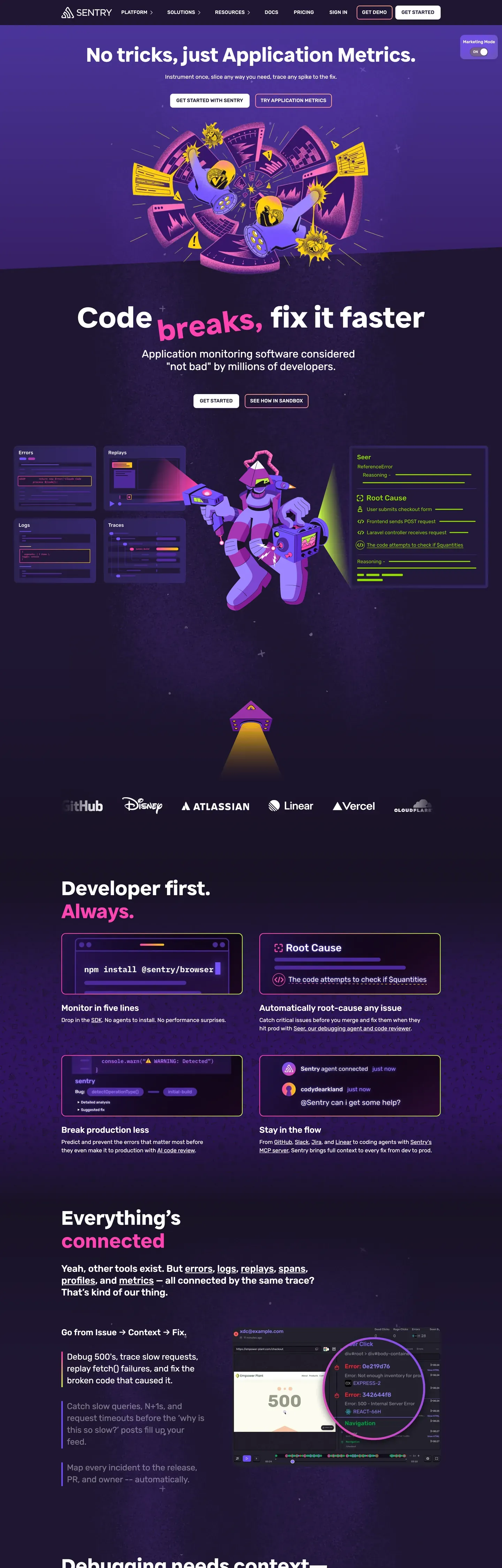
Sentri's design language reads like a debugging console wearing a leather jacket. The product surfaces sit on a near-black violet midnight (#150f23 and #1f1633), strewn with starfield textures and floating sticker-style mascots — astronauts, monsters, traffic cones — that puncture the seriousness of an observability product. Headlines run in a chunky proprietary display sans at 88px / 700, where the most important keywords get wrapped in lime-green highlight chips (#c2ef4e), as if a developer redlined their own console output. The palette is deliberately narrow: midnight as the dominant canvas, electric lime as the primary attention-grabber, hot pink (#fa7faa) as secondary punctuation, and a mid-violet (#79628c) for tag chips and hairlines. Pricing and contact pages flip to a pure white #ffffff canvas with the same near-black ink doing double duty as background on dark surfaces.
This page packages the system into a single DESIGN.md file built on the Google Labs spec. Inside: 21 colors tokens spanning the violet-and-lime brand palette plus surface, hairline, text, and semantic groups; 16 typography tokens running across a proprietary display sans, Rubik for every UI role, and Monaco for code; 7 corner radii from a 4px badge corner to the 18px image container; 8 spacing tokens on an 8px base with a 96px section unit; and 21 components entries covering buttons, cards, code blocks, form inputs, the pill-shaped nav, the lime keyword chip, and the sticker mascot signature. Every component references its tokens by name rather than hardcoded hex.
Feed the file to Claude, Cursor, or GitHub Copilot and the AI produces React components that match Sentri's "developer console" cadence — uppercase button caps with 0.2px tracking, two-polarity canvases, dark-inverted featured pricing tiers, single-primary CTA hierarchy — rather than a generic shadcn theme. Reference the tokens directly in Tailwind config or CSS variables. The discipline of treating lime as a typographic glyph rather than a color swatch is what gives the system its identity, and it's worth studying any time you're tempted to add a second accent.
What makes it distinct
5 highlights
- Two-polarity canvas systemDeep violet #1f1633 for marketing, white #ffffff for pricing, with no half-measures between
- Lime keyword chip#c2ef4e wraps single words inside the 88px hero display as a syntax-highlight glyph, never a button
- Single-primary CTANear-black #150f23 stays the dominant action whether the canvas is dark or light
- Sticker mascot layerIllustrated astronauts and monsters break section boundaries instead of drop shadows carrying depth
- Three-family type stackProprietary display sans, Rubik for UI, Monaco for code, with 0.2px tracking on every button cap
Live at sentry.io
Sentri in production, as captured. Scroll the window to see the whole page.
21 colors
Sentri's system runs on #150f23 as its primary voltage, used in 1 of 21 components. Type is set in Rubik across 16 tokens from 10px to 88px, weights 400–700. Shape language is mixed across 21 components, blending pills, soft rounds, and squarer corners.
Brand & Accent
Sparing, CTA-only voltage · 6
Surface
Page and card backgrounds · 5
Text
Headlines, body, captions · 6
Borders & Hairlines
Dividers, outlines, rules · 3
Other
Specialty colors · 1
16 type tokens
Set in Rubik across 16 tokens, from 10px to 88px, weights 400–700. Shown in its own stack: where the font isn't installed, the fallback the file names stands in.
- display-hero88px · weight 700 · lh 1.2The quick brown fox jumps over the lazy dog
- display-large60px · weight 500 · lh 1.1The quick brown fox jumps over the lazy dog
- heading-xl30px · weight 500 · lh 1.2The quick brown fox jumps over the lazy dog
- heading-lg27px · weight 500 · lh 1.25The quick brown fox jumps over the lazy dog
- heading-md24px · weight 500 · lh 1.25The quick brown fox jumps over the lazy dog
- heading-sm20px · weight 600 · lh 1.25The quick brown fox jumps over the lazy dog
- body-lg16px · weight 400 · lh 2The quick brown fox jumps over the lazy dog
- body-strong16px · weight 600 · lh 1.5The quick brown fox jumps over the lazy dog
- body-md16px · weight 500 · lh 1.5The quick brown fox jumps over the lazy dog
- eyebrow15px · weight 500 · lh 1.4The quick brown fox jumps over the lazy dog
- button-cap14px · weight 700 · lh 1.14 · tracking 0.2pxThe quick brown fox jumps over the lazy dog
- button-cap-light14px · weight 500 · lh 1.29 · tracking 0.2pxThe quick brown fox jumps over the lazy dog
- caption14px · weight 400 · lh 1.43The quick brown fox jumps over the lazy dog
- micro-cap10px · weight 600 · lh 1.8 · tracking 0.25pxThe quick brown fox jumps over the lazy dog
- code16px · weight 400 · lh 1.5The quick brown fox jumps over the lazy dog
- code-strong16px · weight 700 · lh 1.5The quick brown fox jumps over the lazy dog
Radii and spacing
7 corner radii and 8 spacing values. Shape language: mixed, on a 8px base radius.
Radii7
- xs4px
- sm6px
- md8px
- lg10px
- xl12px
- xxl18px
- full9999px
Spacing8
- xxs2px
- xs4px
- sm8px
- md12px
- lg16px
- xl24px
- xxl32px
- section96px
21 components
Each rendered from its tokens (color, type, radius, padding) on Sentri's own canvas.
- Button PrimaryButton Primarybutton-primary
- Button Primary PressedButton Primary Pressedbutton-primary-pressed
- Button InvertedButton Invertedbutton-inverted
- Button Inverted PressedButton Inverted Pressedbutton-inverted-pressed
- Button Ghost On DarkButton Ghost On Darkbutton-ghost-on-dark
- Button Violet TokenButton Violet Tokenbutton-violet-token
- Button DisabledButton Disabledbutton-disabled
- Pill Neutral DarkPill Neutral Darkpill-neutral-dark
- Chip Lime KeywordChip Lime Keywordchip-lime-keyword
- Type here…Text Inputtext-input
- Type here…Text Input Focusedtext-input-focused
- Select VioletSelect Violetselect-violet
- Card PricingCard Pricingcard-pricing
- Card Pricing FeaturedCard Pricing Featuredcard-pricing-featured
- Card Feature DarkCard Feature Darkcard-feature-dark
- Card Spotlight VioletCard Spotlight Violetcard-spotlight-violet
- Code BlockCode Blockcode-block
- Link On DarkLink On Darklink-on-dark
- Link On LightLink On Lightlink-on-light
- Nav Bar LightNav Bar Lightnav-bar-light
- Footer LightFooter Lightfooter-light
The system, in use
Sentri's tokens on the kind of product it builds.
The fastest way to build and ship software
Deploy from git in seconds, scale on demand and keep every environment in sync.
Sentri design system FAQ
Sentri's tokens, its components and how to use this DESIGN.md in your project.
Related reading
Specs, directories and component libraries that pair with this design system.
Use Sentri Inspired in your project
One machine-readable file. Drop it into Claude Code, Cursor, VS Code or any AI tool that reads DESIGN.md.
Download the DESIGN.md
One machine-readable file: every color, type, radius, spacing, and component token of Sentri Inspired.
Feed it to your AI tool
Drop it into Claude, Cursor, or GitHub Copilot. The agent writes React components and Tailwind classes that match Sentri Inspired's visual language.
Reference the tokens directly
Or paste the values into your Tailwind config, CSS variables, or component library: every color, size and radius is a quoted, ready-to-copy value.
Read the full DESIGN.md overview, rationale, do’s and don’ts
Overview
Sentri's design language reads like a debugging console wearing a leather jacket. The home and product surfaces sit on a near-black violet midnight ({colors.surface-canvas-dark} — #1f1633 — and {colors.surface-night} — #150f23), strewn with starfield textures and floating sticker-style mascots — astronauts, monsters, traffic cones — that puncture the seriousness of an observability product. Headlines run in a chunky proprietary display sans at 88px / 700, where the most important keywords get wrapped in lime-green highlight chips ({colors.accent-lime} — #c2ef4e), as if the copy itself has been marked up by a developer redlining their own console output.
The palette is deliberately narrow: deep midnight as the dominant canvas, electric lime as the primary attention-grabber, hot pink ({colors.accent-pink} — #fa7faa) as a secondary punctuation, and a violet-mid ({colors.accent-violet-mid} — #79628c) for tag chips and hairline strokes. White appears in two roles — as text on dark, and as the canvas for pricing, contact, and content-heavy pages where developers need to scan dense tables. The "single primary CTA" is visually inverted depending on context: filled black-violet ({colors.primary} — #150f23) with white type on light surfaces, or filled white with dark type on dark surfaces. The button always reads as the strongest UI affordance regardless of polarity.
Typography splits cleanly between three families: a custom display sans for hero and section openers (chunky, near-condensed, slightly playful), Rubik for every UI text role (body, captions, eyebrow caps, button labels), and Monaco for code. Buttons and eyebrows almost always run in uppercase with a 0.2px tracking lift to give them the snap of console output.
Key Characteristics:
- Two-polarity canvas system: deep violet midnight (
{colors.surface-canvas-dark}— #1f1633) for marketing hero and product feature pages, white ({colors.surface-canvas-light}— #ffffff) for pricing, contact, and dense reference content — the system never tries to blur the two. - Lime keyword highlight (
{colors.accent-lime}— #c2ef4e) treated as a typographic device, not a color swatch — it wraps single words inside the display headline to act as a syntax highlight on the reading flow. - Sticker illustration system: floating mascot characters with hand-drawn outlines, appearing at section junctions, never inside cards — they create rhythm and personality between dense info blocks.
- Uppercase eyebrow + button caps in
{typography.button-cap}and{typography.eyebrow}, with a consistent 0.2px tracking lift, give the brand its "developer console" cadence. - Single-primary CTA hierarchy: every page has one filled button reading either
{colors.primary}(#150f23) on light or{colors.on-primary}(#ffffff) on dark; outlined and ghost variants are downgraded. - Card surfaces follow the canvas: dark sections nest dark cards (
{colors.ink-deep}— #1f1633 — with subtle hairline) and light sections nest white cards with{colors.hairline-cloud}(#e5e7eb) borders — chrome stays consistent, only the polarity flips. - A pricing-page color rhythm of cream-white tiers with one dark inverted "featured" tier (
{colors.surface-night}— #150f23), avoiding the typical accent-bordered featured pattern.
Known Gaps
- Hover state colors: intentionally not documented per the global no-hover policy — only Default and Pressed states are captured for buttons and inputs. The pressed state for inverted buttons is captured (
button-inverted-pressed), but mid-press hover transitions are not. - Starfield hero texture: described as a low-opacity white-on-violet pinprick pattern overlaid on the hero canvas, but ships as a project-specific background image rather than a generated CSS pattern. Producers should treat it as a placeholder asset.
- Lime squiggly footer divider: specified at ~3px stroke at full container width, but the exact hand-drawn SVG is not bundled with the spec — recreate it per project.
- Sticker mascot library: the illustrated astronauts, monsters, and traffic cones are characterized in prose (hand-rendered outlines, saturated
{colors.accent-pink}and{colors.accent-lime}fills, no shadow) but no source library is provided — substitute house-style illustrations with the same color discipline. - Proprietary display sans: the chunky near-condensed display face is named (
Sentri Display) but not licensed for redistribution. Use Space Grotesk, Archivo, or Hubot Sans at heavier weights, adjusting line-height down by 0.05 to compensate for tighter leading at large sizes. - Loading skeletons: not visible on the captured surfaces. Inherit the dark/light polarity rule — skeletons on dark canvas use
{colors.hairline-violet}shimmer, on light canvas use{colors.hairline-cloud}.
More systems like this
Algolia, Astro, Biome and 67 more in Developer Tools & IDEs: each brand's colors, type and components in one file your AI agent builds from.
Build it with Pro
The DESIGN.md files are free. Pro adds 6,000+ blocks, premium templates and the MCP server, so your AI editor builds in your system for you.
4.9/5 out of 5 · 150+ reviewsfrom 150+ founders and developers.
Billing
Billed once a year in USD. Cancel anytime.
- How many people can use the license.
- Client work, SaaS products and anything you charge for.
- Page sections in 56 categories, from heroes and pricing tables to dashboards and settings, on every framework and UI library, in your theme.
- Complete Next.js sites for startups, SaaS, agencies and portfolios, every page designed, ready to ship.
- Your AI agent searches, previews and installs any component, block, icon or DESIGN.md from a prompt: 22 tools in Claude Code, Cursor, VS Code and 35 more clients.
- Buttons with motion and states of their own, from an arrow that slides in to a burst of confetti.
- Typewriters, scrambles, counters and more, for headlines, labels and numbers.
- Animated backgrounds for heroes, sections and cards, from a soft aurora to a flock that flees the cursor. Most are pure CSS.
- WebGPU shaders, from a slow aurora to a black hole, each drawing only while it's on screen.
- One design and one theme on all four: the components, blocks and effects are built for each framework.
- React on Base UI, Radix UI, React Aria or Ark UI: install the version for the library your project already uses. Vue, Svelte and Solid run on Ark UI.
- From a button to a date picker, a color picker or a guided tour: accessible, typed in TypeScript, each with live demos.
- Real-world patterns built from the components, in 53 galleries: forms, tables, menus, dialogs and more.
- Area, bar, line, pie, radar and radial charts on TanStack Charts, on every framework. React also gets the Recharts originals.
- Debounce, local storage, media queries and more: each hook is one typed file you own.
- From 222 libraries, Lucide, Heroicons, Tabler and Material Symbols among them, as SVG or a React component in one command.
- Stripe, Linear, Apple and 497 more: a brand's colors, typography and components in one file your AI agent builds from.
- Restyle every component and block at once: 8 styles, 8 grays, 18 colors and 5 radii, shared as a shadcn preset code.
- Priority requests are answered first.
Individual
For personal projects & open source
$32instead of $49/mo
$389 billed yearly
- Seats: 1 seat
- Commercial use: Personal & open source only
- Blocks: All 6,181 blocks
- Templates: All 14 templates
- MCP server: 38 AI clients
- Animated buttons: All 35 buttons
- Text effects: All 97 effects
- Backgrounds: All 100 backgrounds
- Shaders: All 100 shaders
- Frameworks: React, Vue, Svelte, Solid
- UI libraries: Base UI, Radix, Aria, Ark
- Components: All 174 components
- Examples: All 1,103 examples
- Charts: All 70 charts
- React hooks: All 35 hooks
- Icons: 294k+ icons
- DESIGN.md files: All 500 brands
- Theme builder: 8 styles × 18 colors
- Support: Standard
Team
Most popularFor freelancers, agencies & startups
$66instead of $99/mo
$789 billed yearly · ≈ $13/dev/mo
- Seats: Up to 5 seats
- Commercial use: Included
- Blocks: All 6,181 blocks
- Templates: All 14 templates
- MCP server: 38 AI clients
- Animated buttons: All 35 buttons
- Text effects: All 97 effects
- Backgrounds: All 100 backgrounds
- Shaders: All 100 shaders
- Frameworks: React, Vue, Svelte, Solid
- UI libraries: Base UI, Radix, Aria, Ark
- Components: All 174 components
- Examples: All 1,103 examples
- Charts: All 70 charts
- React hooks: All 35 hooks
- Icons: 294k+ icons
- DESIGN.md files: All 500 brands
- Theme builder: 8 styles × 18 colors
- Support: Priority
Organization
For companies with larger teams
$132instead of $199/mo
$1,589 billed yearly
- Seats: Unlimited seats
- Commercial use: Included
- Blocks: All 6,181 blocks
- Templates: All 14 templates
- MCP server: 38 AI clients
- Animated buttons: All 35 buttons
- Text effects: All 97 effects
- Backgrounds: All 100 backgrounds
- Shaders: All 100 shaders
- Frameworks: React, Vue, Svelte, Solid
- UI libraries: Base UI, Radix, Aria, Ark
- Components: All 174 components
- Examples: All 1,103 examples
- Charts: All 70 charts
- React hooks: All 35 hooks
- Icons: 294k+ icons
- DESIGN.md files: All 500 brands
- Theme builder: 8 styles × 18 colors
- Support: Priority
Billed once a year in USD. Cancel anytime.
Individual
For personal projects & open source
$32instead of $49/mo
$389 billed yearly
- How many people can use the license.Seats: 1 seat
- Client work, SaaS products and anything you charge for.Commercial use: Personal & open source only
- Page sections in 56 categories, from heroes and pricing tables to dashboards and settings, on every framework and UI library, in your theme.Blocks: All 6,181 blocks
- Complete Next.js sites for startups, SaaS, agencies and portfolios, every page designed, ready to ship.Templates: All 14 templates
- Your AI agent searches, previews and installs any component, block, icon or DESIGN.md from a prompt: 22 tools in Claude Code, Cursor, VS Code and 35 more clients.MCP server: 38 AI clients
- Buttons with motion and states of their own, from an arrow that slides in to a burst of confetti.Animated buttons: All 35 buttons
- Typewriters, scrambles, counters and more, for headlines, labels and numbers.Text effects: All 97 effects
- Animated backgrounds for heroes, sections and cards, from a soft aurora to a flock that flees the cursor. Most are pure CSS.Backgrounds: All 100 backgrounds
- WebGPU shaders, from a slow aurora to a black hole, each drawing only while it's on screen.Shaders: All 100 shaders
- One design and one theme on all four: the components, blocks and effects are built for each framework.Frameworks: React, Vue, Svelte, Solid
- React on Base UI, Radix UI, React Aria or Ark UI: install the version for the library your project already uses. Vue, Svelte and Solid run on Ark UI.UI libraries: Base UI, Radix, Aria, Ark
- From a button to a date picker, a color picker or a guided tour: accessible, typed in TypeScript, each with live demos.Components: All 174 components
- Real-world patterns built from the components, in 53 galleries: forms, tables, menus, dialogs and more.Examples: All 1,103 examples
- Area, bar, line, pie, radar and radial charts on TanStack Charts, on every framework. React also gets the Recharts originals.Charts: All 70 charts
- Debounce, local storage, media queries and more: each hook is one typed file you own.React hooks: All 35 hooks
- From 222 libraries, Lucide, Heroicons, Tabler and Material Symbols among them, as SVG or a React component in one command.Icons: 294k+ icons
- Stripe, Linear, Apple and 497 more: a brand's colors, typography and components in one file your AI agent builds from.DESIGN.md files: All 500 brands
- Restyle every component and block at once: 8 styles, 8 grays, 18 colors and 5 radii, shared as a shadcn preset code.Theme builder: 8 styles × 18 colors
- Priority requests are answered first.Support: Standard
Team
Most popularFor freelancers, agencies & startups
$66instead of $99/mo
$789 billed yearly · ≈ $13/dev/mo
Everything in Individual, plus
- How many people can use the license.Seats: Up to 5 seats
- Client work, SaaS products and anything you charge for.Commercial use: Included
- Priority requests are answered first.Support: Priority
Organization
For companies with larger teams
$132instead of $199/mo
$1,589 billed yearly
Everything in Team, plus
- How many people can use the license.Seats: Unlimited seats
- Secure checkout via Stripe
- Code lives in your repo
- Keep what you've shipped if you cancel
- License terms
4.9 out of 5 from 150+ developers


Your system, built for you
Every block, template and icon, installed by your AI agent in your design system. The DESIGN.md files stay free.
- Cancel anytime
- Keep what you've shipped