CRC32 hash generator.
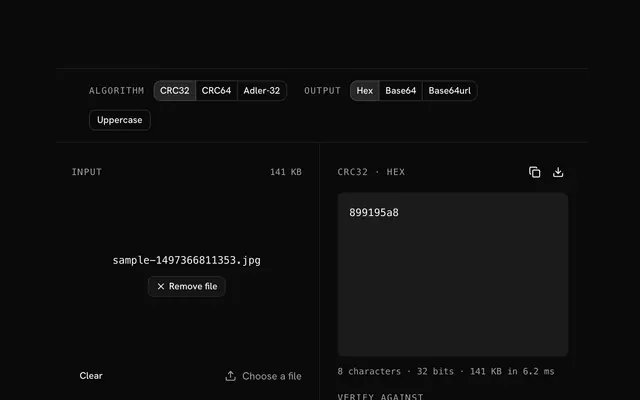
Paste text or drop a file and read its CRC32 checksum as you type. CRC32 is the 32-bit cyclic redundancy check inside ZIP, gzip, PNG and Ethernet: a checksum for errors, not security; everything runs in your browser and nothing is uploaded.
CRC32 hash generator.
Need the UI around it? With Pro, your AI agent builds the form, the result card and the rest of the page from a prompt.
Get ProHow it works
4 steps, no account. It runs in your browser and nothing is uploaded.
Enter text or a file
Type or paste anything, or drop a file onto the input. The checksum updates with every keystroke.
Pick the algorithm and format
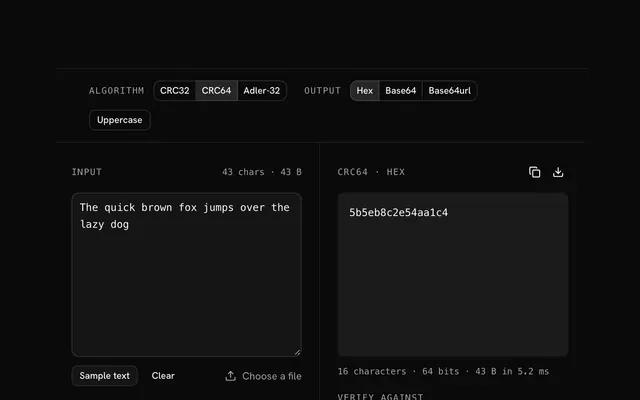
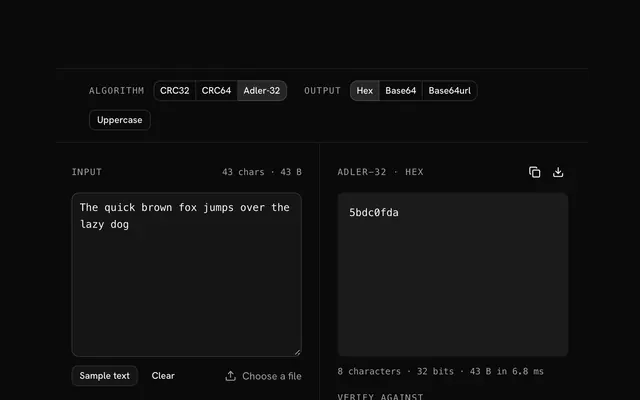
CRC32 is the default; switch to CRC64 and Adler-32, and read the checksum as hex or Base64.
Pick the format
Read the checksum as hex in either case, or as Base64 or Base64url; the value is re-encoded, not recomputed.
Verify, copy or download
Paste a published checksum to confirm a download, or copy and download your own.
Checksums and fast hashes
A checksum catches accidents. Flipped bits, truncated downloads, a bad sector. None of these resist someone who wants a collision.
CRC32
32 bits, 1961. A polynomial division: catches every one-bit and most burst errors, trivially forged on purpose. ZIP, gzip, PNG, Ethernet.
CRC64
64 bits. The same arithmetic with a longer polynomial, for large files and storage. The ECMA-182 form here: xz, Redis, Go's crc64.ECMA.
Adler-32
32 bits, 1995. Two running sums modulo 65,521; faster than CRC32 and weaker on short input. The zlib trailer, so inside every PNG.
xxHash32
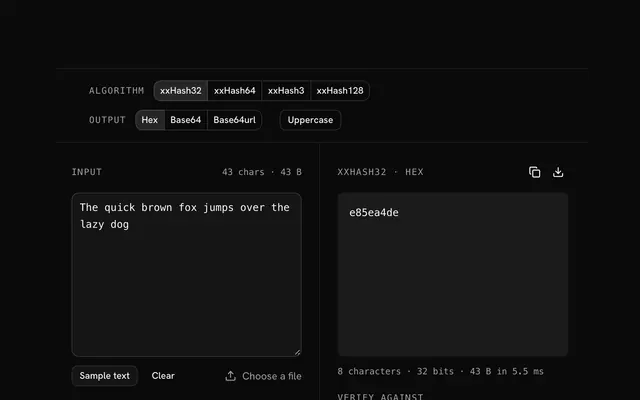
32 bits, 2012. A non-cryptographic hash, not a CRC: good distribution for hash tables, several GB/s. LZ4 frame checksums.
xxHash64
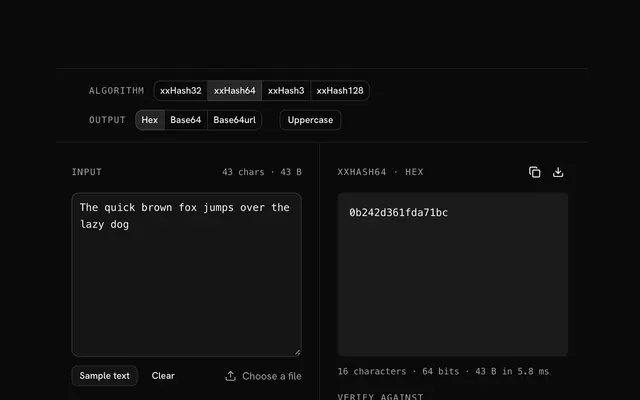
64 bits, 2014. The 64-bit variant: fewer accidental collisions at the same speed on a 64-bit CPU. Zstandard, rsync 3.2.
xxHash3
64 bits, 2019. XXH3: the redesign for SIMD, fast on short keys too. The xxHash to pick for anything new.
xxHash128
128 bits, 2019. XXH3's 128-bit output, for deduplication and content addressing where 64 bits is too few.
MD5
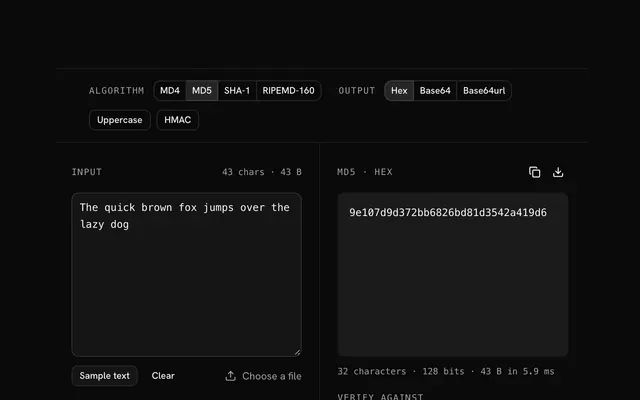
128 bits, broken as a cryptographic hash and slower than every hash above. Only its ubiquity keeps it as a checksum.
Related tools
More hash generators. Every one free, in the browser.
Pricing
Build it with Pro
The tool is free. Pro adds 6,000+ blocks, premium templates and the MCP server, so your AI editor builds the product around it.
4.9/5 out of 5 · 150+ reviewsfrom 150+ founders and developers.
- Secure checkout via Stripe
- Code lives in your repo
- Keep what you've shipped if you cancel
- License terms
Questions and answers
Before you trust the result: what to know about the format, the limits, your data and the tools next to it.
CRC32 is a 32-bit cyclic redundancy check: the remainder of the input, treated as a polynomial, divided by a fixed 33-bit polynomial. The form everyone means by CRC32 uses the IEEE 802.3 polynomial 0x04C11DB7 and is what ZIP, gzip, PNG, Ethernet and zlib.crc32 compute; that is what this tool gives.
Every single-bit error, every odd number of bit errors, any two or three flipped bits in a message up to about 11 KB, and any burst of up to 32 bits: that is what the polynomial guarantees. For a random corruption of any size the chance of a false pass is one in four billion.
No. A CRC is linear: given any file, anyone can append four bytes to make it match any CRC they like, and a change that keeps the checksum is easy to craft. It detects accidents (a flipped bit, a truncated download, a bad sector), which is all it was made for. Against a person, use SHA-256 or BLAKE3.
ZIP entries and gzip members end in one; every PNG chunk carries one; Ethernet frames, SATA, MPEG-2 and Bluetooth packets use CRC-32 variants; and with the SSE4.2 and ARMv8 instructions a different polynomial (CRC-32C, Castagnoli) runs at memory speed in iSCSI, ext4 and Btrfs. Those variants give different numbers from this one.
Faster than any cryptographic hash, several gigabytes a second with hardware help, since it is a table lookup per byte with no mixing rounds. xxHash is about as fast with better distribution for hash tables; CRC32 is the one with error-detection guarantees and the one existing formats expect.
Nothing leaves your browser. The hash is computed on your machine, by the browser's Web Crypto API or a WebAssembly build of the algorithm loaded on first use, and the page makes no request with your input. You can load the page, go offline and keep hashing.
Drop the file onto the input or choose it with the button, and the tool reads it in your browser and hashes the bytes. Files up to 1 GB work; past that the browser would need the whole file in memory, so the tool declines. Paste the published checksum into the Verify field to compare.
Hex is the common form: 8 characters from 0 to 9 and a to f, the same value in upper or lower case. Base64 writes the same 4 bytes in fewer characters, and Base64url swaps + and / for - and _ with no padding. Switch the output and the checksum is re-encoded, not recomputed.
Text is hashed as UTF-8 bytes, which is what every language and command line does by default. A trailing newline changes the checksum, so `echo -n` or this tool's input, with no newline added, matches a command-line tool run on a file without one.
No. The CRC32 hash generator is free and opens without a sign-in, an account or an install.
Nothing. The CRC32 hash generator holds your input in the page's memory, so closing or reloading the tab clears it, and it saves nothing in this browser.
The toolbar switches to CRC64 and Adler-32 without leaving the page. Each one reads the same input, so you can compare digests side by side.
CRC32 is computed by a WebAssembly build from the hash-wasm library, which the page loads the first time you hash something and reuses after that.
No: CRC32 is a checksum or fast non-cryptographic hash, and none of the algorithms in this toolbar take a key, because a keyed checksum proves nothing.
Yes: the File to CRC32 page has the same algorithms and options and opens on the file pane. Files are read in your browser and never uploaded.
Not on its own. CRC32 is built to be fast, and fast hashes are cheap for an attacker to guess against. Passwords need a salted, deliberately slow hash: use Argon2id, Argon2d, and bcrypt from the hash generators, which draw a fresh random salt each time.
Closest to the CRC32 hash generator: File to CRC32, CRC64 hash generator, Adler-32 hash generator, xxHash32 hash generator. Each opens on its own page, free and in the browser.
The CRC32 hash generator is one of 64 in its group. The group's page, /tools/hash, lists them all.
The tool is free. Its interface is built from shadcn.io's own components (Button, Input, Slider and the rest of the registry under /ui), which come in React, Vue, Svelte and Solid. Pro adds the blocks and templates for the product around it.
4.9 out of 5 from 150+ developers


Build the product around it
Every block, template and icon, installed by your AI agent in your theme. The tools stay free.
Get Pro