File to Base85.
Drop any file and get its ASCII85, a quarter larger than the bytes. Encoded in your browser, with or without the <~ ~> delimiters, and never uploaded.
File to Base85.
Need the UI around it? With Pro, your AI agent builds the form, the result card and the rest of the page from a prompt.
Get ProHow it works
3 steps, no account. It runs in your browser and nothing is uploaded.
Drop a file
Drop any file onto the input or choose one with the button; it is read on your machine.
Read the result
The bytes are encoded as Base85 and the result shows how much larger the text is.
Copy or download
Copy the Base85 into your code or config, or download it as a text file.
Related tools
More encoders and decoders. Every one free, in the browser.
Pricing
Build it with Pro
The tool is free. Pro adds 6,000+ blocks, premium templates and the MCP server, so your AI editor builds the product around it.
4.9/5 out of 5 · 150+ reviewsfrom 150+ founders and developers.
- Secure checkout via Stripe
- Code lives in your repo
- Keep what you've shipped if you cancel
- License terms
Questions and answers
Before you trust the result: what to know about the format, the limits, your data and the tools next to it.
Base85, or ASCII85, writes four bytes as five characters drawn from the 85 printable ASCII characters from ! to u, with z standing for four zero bytes. Paul Rutter's btoa program introduced the idea in 1985; Adobe adopted it in PostScript Level 2 and in PDF (the ASCII85Decode filter), which is where most of it lives today.
Four bytes are read as one 32-bit number and written as five base-85 digits, each offset by 33 to land on a printable character. The output is a quarter larger than the input, the least of the common encodings. A final group of one to three bytes is written as two to four characters; a group of four zeros is a single z.
PDF streams and PostScript files, where binary images and fonts are embedded as text; Git's binary patches, with its own alphabet; ZeroMQ's Z85 variant for keys; and anywhere the extra density over Base64 is worth the unfriendly characters.
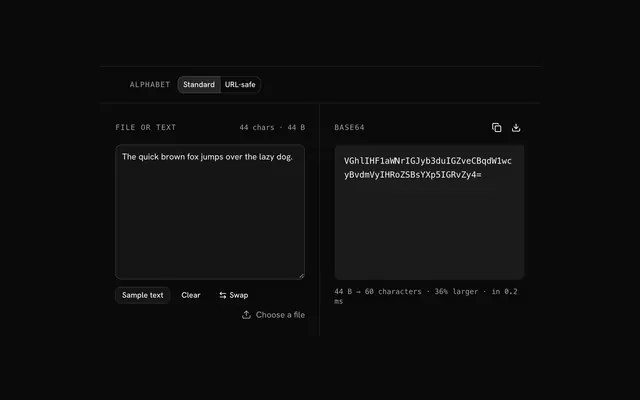
Denser than Base64 (25% against 33%) and that is its only advantage: the alphabet has quotes, slashes and brackets, so it needs escaping in a URL, a JSON string or a shell, and there are several incompatible variants. Use it where a format asks for it; otherwise Base64.
There are several Base85s. This one is ASCII85, as PDF and PostScript write it, optionally between <~ and ~>. Git's binary patches and ZeroMQ's Z85 use the same density with different alphabets and no z shorthand, so their text won't decode here and ASCII85 won't decode there.
No. Base85 is an encoding, not encryption: it changes how bytes are written, not who can read them, and anyone can decode it with no key. Encrypt first (AES, age, a library's sealed box) when the content needs protecting, then encode the ciphertext if it has to travel as text.
Drop the file onto the input or choose it with the button. Its bytes are encoded in your browser and the Base85 appears in the result pane, with the size it grew to. Copy it, or download it as a text file.
Any file the browser can hold in memory works; a few hundred megabytes is fine, and the result is a quarter larger.
Whatever needs the bytes as text: a PDF or PostScript stream, or a check of what one holds. Base85 is not safe in a URL, and it is a quarter larger than the file, so it is for carrying bytes through text, not for storing them.
Nothing leaves your browser. The file is read into memory on your machine and the encoding is computed there, in plain JavaScript; the page makes no request with it. Load the page, go offline and it keeps working.
No. The "File to Base85" tool is free and opens without a sign-in, an account or an install.
Nothing. The "File to Base85" tool holds your input in the page's memory, so closing or reloading the tab clears it, and it saves nothing in this browser.
Any file the browser can open. The bytes are read in your browser and encoded as Base85; the result can be copied or downloaded as base85-encoded.txt.
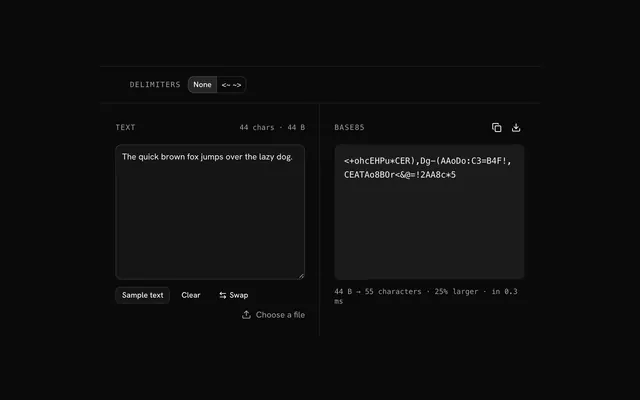
Base85 output is 5 characters for every 4 bytes, so a quarter longer, and the status line under the result shows the bytes in, the characters out and the percentage.
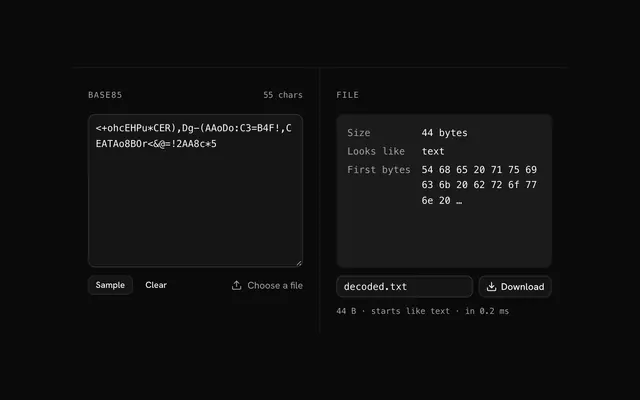
Use the Base85 to file page: it decodes Base85 back to the original bytes, and names the download after the file type it recognises.
Yes, the same choices as the text encoder: Delimiters, none or the <~ ~> that Adobe's tools write.
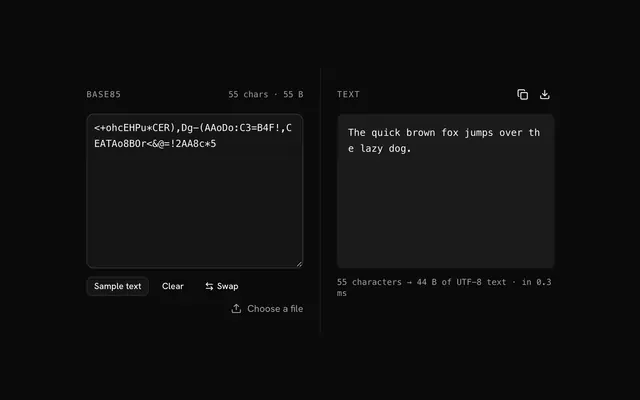
Closest to the "File to Base85" tool: Base85 to file, Base85 encoder, Base85 decoder, File to Base64. Each opens on its own page, free and in the browser.
The "File to Base85" tool is one of 32 in its group. The group's page, /tools/encoding, lists them all.
The tool is free. Its interface is built from shadcn.io's own components (Button, Input, Slider and the rest of the registry under /ui), which come in React, Vue, Svelte and Solid. Pro adds the blocks and templates for the product around it.
4.9 out of 5 from 150+ developers


Build the product around it
Every block, template and icon, installed by your AI agent in your theme. The tools stay free.
Get Pro