File to SHA-1.
Drop a file and read its SHA-1 digest at once, in your browser. SHA-1 is the web's old standard hash, broken by a public collision in 2017 and kept for legacy ids and checksums; the file is read on your machine and never uploaded.
File to SHA-1.
Need the UI around it? With Pro, your AI agent builds the form, the result card and the rest of the page from a prompt.
Get ProHow it works
4 steps, no account. It runs in your browser and nothing is uploaded.
Drop a file
Drop it onto the pane or choose it with the button; anything up to 1 GB is read in your browser.
Read the digest
The SHA-1 digest appears at once, as hex, Base64 or Base64url; switch to SHA-1, SHA-256, SHA-384 and SHA-512 in the bar.
Verify against a published checksum
Paste the digest the publisher lists and the tool says whether the file matches.
Copy or download
Copy the digest, or download it as a line a checksum tool can read.
Related tools
More hash generators. Every one free, in the browser.
Pricing
Build it with Pro
The tool is free. Pro adds 6,000+ blocks, premium templates and the MCP server, so your AI editor builds the product around it.
4.9/5 out of 5 · 150+ reviewsfrom 150+ founders and developers.
- Secure checkout via Stripe
- Code lives in your repo
- Keep what you've shipped if you cancel
- License terms
Questions and answers
Before you trust the result: what to know about the format, the limits, your data and the tools next to it.
SHA-1 is a 160-bit cryptographic hash published by NIST in 1995, written as 40 hexadecimal characters. It was the standard hash of the web's first twenty years: TLS certificates, Git object ids, PGP fingerprints and countless signatures were SHA-1.
No. In 2017 Google and CWI published SHAttered, two different PDFs with the same SHA-1 digest, and in 2020 a chosen-prefix collision (two documents of the attacker's choosing) cost about 45,000 dollars of computing. Browsers stopped trusting SHA-1 certificates in 2017; Git is moving its object format to SHA-256.
Only to identify things in systems that already use it: Git commits, old package feeds, legacy APIs that expect a SHA-1 of the payload. As a checksum against accidental corruption it still works. For anything an attacker could influence, a signature, a certificate, deduplication of untrusted files, use SHA-256.
Yes. HMAC's security does not rest on collision resistance, so HMAC-SHA-1 was not broken by SHAttered and remains in old OAuth 1.0 signatures and TOTP authenticator codes (RFC 6238 defaults to HMAC-SHA-1). New designs should still pick HMAC-SHA-256.
Git hashes a header ("commit", "blob" or "tree", a space, the length, a NUL) followed by the content, so the SHA-1 of a file's bytes is not its Git blob id. Prefix the header, or use git hash-object, to get the id Git shows.
Nothing leaves your browser. The file is read on your machine and hashed there, by the browser's Web Crypto API or a WebAssembly build of SHA-1 loaded on first use; the page makes no request with its bytes. You can load the page, go offline and keep hashing.
Drop the file onto the pane or choose it with the button. It is read into memory and hashed at once, with no size steps and no upload progress because there is no upload. Files up to 1 GB work; a 100 MB file takes well under a second on SHA-1.
Paste the digest the publisher gave you into the Verify field, in hex of either case, with or without spaces, colons or a 0x prefix, or in Base64. The tool says whether it matches the file you dropped. A match means the bytes are exactly the ones that were published.
Hex by default, 40 characters; Base64 and Base64url are one click away and re-encode the same 20 bytes. The download button saves a line in the `digest filename` form that sha256sum-style tools read.
Yes: turn on HMAC and enter the secret, and the file is signed with HMAC-SHA-1 rather than hashed, the same construction a server uses to sign an upload or a webhook payload.
No. The "File to SHA-1" tool is free and opens without a sign-in, an account or an install.
Nothing. The "File to SHA-1" tool holds your input in the page's memory, so closing or reloading the tab clears it, and it saves nothing in this browser.
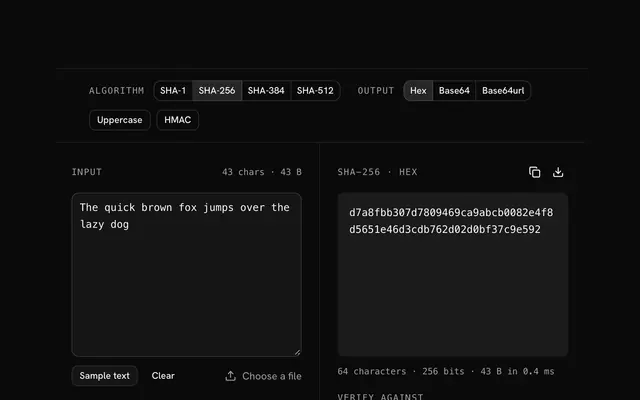
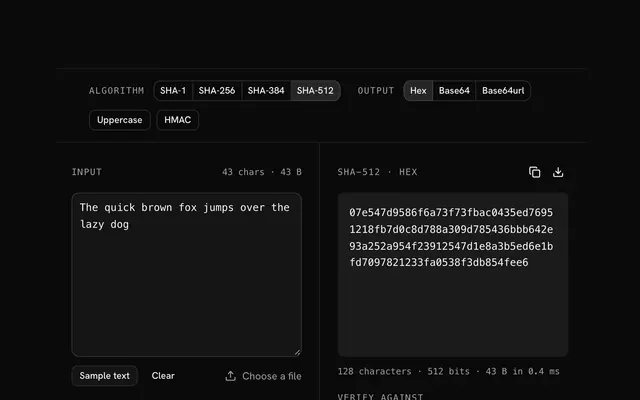
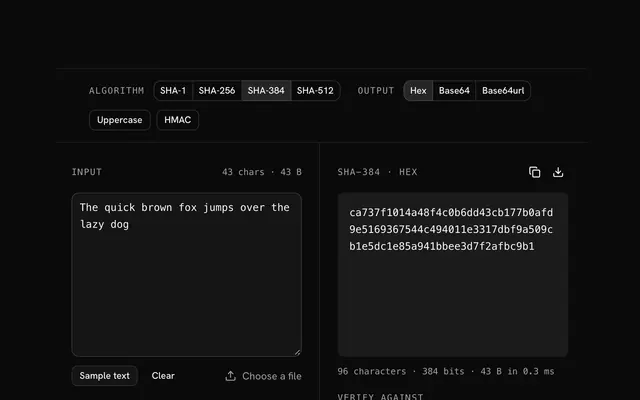
The toolbar switches to SHA-256, SHA-384, and SHA-512 without leaving the page. Each one reads the same input, so you can compare digests side by side.
SHA-1 runs on the browser's own Web Crypto API, so there is nothing to download and it is the fastest path.
Yes: the SHA-1 hash generator page has the same algorithms and options and opens on the text box. This page opens on the file pane.
Not on its own. SHA-1 is built to be fast, and fast hashes are cheap for an attacker to guess against. Passwords need a salted, deliberately slow hash: use Argon2id, Argon2d, and bcrypt from the hash generators, which draw a fresh random salt each time.
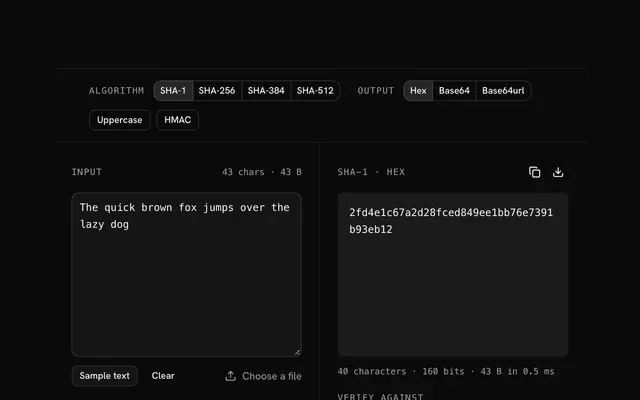
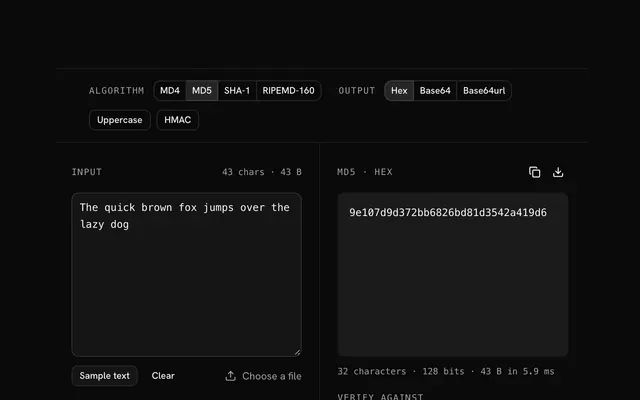
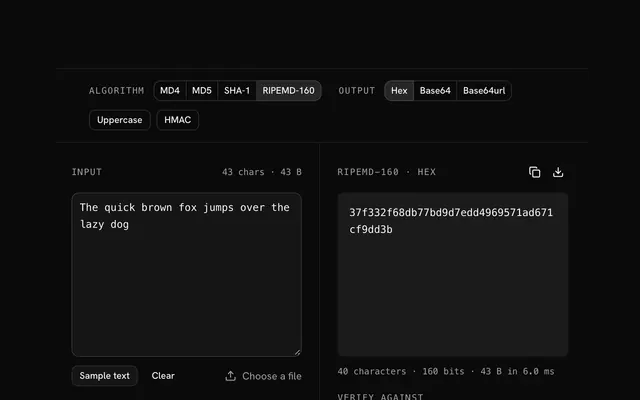
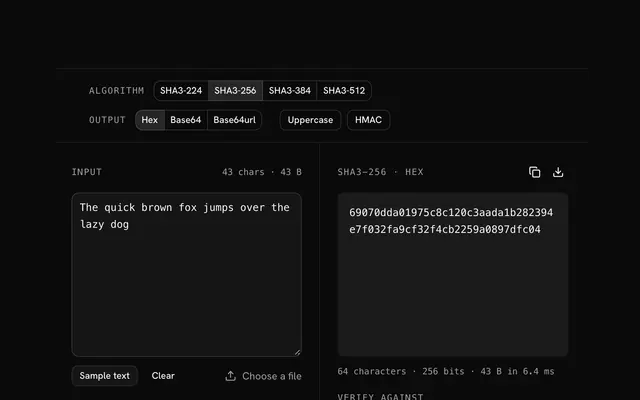
Closest to the "File to SHA-1" tool: SHA-1 hash generator, MD5 hash generator, RIPEMD-160 hash generator, SHA3-256 hash generator. Each opens on its own page, free and in the browser.
The "File to SHA-1" tool is one of 64 in its group. The group's page, /tools/hash, lists them all.
The tool is free. Its interface is built from shadcn.io's own components (Button, Input, Slider and the rest of the registry under /ui), which come in React, Vue, Svelte and Solid. Pro adds the blocks and templates for the product around it.
4.9 out of 5 from 150+ developers


Build the product around it
Every block, template and icon, installed by your AI agent in your theme. The tools stay free.
Get Pro