Hugging Face Design System
Hugging Face's design system as a DESIGN.md file.
About Hugging Face DESIGN.md
Curated by Dov AzencotUpdated Source huggingface.co
- AI & LLM Platforms
- Developer Tools & IDEs
Hugging Face's homepage is a research dashboard that pretends to be a marketing page. The fold opens on a near-black canvas ("#0b0f19") with a single 48px Source Sans Pro wordmark headline — "The AI community building the future." — over a wall of IBM Plex Mono code samples showing actual `transformers` API calls. There is no hero illustration, no gradient mesh, no product mockup card. The page leans on the type and the code, and that is the entire brand voice. The dark band only runs for one viewport; below the fold the canvas inverts to pure white ("#ffffff") and stays there for the remainder of the page, populated with model cards, dataset rows, and Spaces grids that read like a notebook index rather than a SaaS landing template.
This DESIGN.md packages the whole surface into one machine-readable file. Inside: 22 color tokens grouped into hero-dark, workspace-light, and category-signal layers, 12 typography roles split between Source Sans Pro (display through caption) and IBM Plex Mono (repo IDs and code), 6 radii anchored at 8px, 9 spacing values pivoting on 8px and 16px, and 17 components covering the dark hero band, white workspace cards, category pills, repo rows, and the model carousel. The schema follows the Google Labs DESIGN.md specification — every token quotes its hex and every numeric component value is a string.
Pipe the file into Claude, Cursor, or Copilot when you need a build that looks like Hugging Face rather than a generic AI startup. The agent reproduces the dark-to-white surface flip, the wordmark-headline-over-code-block hero, the multi-hue repo pills used only as signal, and the 8px card rhythm — without inventing gradient washes or oversized hero illustrations. Or treat it as an audit reference: any drift from the two-surface rule or the Source-Sans-only display ladder shows up immediately against the token list.
What makes it distinct
- Two-surface alternationa near-black hero ('#0b0f19') flips to a pure white workspace ('#ffffff') the moment the page enters the content tier, no transitional gray
- Source Sans Pro carries the entire chrome48px/700 hero down to 12px/600 micro-labels — paired with IBM Plex Mono ('15.04px') for inline repo IDs and code
- Repo category pills run four hues against whiteblue '#388bfd', green '#3fb950', amber '#d29922', red '#f85149' — used as signal-only, never decorative
- Card radii sit at 8px with 25.6px pill radii reserved for tag chips and the 17px-tracking 'huge-radius' badge that wraps avatars
- 8px is both the dominant spacing increment (59 hits) and the dominant card radius (41 hits)one number governs the rhythm at two scales
Live at huggingface.co
A snapshot of the brand in production. Hover the frame to scroll the page; click to visit.
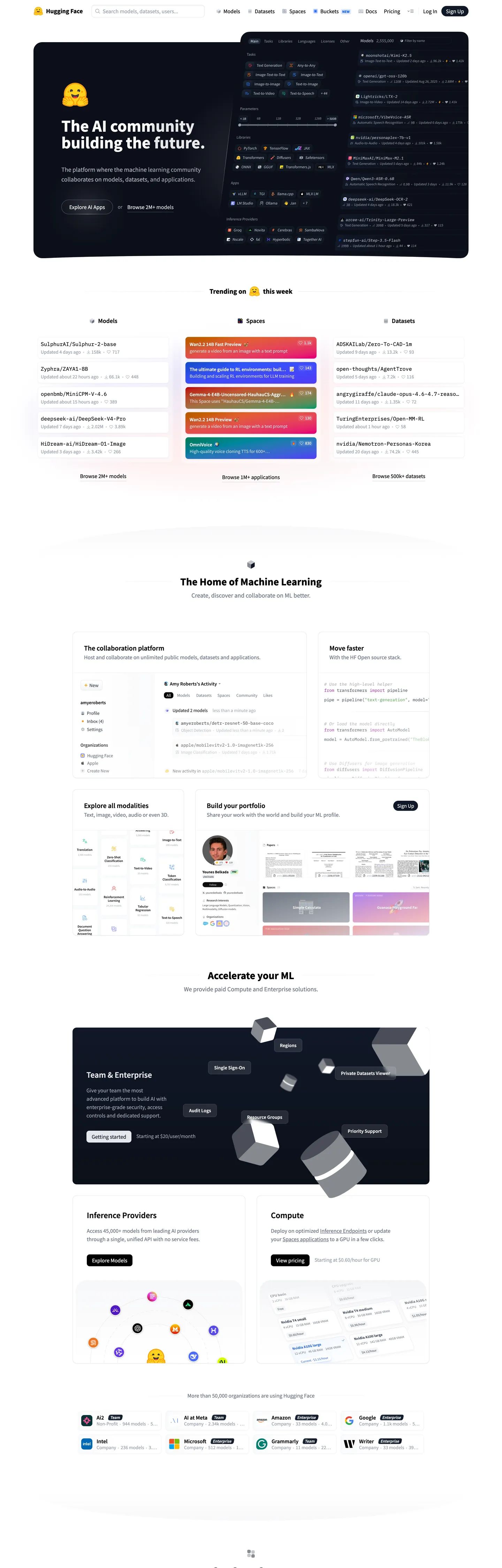 huggingface.co
Explore Hugging Face
Pick what you want to see — mockups, colors, typography, layout, or the full component list.
Surface
Page and card backgrounds.
Text
Headlines, body, captions, muted.
Borders & Hairlines
Dividers, outlines, structural rules.
Other
Specialty colors.
Hugging Face design system FAQ
Common questions about Hugging Face's tokens, components, and how to use this DESIGN.md in your project.
Related reading
Specs, directories, and component libraries that pair with this design system.
Browse all design systems
The full directory of DESIGN.md files on shadcn.io, with live mockups for each.
Hugging Face — official site
The platform where the machine learning community collaborates on models, datasets, and applications.
The DESIGN.md specification
Google Labs' open spec for machine-readable design system files — the format this page is built on.