Mintlify Design System
Mintlify's mint #00d4a4 accent, Inter and Geist Mono as a DESIGN.md file, with tokens and a large set of components for React, Next.js and Claude.
- Primary color
- #0a0a0a
- Typeface
- Inter
- Shape
- Mixed
- Base radius
- 8px
- Colors
- 32
- Type tokens
- 20
- Components
- 51
- Spacing values
- 12
About Mintlify DESIGN.md
Curated by Dov Azencot, updated May 12, 2026. Source mintlify.com (opens in a new tab).
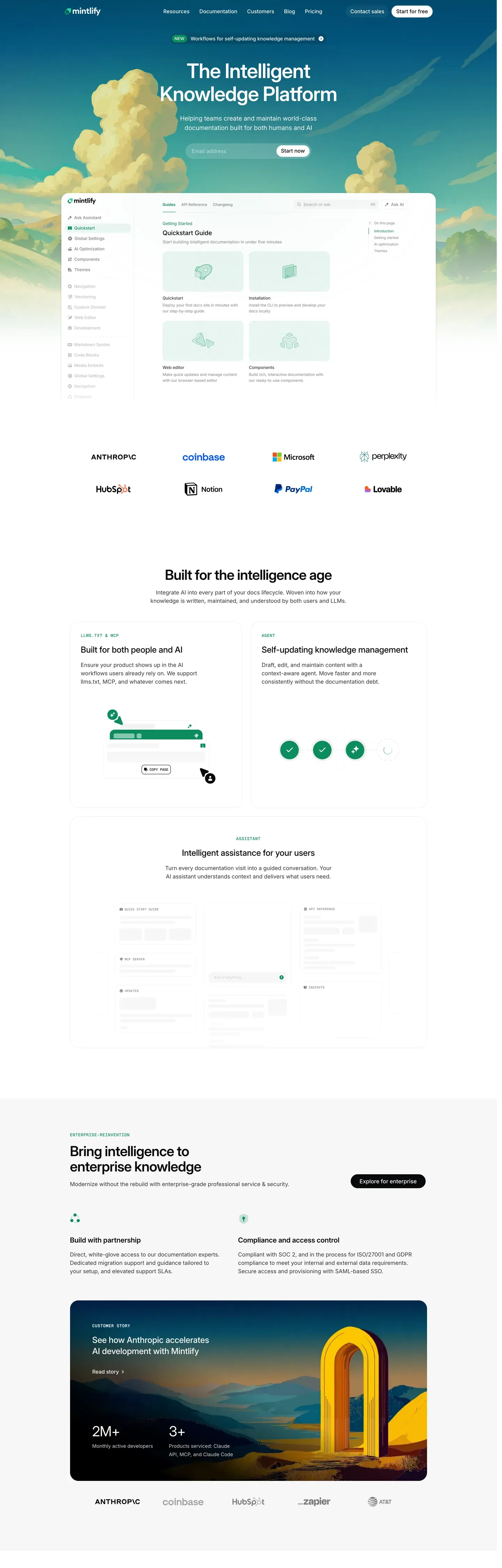
Mintlify sits at the seam between polished SaaS marketing and developer-grade documentation density. The homepage opens with a cinematic sky-gradient hero (a cloud illustration backdrop washing from "#87a8c8" sky-blue to "#f5e9d8" cream) and the startups page swaps in a dark teal-to-mint band with a rocket-launch illustration cutting across "#1a3d4a" to "#2d5a4f". Then the deeper surfaces collapse into a strict 3-column documentation grid — left sidebar nav at 240px, center prose capped at 720px, right table of contents at 200px. Inter carries every UI surface and Geist Mono shows up only for code blocks, inline references, and type signatures. The signature mint "#00d4a4" appears sparingly: hero "Get started" pill, green checkmarks on features, the 2px featured-pricing border, sidebar active indicators.
This page packages the full Mintlify spec as a single DESIGN.md file using the Google Labs DESIGN.md format. Inside: 32 colors tokens (brand mint plus deep "#00b48a" and soft "#7cebcb" variants, plus testimonial coral "#f55a3c", documentation tag blue "#3772cf", and the hero atmospheric gradient stops), 22 typography tokens spanning a 72px hero display down to 11px uppercase micro labels, an 8px-base spacing scale running through 12 tokens up to 120px hero padding, a 7-step border-radius scale, and 51 components covering buttons, cards, inputs, badges, code surfaces, sidebar and TOC navigation, hero bands, and the FAQ accordion.
Feed the file to Claude, Cursor, or GitHub Copilot when building documentation portals, developer landing pages, or API reference surfaces. The agent reads token references directly — `{colors.brand-green}`, `{rounded.full}`, `{typography.code-md}` — and writes React components and Tailwind classes that match Mintlify's voice instead of a generic shadcn theme. Or use the file as a reference audit: drop it next to your own design tokens and run a diff against discipline that already works. The system is worth studying because it solves the rare problem of presenting marketing atmosphere and developer density in the same brand language without either surface feeling diluted.
What makes it distinct
5 highlights
- Dual-mode aestheticAtmospheric sky-gradient marketing heroes paired with dense 3-column developer documentation surfaces
- Signature mint #00d4a4 reserved for accent CTAs, active states, and feature checkmarksNever on body text
- Inter + Geist Mono pairingInter carries all UI prose, Geist Mono surgically marks code blocks, type signatures, and inline references
- Black-pill primary buttons with rounded.full (9999px) corners dominate marketing; white pills invert on dark hero bands
- Tight 14px body type with 1.50 line-height anchors documentation reading; hero displays push to 72px / weight 600
Live at mintlify.com
Mintlify in production, as captured. Scroll the window to see the whole page.
32 colors
Mintlify's system runs on #0a0a0a as its primary voltage, used in 5 of 51 components. Type is set in Inter across 20 tokens from 11px to 72px, weights 400–600. Shape language is mixed across 51 components, blending pills, soft rounds, and squarer corners.
Brand & Accent
Sparing, CTA-only voltage · 9
Surface
Page and card backgrounds · 5
Text
Headlines, body, captions · 5
Borders & Hairlines
Dividers, outlines, rules · 3
Other
Specialty colors · 10
20 type tokens
Set in Inter across 20 tokens, from 11px to 72px, weights 400–600. Shown in its own stack: where the font isn't installed, the fallback the file names stands in.
- hero-display72px · weight 600 · lh 1.05 · tracking -2pxThe quick brown fox jumps over the lazy dog
- display-lg56px · weight 600 · lh 1.1 · tracking -1.5pxThe quick brown fox jumps over the lazy dog
- heading-148px · weight 600 · lh 1.1 · tracking -1pxThe quick brown fox jumps over the lazy dog
- heading-236px · weight 600 · lh 1.2 · tracking -0.5pxThe quick brown fox jumps over the lazy dog
- heading-328px · weight 600 · lh 1.25The quick brown fox jumps over the lazy dog
- heading-422px · weight 600 · lh 1.3The quick brown fox jumps over the lazy dog
- heading-518px · weight 600 · lh 1.4The quick brown fox jumps over the lazy dog
- subtitle18px · weight 400 · lh 1.5The quick brown fox jumps over the lazy dog
- body-md16px · weight 400 · lh 1.5The quick brown fox jumps over the lazy dog
- body-md-medium16px · weight 500 · lh 1.5The quick brown fox jumps over the lazy dog
- body-sm14px · weight 400 · lh 1.5The quick brown fox jumps over the lazy dog
- body-sm-medium14px · weight 500 · lh 1.5The quick brown fox jumps over the lazy dog
- caption13px · weight 400 · lh 1.4The quick brown fox jumps over the lazy dog
- caption-bold13px · weight 600 · lh 1.4The quick brown fox jumps over the lazy dog
- micro12px · weight 500 · lh 1.4The quick brown fox jumps over the lazy dog
- micro-uppercase11px · weight 600 · lh 1.4 · tracking 0.5pxThe quick brown fox jumps over the lazy dog
- button-md14px · weight 500 · lh 1.3The quick brown fox jumps over the lazy dog
- code-md14px · weight 400 · lh 1.5The quick brown fox jumps over the lazy dog
- code-sm13px · weight 400 · lh 1.4The quick brown fox jumps over the lazy dog
- code-inline13px · weight 500 · lh 1.3The quick brown fox jumps over the lazy dog
Radii and spacing
7 corner radii and 12 spacing values. Shape language: mixed, on a 8px base radius.
Radii7
- xs4px
- sm6px
- md8px
- lg12px
- xl16px
- xxl24px
- full9999px
Spacing12
- xxs4px
- xs8px
- sm12px
- md16px
- lg20px
- xl24px
- xxl32px
- xxxl40px
- section-sm48px
- section64px
- section-lg96px
- hero120px
51 components
Each rendered from its tokens (color, type, radius, padding) on Mintlify's own canvas.
- Button PrimaryButton Primarybutton-primary
- Button Primary PressedButton Primary Pressedbutton-primary-pressed
- Button Primary DisabledButton Primary Disabledbutton-primary-disabled
- Button Accent GreenButton Accent Greenbutton-accent-green
- Button On DarkButton On Darkbutton-on-dark
- Button SecondaryButton Secondarybutton-secondary
- Button GhostButton Ghostbutton-ghost
- Button LinkButton Linkbutton-link
- Button Icon Circularbutton-icon-circular
- Card BaseCard Basecard-base
- Card FeatureCard Featurecard-feature
- Card HelpCard Helpcard-help
- Card Startup PerkCard Startup Perkcard-startup-perk
- Pricing CardPricing Cardpricing-card
- Pricing Card FeaturedPricing Card Featuredpricing-card-featured
- Testimonial Card FeatureTestimonial Card Featuretestimonial-card-feature
- Testimonial Card QuoteTestimonial Card Quotetestimonial-card-quote
- Type here…Text Inputtext-input
- Type here…Text Input Focusedtext-input-focused
- Search PillSearch Pillsearch-pill
- Segmented TabSegmented Tabsegmented-tab
- Segmented Tab ActiveSegmented Tab Activesegmented-tab-active
- Pill TabPill Tabpill-tab
- Pill Tab ActivePill Tab Activepill-tab-active
- Toggle Monthly YearlyToggle Monthly Yearlytoggle-monthly-yearly
- Badge DiscountBadge Discountbadge-discount
- Badge RequiredBadge Requiredbadge-required
- Badge TypeBadge Typebadge-type
- Badge TagBadge Tagbadge-tag
- Promo BannerPromo Bannerpromo-banner
- Code BlockCode Blockcode-block
- Code Block HeaderCode Block Headercode-block-header
- Code InlineCode Inlinecode-inline
- Property RowProperty Rowproperty-row
- Feature Comparison TableFeature Comparison Tablefeature-comparison-table
- Feature Comparison RowFeature Comparison Rowfeature-comparison-row
- Sidebar Nav ItemSidebar Nav Itemsidebar-nav-item
- Sidebar Nav Item ActiveSidebar Nav Item Activesidebar-nav-item-active
- Sidebar Section HeaderSidebar Section Headersidebar-section-header
- Doc Toc ItemDoc Toc Itemdoc-toc-item
- Doc Toc Item ActiveDoc Toc Item Activedoc-toc-item-active
- Copy Code ButtonCopy Code Buttoncopy-code-button
- Hero Band SkyHero Band Skyhero-band-sky
- Hero Band DarkHero Band Darkhero-band-dark
- Hero Product MockupHero Product Mockuphero-product-mockup
- Logo Wall ItemLogo Wall Itemlogo-wall-item
- Faq Accordion ItemFaq Accordion Itemfaq-accordion-item
- Footer RegionFooter Regionfooter-region
- Footer LinkFooter Linkfooter-link
- Startup Program CardStartup Program Cardstartup-program-card
- Founder Quote CardFounder Quote Cardfounder-quote-card
The system, in use
Mintlify's tokens on the kind of product it builds.
Plan, build and ship in one place
Bring your team's work together, from the first idea to the final release.
Mintlify design system FAQ
Mintlify's tokens, its components and how to use this DESIGN.md in your project.
Related reading
Specs, directories and component libraries that pair with this design system.
- Browse all design systemsThe full directory of DESIGN.md files on shadcn.io, with live mockups for each.shadcn.io
- Mintlify product siteThe live homepage, startups program, pricing, and documentation surfaces this spec was extracted from.mintlify.com (opens in a new tab)
- The DESIGN.md specificationGoogle Labs' open spec for machine-readable design system files — the format this page is built on.github.com (opens in a new tab)
Use Mintlify in your project
One machine-readable file. Drop it into Claude Code, Cursor, VS Code or any AI tool that reads DESIGN.md.
Download the DESIGN.md
One machine-readable file: every color, type, radius, spacing, and component token of Mintlify.
Feed it to your AI tool
Drop it into Claude, Cursor, or GitHub Copilot. The agent writes React components and Tailwind classes that match Mintlify's visual language.
Reference the tokens directly
Or paste the values into your Tailwind config, CSS variables, or component library: every color, size and radius is a quoted, ready-to-copy value.
Read the full DESIGN.md overview, rationale, do’s and don’ts
Overview
Mintlify positions itself at the intersection of polished marketing presentation and developer-grade documentation density. The home and startups pages open with cinematic atmospheric heroes — soft sky-gradient backdrops with cloud illustrations on the homepage, dark teal-to-mint gradients with a rocket launch on the startups page — that feel more like a SaaS landing aesthetic than a developer tool. Then the deeper surfaces (pricing comparison, live documentation pages) collapse into dense, high-information layouts where Inter body type carries 14–16px copy across long-form prose, syntax-highlighted code blocks, and 3-column documentation grids.
The brand's signature mint green ({colors.brand-green}) appears sparingly but decisively — on the hero "Get started" pill button, the green checkmark icons inside feature lists, the "Featured" pricing tier border, and active state indicators inside docs UI. Black-pill primary buttons dominate the marketing flow; white-on-dark inversions appear on dark hero bands. The signature pairing of Inter (body, headings) with Geist Mono (code blocks, inline references, type signatures) reinforces the developer-tool DNA without requiring a third typeface.
Key Characteristics:
- Atmospheric gradient hero bands (sky-blue to cream on homepage; teal-to-mint on startups) provide cinematic marketing presentation
- Signature Mintlify mint green ({colors.brand-green}) reserved for accent CTAs, active states, and feature confirmations
- Black-pill primary buttons ({colors.primary} +
{rounded.full}) for marketing CTAs - Inter for all UI prose; Geist Mono for code blocks, inline code, and type/property signatures
- 3-column documentation layout (sidebar / prose / TOC) with dense 14px body type for long-form developer reading
- Tightly-controlled radius scale: marketing uses
{rounded.lg}(12px), pill buttons use{rounded.full}— no in-between corner softening - Vibrant testimonial card (
{colors.testimonial-orange}) breaks color rhythm intentionally for emotional impact
Known Gaps
- Specific dark-mode token values for canvas, surface, ink, and hairline are not surfaced on these pages; the brand has not yet shipped a published dark-mode palette
- Animation/transition timings are not extracted; recommend 150–200ms ease for hover/focus state transitions
- Form validation success state is not explicitly captured beyond defaults — implement following standard green-border + success badge patterns
- Code syntax highlighting palette inside docs is not formalized; documentation samples carry their own twoslash-style annotation system tokens (e.g.
{colors.brand-tag},{colors.brand-annotate},{colors.brand-warn}) but the full highlight scheme is not enumerated
More systems like this
Cohere, Dropbox, Logseq and 5 more in Documentation & Knowledge: each brand's colors, type and components in one file your AI agent builds from.
Build it with Pro
The DESIGN.md files are free. Pro adds 6,000+ blocks, premium templates and the MCP server, so your AI editor builds in your system for you.
4.9/5 out of 5 · 150+ reviewsfrom 150+ founders and developers.
Billing
Billed once a year in USD. Cancel anytime.
- How many people can use the license.
- Client work, SaaS products and anything you charge for.
- Page sections in 56 categories, from heroes and pricing tables to dashboards and settings, on every framework and UI library, in your theme.
- Complete Next.js sites for startups, SaaS, agencies and portfolios, every page designed, ready to ship.
- Your AI agent searches, previews and installs any component, block, icon or DESIGN.md from a prompt: 22 tools in Claude Code, Cursor, VS Code and 35 more clients.
- Buttons with motion and states of their own, from an arrow that slides in to a burst of confetti.
- Typewriters, scrambles, counters and more, for headlines, labels and numbers.
- Animated backgrounds for heroes, sections and cards, from a soft aurora to a flock that flees the cursor. Most are pure CSS.
- WebGPU shaders, from a slow aurora to a black hole, each drawing only while it's on screen.
- One design and one theme on all four: the components, blocks and effects are built for each framework.
- React on Base UI, Radix UI, React Aria or Ark UI: install the version for the library your project already uses. Vue, Svelte and Solid run on Ark UI.
- From a button to a date picker, a color picker or a guided tour: accessible, typed in TypeScript, each with live demos.
- Real-world patterns built from the components, in 53 galleries: forms, tables, menus, dialogs and more.
- Area, bar, line, pie, radar and radial charts on TanStack Charts, on every framework. React also gets the Recharts originals.
- Debounce, local storage, media queries and more: each hook is one typed file you own.
- From 222 libraries, Lucide, Heroicons, Tabler and Material Symbols among them, as SVG or a React component in one command.
- Stripe, Linear, Apple and 497 more: a brand's colors, typography and components in one file your AI agent builds from.
- Restyle every component and block at once: 8 styles, 8 grays, 18 colors and 5 radii, shared as a shadcn preset code.
- Priority requests are answered first.
Individual
For personal projects & open source
$32instead of $49/mo
$389 billed yearly
- Seats: 1 seat
- Commercial use: Personal & open source only
- Blocks: All 6,181 blocks
- Templates: All 14 templates
- MCP server: 38 AI clients
- Animated buttons: All 35 buttons
- Text effects: All 97 effects
- Backgrounds: All 100 backgrounds
- Shaders: All 100 shaders
- Frameworks: React, Vue, Svelte, Solid
- UI libraries: Base UI, Radix, Aria, Ark
- Components: All 174 components
- Examples: All 1,103 examples
- Charts: All 70 charts
- React hooks: All 35 hooks
- Icons: 294k+ icons
- DESIGN.md files: All 500 brands
- Theme builder: 8 styles × 18 colors
- Support: Standard
Team
Most popularFor freelancers, agencies & startups
$66instead of $99/mo
$789 billed yearly · ≈ $13/dev/mo
- Seats: Up to 5 seats
- Commercial use: Included
- Blocks: All 6,181 blocks
- Templates: All 14 templates
- MCP server: 38 AI clients
- Animated buttons: All 35 buttons
- Text effects: All 97 effects
- Backgrounds: All 100 backgrounds
- Shaders: All 100 shaders
- Frameworks: React, Vue, Svelte, Solid
- UI libraries: Base UI, Radix, Aria, Ark
- Components: All 174 components
- Examples: All 1,103 examples
- Charts: All 70 charts
- React hooks: All 35 hooks
- Icons: 294k+ icons
- DESIGN.md files: All 500 brands
- Theme builder: 8 styles × 18 colors
- Support: Priority
Organization
For companies with larger teams
$132instead of $199/mo
$1,589 billed yearly
- Seats: Unlimited seats
- Commercial use: Included
- Blocks: All 6,181 blocks
- Templates: All 14 templates
- MCP server: 38 AI clients
- Animated buttons: All 35 buttons
- Text effects: All 97 effects
- Backgrounds: All 100 backgrounds
- Shaders: All 100 shaders
- Frameworks: React, Vue, Svelte, Solid
- UI libraries: Base UI, Radix, Aria, Ark
- Components: All 174 components
- Examples: All 1,103 examples
- Charts: All 70 charts
- React hooks: All 35 hooks
- Icons: 294k+ icons
- DESIGN.md files: All 500 brands
- Theme builder: 8 styles × 18 colors
- Support: Priority
Billed once a year in USD. Cancel anytime.
Individual
For personal projects & open source
$32instead of $49/mo
$389 billed yearly
- How many people can use the license.Seats: 1 seat
- Client work, SaaS products and anything you charge for.Commercial use: Personal & open source only
- Page sections in 56 categories, from heroes and pricing tables to dashboards and settings, on every framework and UI library, in your theme.Blocks: All 6,181 blocks
- Complete Next.js sites for startups, SaaS, agencies and portfolios, every page designed, ready to ship.Templates: All 14 templates
- Your AI agent searches, previews and installs any component, block, icon or DESIGN.md from a prompt: 22 tools in Claude Code, Cursor, VS Code and 35 more clients.MCP server: 38 AI clients
- Buttons with motion and states of their own, from an arrow that slides in to a burst of confetti.Animated buttons: All 35 buttons
- Typewriters, scrambles, counters and more, for headlines, labels and numbers.Text effects: All 97 effects
- Animated backgrounds for heroes, sections and cards, from a soft aurora to a flock that flees the cursor. Most are pure CSS.Backgrounds: All 100 backgrounds
- WebGPU shaders, from a slow aurora to a black hole, each drawing only while it's on screen.Shaders: All 100 shaders
- One design and one theme on all four: the components, blocks and effects are built for each framework.Frameworks: React, Vue, Svelte, Solid
- React on Base UI, Radix UI, React Aria or Ark UI: install the version for the library your project already uses. Vue, Svelte and Solid run on Ark UI.UI libraries: Base UI, Radix, Aria, Ark
- From a button to a date picker, a color picker or a guided tour: accessible, typed in TypeScript, each with live demos.Components: All 174 components
- Real-world patterns built from the components, in 53 galleries: forms, tables, menus, dialogs and more.Examples: All 1,103 examples
- Area, bar, line, pie, radar and radial charts on TanStack Charts, on every framework. React also gets the Recharts originals.Charts: All 70 charts
- Debounce, local storage, media queries and more: each hook is one typed file you own.React hooks: All 35 hooks
- From 222 libraries, Lucide, Heroicons, Tabler and Material Symbols among them, as SVG or a React component in one command.Icons: 294k+ icons
- Stripe, Linear, Apple and 497 more: a brand's colors, typography and components in one file your AI agent builds from.DESIGN.md files: All 500 brands
- Restyle every component and block at once: 8 styles, 8 grays, 18 colors and 5 radii, shared as a shadcn preset code.Theme builder: 8 styles × 18 colors
- Priority requests are answered first.Support: Standard
Team
Most popularFor freelancers, agencies & startups
$66instead of $99/mo
$789 billed yearly · ≈ $13/dev/mo
Everything in Individual, plus
- How many people can use the license.Seats: Up to 5 seats
- Client work, SaaS products and anything you charge for.Commercial use: Included
- Priority requests are answered first.Support: Priority
Organization
For companies with larger teams
$132instead of $199/mo
$1,589 billed yearly
Everything in Team, plus
- How many people can use the license.Seats: Unlimited seats
- Secure checkout via Stripe
- Code lives in your repo
- Keep what you've shipped if you cancel
- License terms
4.9 out of 5 from 150+ developers


Your system, built for you
Every block, template and icon, installed by your AI agent in your design system. The DESIGN.md files stay free.
- Cancel anytime
- Keep what you've shipped