bcrypt hash generator.
Type a password and read its bcrypt hash, salted with 16 random bytes, at the cost you pick. bcrypt is the 1999 password hash from Blowfish: salted, slow by a cost you choose, still sound; everything runs in your browser and nothing is uploaded.
bcrypt hash generator.
Need the UI around it? With Pro, your AI agent builds the form, the result card and the rest of the page from a prompt.
Get ProHow it works
4 steps, no account. It runs in your browser and nothing is uploaded.
Enter the password
Type or paste the password, or drop a file onto the input; the tool waits for a pause before it starts.
Pick the algorithm and cost
bcrypt is the default; switch to Argon2id and Argon2d, and pick the cost the login can afford.
Read the encoded hash
The encoded hash carries the salt and the parameters; press Rehash for a fresh salt.
Verify, copy or download
Paste a stored hash to check it against the input, or copy and download the new one.
Password hashes against each other
A password hash is slow on purpose. It costs the server a few milliseconds per login and an attacker the same per guess, billions of times over.
Argon2id
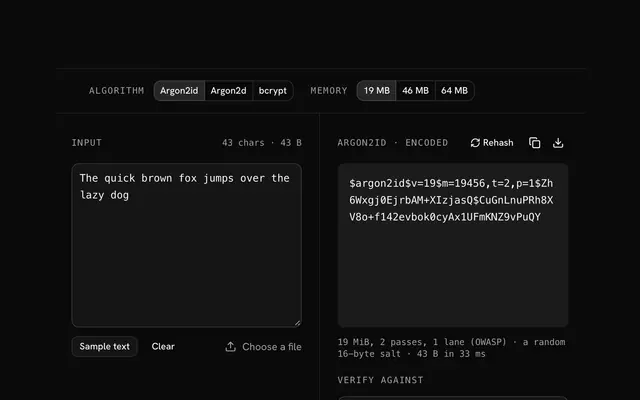
2015, RFC 9106, the Password Hashing Competition's winner. Memory-hard. The first pass data-independent, the rest data-dependent: resists GPUs and side channels both. The recommendation.
Argon2d
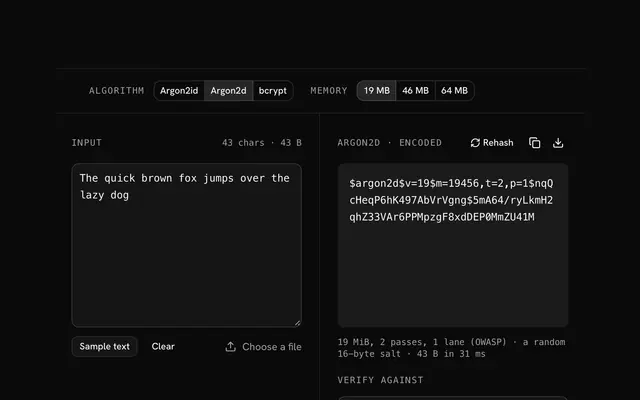
The data-dependent variant: the strongest against GPU cracking, but its memory accesses depend on the password, so a shared machine can leak timing. For mining and proofs of work.
Argon2i
The data-independent variant: safe against side channels, weaker against GPUs for the same cost. Mostly superseded by Argon2id.
bcrypt
1999, from Blowfish. A cost factor doubles the work each step; a 72-byte input limit; 60-character hashes. Still sound, still everywhere.
scrypt
2009, memory-hard before Argon2 existed. Tunable N, r, p. In Tarsnap, Litecoin and many password managers.
PBKDF2
2000, RFC 2898: HMAC iterated many thousand times. Not memory-hard, so GPUs crack it fast; kept where FIPS compliance requires it.
SHA-256
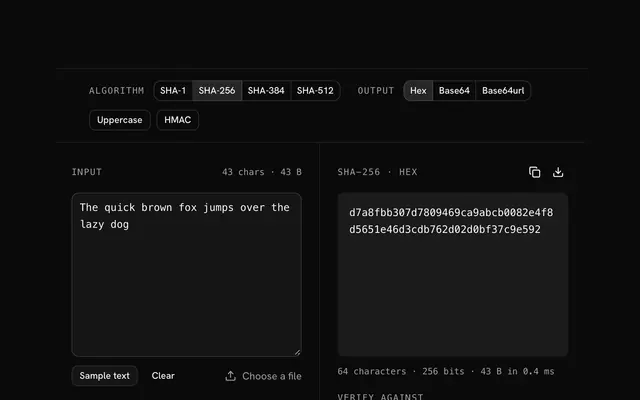
Fast by design, which is the problem: a GPU tries billions a second. Fine for integrity, never for storing passwords.
MD5
Faster still, and broken. Unsalted MD5 password tables are the breaches you read about.
Related tools
More hash generators. Every one free, in the browser.
Pricing
Build it with Pro
The tool is free. Pro adds 6,000+ blocks, premium templates and the MCP server, so your AI editor builds the product around it.
4.9/5 out of 5 · 150+ reviewsfrom 150+ founders and developers.
- Secure checkout via Stripe
- Code lives in your repo
- Keep what you've shipped if you cancel
- License terms
Questions and answers
Before you trust the result: what to know about the format, the limits, your data and the tools next to it.
bcrypt is a password hash Niels Provos and David Mazières published in 1999, built on the Blowfish cipher. It runs an expensive key setup 2^cost times, salts every hash with 16 random bytes, and writes the result as a 60-character string ($2a$ or $2b$, the cost, the salt and the 184-bit hash in bcrypt's own base-64) that carries everything a verifier needs.
Yes, 25 years on. Its cost factor has kept pace with hardware (10 to 12 is typical today, each step doubling the work), and its memory access pattern makes it awkward on GPUs. Argon2id is the better design for a new system, with tunable memory; bcrypt remains a sound choice and the default in many frameworks.
The cost is the base-2 logarithm of the rounds: 10 means 1,024 rounds and about 100 ms in native code, 12 means 4,096 and roughly four times that. Pick the highest your login latency allows, around 250 ms, and raise it as hardware improves; stored hashes keep their own cost, so old ones still verify.
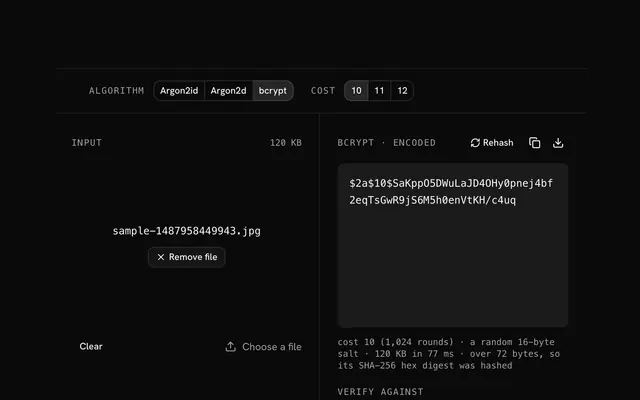
bcrypt reads at most 72 bytes of input and silently ignores the rest. This tool follows the common fix: input past 72 bytes is replaced by its SHA-256 digest written as 64 hex characters, and the status line says when that happened. Some libraries do the same; others truncate, so match what your verifier does.
The salt is 16 random bytes drawn in your browser for each run, so the same input gives a different hash every time, and that is correct: a salt stops attackers precomputing tables and hides which users share a password. The salt is written into the encoded hash, so a verifier needs nothing else. Press Rehash for a fresh one.
Nothing leaves your browser. The hash is computed on your machine, by the browser's Web Crypto API or a WebAssembly build of the algorithm loaded on first use, and the page makes no request with your input. You can load the page, go offline and keep hashing.
Paste a stored hash into the Verify field and the tool checks whether it is a hash of the current input, reading the salt and the cost from the hash itself, as a login would. The input is never sent anywhere; the check runs in your browser.
Yes: drop a file onto the input or choose it with the button, up to 64 MB, and it is hashed as the password. The File to bcrypt page opens on the file pane. A hash that takes a quarter of a second on a short password takes the same on a file, since the input is read once and the cost is in the memory and rounds.
Nothing. The bcrypt hash generator holds your input in the page's memory, so closing or reloading the tab clears it, and it saves nothing in this browser.
The bcrypt hash generator offers cost 10 (1,024 rounds), cost 11 (2,048 rounds), and cost 12 (4,096 rounds). The default is cost 10 (1,024 rounds); a higher setting is slower for you and for anyone guessing.
The toolbar has Argon2id, Argon2d, and bcrypt, with the recommended one first. All three run in your browser on a WebAssembly build from the hash-wasm library, and each run takes a fresh 16-byte salt from crypto.getRandomValues.
The result is one self-describing string that holds the algorithm, the cost, the salt and the hash. A library's verify function can read it as it is, and so can the verify field on this page.
bcrypt reads only the first 72 bytes of its input. When the input is longer, the tool hashes its SHA-256 digest (64 hex characters) instead and tells you so in the status line.
Yes: the File to bcrypt page is the same tool, opening on the file pane.
Closest to the bcrypt hash generator: File to bcrypt, Argon2id hash generator, Argon2d hash generator, SHA-256 hash generator. Each opens on its own page, free and in the browser.
The bcrypt hash generator is one of 64 in its group. The group's page, /tools/hash, lists them all.
The tool is free. Its interface is built from shadcn.io's own components (Button, Input, Slider and the rest of the registry under /ui), which come in React, Vue, Svelte and Solid. Pro adds the blocks and templates for the product around it.
4.9 out of 5 from 150+ developers


Build the product around it
Every block, template and icon, installed by your AI agent in your theme. The tools stay free.
Get Pro