Disposable camera effect.
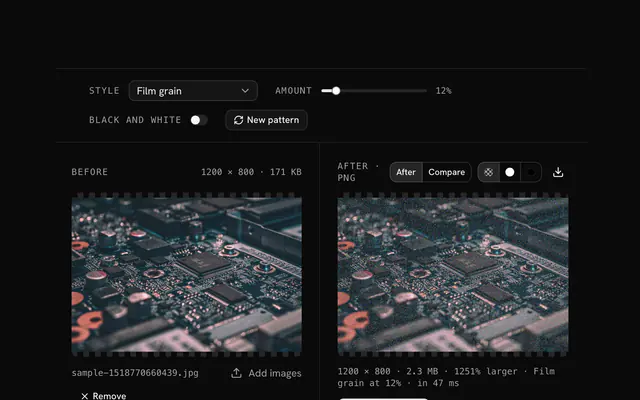
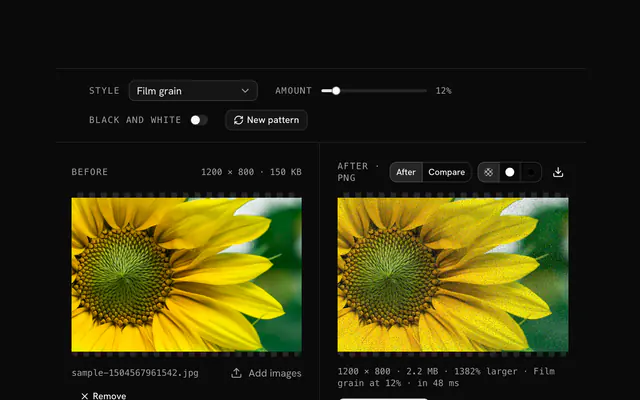
Give a digital photo the candid look of a disposable camera: heavy grain, in color or black and white, at an amount you set. It is generated in your browser; nothing is uploaded.
Disposable camera effect.
Need the UI around it? With Pro, your AI agent builds the form, the result card and the rest of the page from a prompt.
Get ProHow it works
4 steps, no account. It runs in your browser and nothing is uploaded.
Drop a photo
Drop a JPG, PNG or WebP onto the pane; the clean photo shows beside the result.
Pick a style and an amount
Film, monochrome, color-matched, sampled or tinted, and the amount from a whisper to heavy.
Tune it
Turn on black and white for a classic look, or click New pattern until the specks fall right.
Download
Download the PNG; the grain is baked in and survives any editor.
Related tools
More JPG tools. Every one free, in the browser.
Pricing
Build it with Pro
The tool is free. Pro adds 6,000+ blocks, premium templates and the MCP server, so your AI editor builds the product around it.
4.9/5 out of 5 · 150+ reviewsfrom 150+ founders and developers.
- Secure checkout via Stripe
- Code lives in your repo
- Keep what you've shipped if you cancel
- License terms
Questions and answers
Before you trust the result: what to know about the format, the limits, your data and the tools next to it.
A plastic lens that is never quite sharp, a consumer film stock with pronounced grain, a flash that reaches a few meters and colors that drift. Together they make a photo that feels candid and unposed, the opposite of a polished feed.
Film grain at 25 to 40 percent, in color, is the core of it. For a black-and-white single-use camera, turn on black and white and use monochrome grain at 30 to 45.
Because the photos cannot be retaken or deleted, so they read as honest. The grain and softness forgive an unflattering moment, and the look says the moment mattered more than the picture.
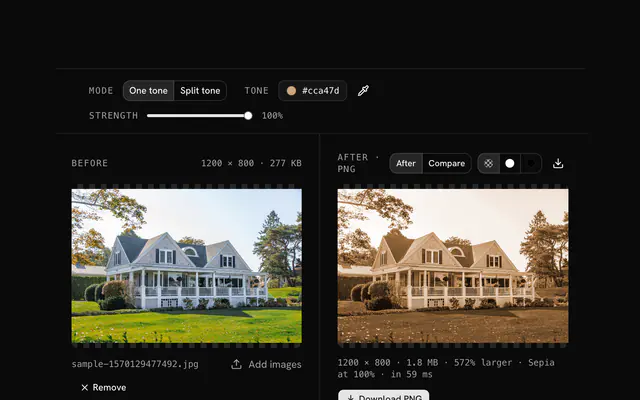
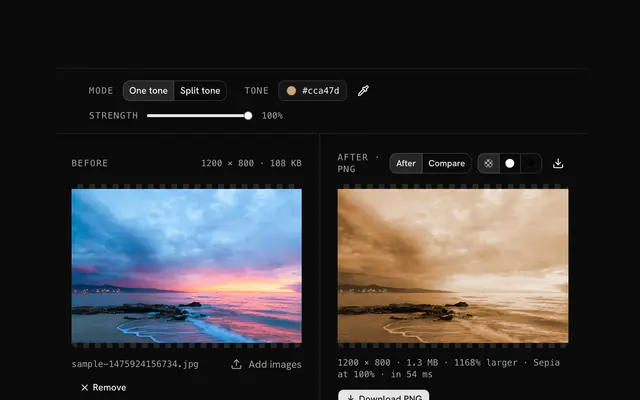
Stop at 25 to 35 percent. Real disposable photos have character, not chaos. Pair the grain with a warm, slightly faded grade from the tone changer.
This tool does the grain. For the hard direct flash, blown highlights in the middle and a dark edge, use an editor's exposure and vignette controls; add the grain last.
Tinted grain with a color from the picker: a pink or violet for neon nights, a gold or orange for tungsten light. It keeps the casual feel and ties the grain to the room's light.
Film grain scatters random colored specks, like expired color film. Monochrome grain is gray only, the silver halide look. Color-matched grain nudges each speck a little away from the pixel's own color, so it blends. Sampled grain reuses colors found elsewhere in the photo, and tinted grain uses one color you pick.
The amount is the share of pixels that get a speck. 8 to 15 percent adds texture you feel more than see; 20 to 40 is visible film character; above 50 it reads as damaged or experimental film.
Each pattern is random, and no two frames of real film share one either. Click New pattern until the specks fall where they suit the photo; the same amount and style keep a series consistent even though every pattern differs.
No. The file is decoded, drawn and re-encoded by your browser's canvas, and the page makes no request with it. You can load the page, go offline and keep working; nothing is stored either.
No. The "Disposable camera effect" tool is free and opens without a sign-in, an account or an install.
Nothing. The "Disposable camera effect" tool holds your input in the page's memory, so closing or reloading the tab clears it, and it saves nothing in this browser.
Up to 100 MB per file, the limit the tool states under its drop area. A larger file is refused with a plain message instead of being decoded.
No, it takes one file at a time. If you drop or choose several, only the first is used; run the tool again for the next one.
The edit is written as a PNG because PNG stores every pixel exactly, with a full alpha channel, so the result can be edited again without a second round of loss.
No. The browser decodes the image and the tool writes a new file from its pixels, so camera EXIF, GPS position and text chunks in the original are not copied into the result. Keep the original file if you need them.
No. The result has the same width and height in pixels as the source.
Closest to the "Disposable camera effect" tool: Photo grain generator, JPG film grain effect, Vintage photo effect, JPG color tone changer. Each opens on its own page, free and in the browser.
The "Disposable camera effect" tool is one of 44 in its group. The group's page, /tools/jpg, lists them all.
The tool is free. Its interface is built from shadcn.io's own components (Button, Input, Slider and the rest of the registry under /ui), which come in React, Vue, Svelte and Solid. Pro adds the blocks and templates for the product around it.
4.9 out of 5 from 150+ developers


Build the product around it
Every block, template and icon, installed by your AI agent in your theme. The tools stay free.
Get Pro