File to CRC64.
Drop a file and read its CRC64 checksum at once, in your browser. CRC64 is CRC32's 64-bit cousin for large files and storage, in the ECMA-182 form xz and Redis use; the file is read on your machine and never uploaded.
File to CRC64.
Need the UI around it? With Pro, your AI agent builds the form, the result card and the rest of the page from a prompt.
Get ProHow it works
4 steps, no account. It runs in your browser and nothing is uploaded.
Drop a file
Drop it onto the pane or choose it with the button; anything up to 1 GB is read in your browser.
Read the checksum
The CRC64 checksum appears at once, as hex, Base64 or Base64url; switch to CRC32 and Adler-32 in the bar.
Verify against a published checksum
Paste the checksum the publisher lists and the tool says whether the file matches.
Copy or download
Copy the checksum, or download it as a line a checksum tool can read.
Related tools
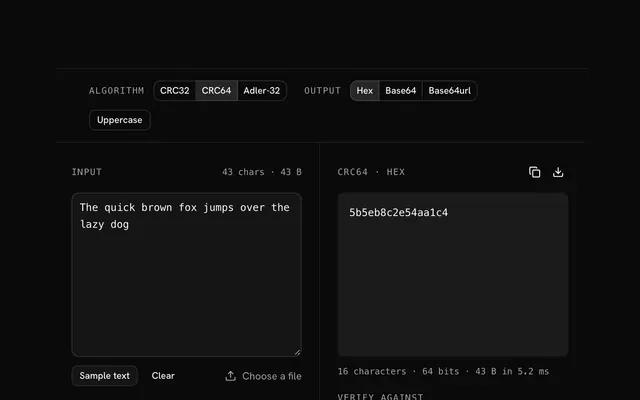
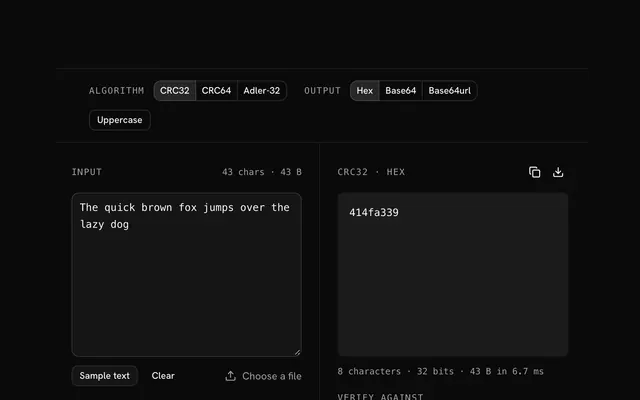
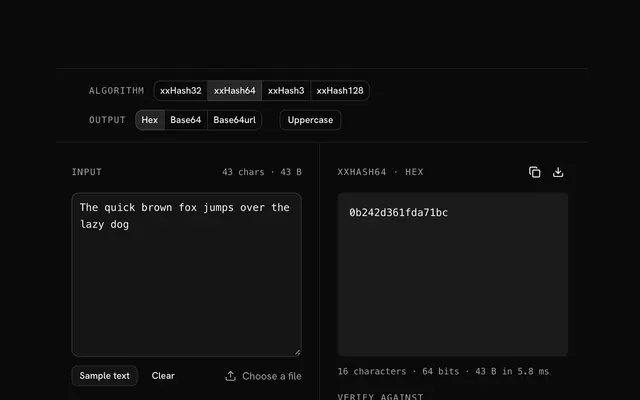
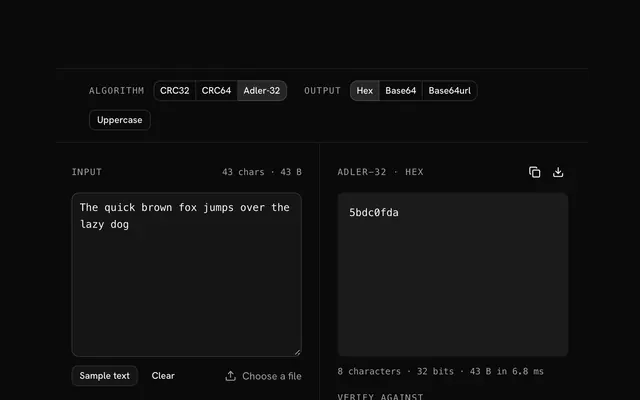
More hash generators. Every one free, in the browser.
Pricing
Build it with Pro
The tool is free. Pro adds 6,000+ blocks, premium templates and the MCP server, so your AI editor builds the product around it.
4.9/5 out of 5 · 150+ reviewsfrom 150+ founders and developers.
- Secure checkout via Stripe
- Code lives in your repo
- Keep what you've shipped if you cancel
- License terms
Questions and answers
Before you trust the result: what to know about the format, the limits, your data and the tools next to it.
CRC64 is a cyclic redundancy check with a 64-bit remainder, the same polynomial-division idea as CRC32 with a longer divisor, so random corruption slips through once in 18 quintillion rather than once in four billion. This tool computes CRC-64/XZ, the ECMA-182 polynomial 0x42F0E1EBA9EA3693 as the xz format, Redis and Go's crc64.ECMA table use it.
Several CRC-64s exist and give different numbers: CRC-64/ISO (ISO 3309, used by HDLC and old SMB), CRC-64/ECMA-182 in its unreflected form, and CRC-64/XZ, the reflected ECMA form that most software means today. If your values don't match, check which polynomial and reflection the other side uses.
No. A CRC is linear: given any file, anyone can append four bytes to make it match any CRC they like, and a change that keeps the checksum is easy to craft. It detects accidents (a flipped bit, a truncated download, a bad sector), which is all it was made for. Against a person, use SHA-256 or BLAKE3.
xz and 7-Zip archives, Redis's DUMP payloads and cluster keys, Rust's and Go's standard libraries, large-file verification in storage systems and backups. Where a 32-bit check would see a false pass across petabytes, 64 bits leaves the odds negligible.
A little slower than CRC32 in a plain table implementation and without CRC32's hardware instructions, but still gigabytes a second. For a 64-bit value with better hash-table distribution, xxHash64 is faster; for error detection with guarantees, CRC64 is the one.
Nothing leaves your browser. The file is read on your machine and hashed there, by the browser's Web Crypto API or a WebAssembly build of CRC64 loaded on first use; the page makes no request with its bytes. You can load the page, go offline and keep hashing.
Drop the file onto the pane or choose it with the button. It is read into memory and hashed at once, with no size steps and no upload progress because there is no upload. Files up to 1 GB work; a 100 MB file takes well under a second on CRC64.
Paste the checksum the publisher gave you into the Verify field, in hex of either case, with or without spaces, colons or a 0x prefix, or in Base64. The tool says whether it matches the file you dropped. A match means the bytes are exactly the ones that were published.
Hex by default, 16 characters; Base64 and Base64url are one click away and re-encode the same 8 bytes. The download button saves a line in the `checksum filename` form that sha256sum-style tools read.
No. The "File to CRC64" tool is free and opens without a sign-in, an account or an install.
Nothing. The "File to CRC64" tool holds your input in the page's memory, so closing or reloading the tab clears it, and it saves nothing in this browser.
The toolbar switches to CRC32 and Adler-32 without leaving the page. Each one reads the same input, so you can compare digests side by side.
CRC64 is computed by a WebAssembly build from the hash-wasm library, which the page loads the first time you hash something and reuses after that.
No: CRC64 is a checksum or fast non-cryptographic hash, and none of the algorithms in this toolbar take a key, because a keyed checksum proves nothing.
Yes: the CRC64 hash generator page has the same algorithms and options and opens on the text box. This page opens on the file pane.
Not on its own. CRC64 is built to be fast, and fast hashes are cheap for an attacker to guess against. Passwords need a salted, deliberately slow hash: use Argon2id, Argon2d, and bcrypt from the hash generators, which draw a fresh random salt each time.
Closest to the "File to CRC64" tool: CRC64 hash generator, CRC32 hash generator, xxHash64 hash generator, Adler-32 hash generator. Each opens on its own page, free and in the browser.
The "File to CRC64" tool is one of 64 in its group. The group's page, /tools/hash, lists them all.
The tool is free. Its interface is built from shadcn.io's own components (Button, Input, Slider and the rest of the registry under /ui), which come in React, Vue, Svelte and Solid. Pro adds the blocks and templates for the product around it.
4.9 out of 5 from 150+ developers


Build the product around it
Every block, template and icon, installed by your AI agent in your theme. The tools stay free.
Get Pro