Nano ID generator.
Generate Nano IDs with the default alphabet or your own, at any size and in bulk, and see how long it would take for two of them to collide. Drawn from your browser's randomness.
Nano ID generator.
Need the UI around it? With Pro, your AI agent builds the form, the result card and the rest of the page from a prompt.
Get ProHow it works
4 steps, no account. It runs in your browser and nothing is uploaded.
Pick an alphabet
The default URL-safe 64, alphanumeric, numbers, hex, no look-alikes or your own.
Set the size
21 is the default; the entropy updates as you change it.
Check the collision risk
Type how many ids you make an hour to see the time to a 1% collision chance.
Copy the ids
One or a thousand, copied or downloaded as a list.
Related tools
More security and dev tools. Every one free, in the browser.
Pricing
Build it with Pro
The tool is free. Pro adds 6,000+ blocks, premium templates and the MCP server, so your AI editor builds the product around it.
4.9/5 out of 5 · 150+ reviewsfrom 150+ founders and developers.
- Secure checkout via Stripe
- Code lives in your repo
- Keep what you've shipped if you cancel
- License terms
Questions and answers
Before you trust the result: what to know about the format, the limits, your data and the tools next to it.
A short random id, 21 characters from a 64-letter URL-safe alphabet (A–Z, a–z, 0–9, _ and -) by default, made by the nanoid library. It carries 126 random bits, about as many as a UUID v4's 122, in 21 characters instead of 36.
Shorter and URL-safe as is, with any alphabet and length you like. A UUID is the better pick where a database type or an API expects one; a Nano ID suits URLs, file names and public ids.
By the birthday bound: with N possible ids, about √(2N·ln(1/(1−p))) of them give a collision with probability p. The calculator uses your alphabet, size and rate to say how long until a 1% chance of any two ids being the same.
Yes. Each character is drawn from crypto.getRandomValues with a bit mask and rejection, the same method the nanoid library uses, so no character of the alphabet is more likely than another.
Pick an alphabet (the default, alphanumeric, lowercase, numbers, hex, no look-alikes, or your own), set the size and the count, and copy or download the list.
Type the characters in the custom alphabet field; repeated characters are dropped, and the entropy and collision time follow the alphabet's real size. Two characters is the least it takes.
No. The ids are drawn in your browser and the page makes no request.
No. The Nano ID generator is free and opens without a sign-in, an account or an install.
Nothing. The Nano ID generator holds your input in the page's memory, so closing or reloading the tab clears it, and it saves nothing in this browser.
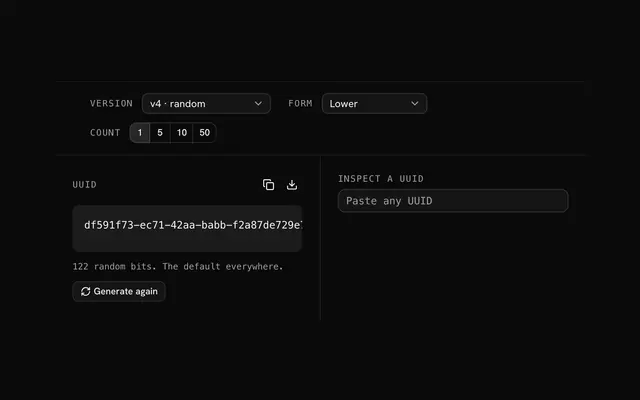
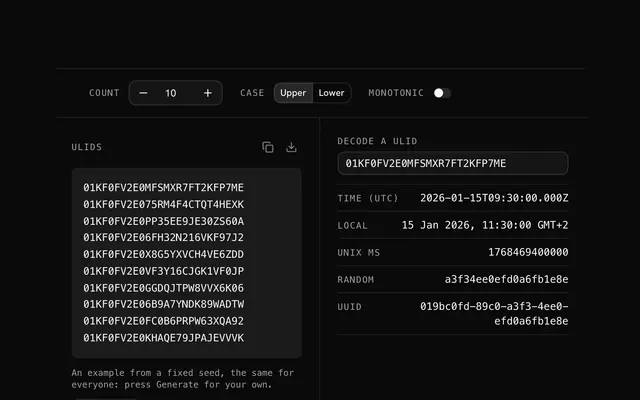
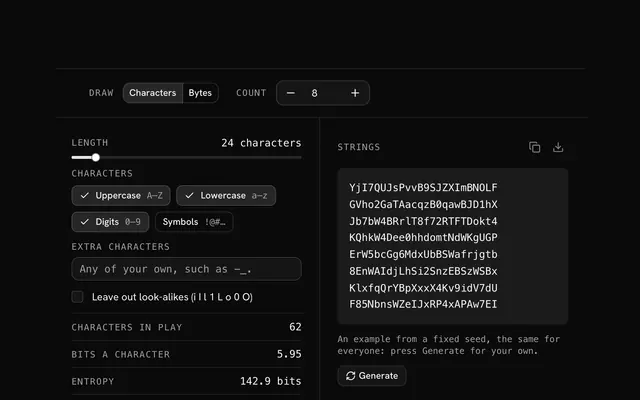
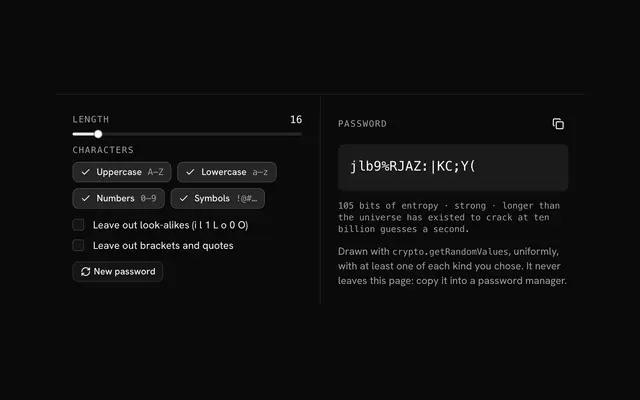
Closest to the Nano ID generator: UUID generator, ULID generator, Random string generator, Password generator. Each opens on its own page, free and in the browser.
The Nano ID generator is one of 20 in its group. The group's page, /tools/security, lists them all.
The tool is free. Its interface is built from shadcn.io's own components (Button, Input, Slider and the rest of the registry under /ui), which come in React, Vue, Svelte and Solid. Pro adds the blocks and templates for the product around it.
4.9 out of 5 from 150+ developers


Build the product around it
Every block, template and icon, installed by your AI agent in your theme. The tools stay free.
Get Pro