Thumbnail gallery fade.
Fade a gallery's thumbnails so they read as clickable and leave room for icons and captions.
Thumbnail gallery fade.
Need the UI around it? With Pro, your AI agent builds the form, the result card and the rest of the page from a prompt.
Get ProHow it works
3 steps, no account. It runs in your browser and nothing is uploaded.
Drop the thumbnail
Drop a thumbnail on the pane or choose it from your device.
Set the fade
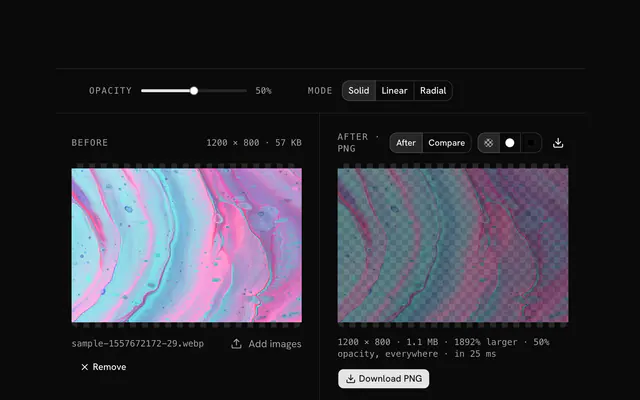
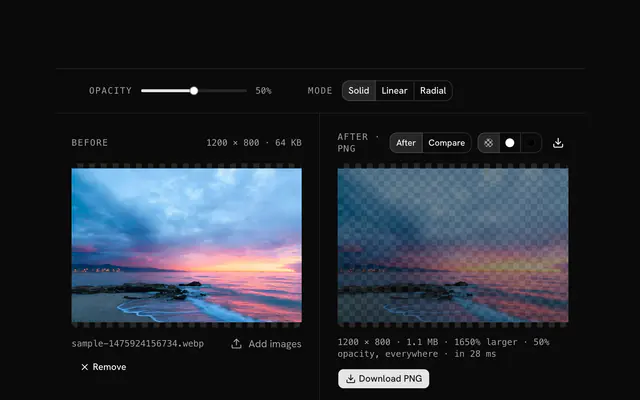
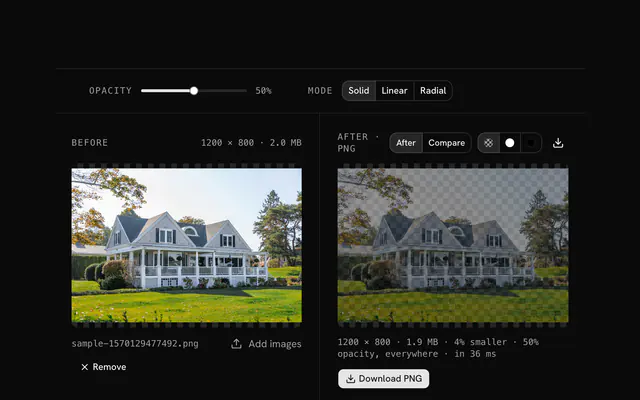
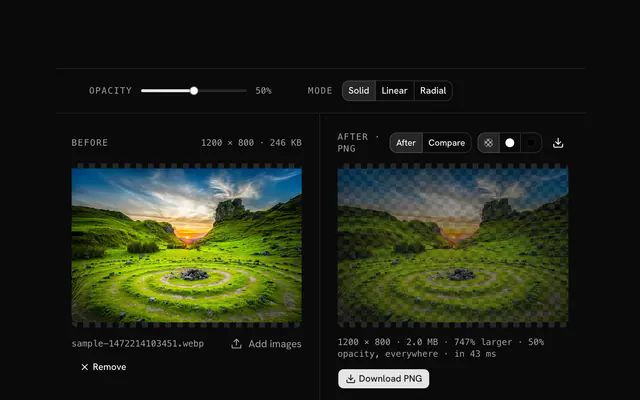
Set the opacity to 60 to 80%, or a bottom fade for a caption.
Download
Download the PNG and apply the same setting to the rest of the gallery.
Related tools
More WebP tools. Every one free, in the browser.

Pricing
Build it with Pro
The tool is free. Pro adds 6,000+ blocks, premium templates and the MCP server, so your AI editor builds the product around it.
4.9/5 out of 5 · 150+ reviewsfrom 150+ founders and developers.
- Secure checkout via Stripe
- Code lives in your repo
- Keep what you've shipped if you cancel
- License terms
Questions and answers
Before you trust the result: what to know about the format, the limits, your data and the tools next to it.
60 to 80% with a brighter hover state. The slight dim says the thumbnail is clickable and the hover confirms it.
Process the thumbnails at 50 to 70%. Zoom, expand and play icons then show clearly whatever the picture, since the transparency gives a consistent contrast.
Yes. The dimmed thumbnail is the gallery state and the full-opacity image opens in the lightbox, which makes the thumbnail-to-full relationship plain.
Apply the same percentage to every image. One opacity across different sizes unifies a masonry grid.
A bottom fade to 0% leaves room for a caption below each thumbnail, with consistent contrast and no solid overlay.
Thumbnails benefit from lower opacity to signal interaction; the full-size image shows at 100%. The difference is what visitors expect from a gallery.
No. The browser decodes the file, a canvas does the work and the result is built on your device; the page makes no request with your image. You can load it, go offline and keep working.
The edit is written as a PNG so nothing is lost: it keeps every pixel and the alpha channel exactly. Run the result through the WebP compressor to get a WebP back for the web, usually 25 to 35% smaller than the PNG.
No. The "Thumbnail gallery fade" tool is free and opens without a sign-in, an account or an install.
Up to 100 MB per file, the limit the tool states under its drop area. A larger file is refused with a plain message instead of being decoded.
No, it takes one file at a time. If you drop or choose several, only the first is used; run the tool again for the next one.
The edit is written as a PNG because PNG stores every pixel exactly, with a full alpha channel, so the result can be edited again without a second round of loss.
No. The browser decodes the image and the tool writes a new file from its pixels, so camera EXIF, GPS position and text chunks in the original are not copied into the result. Keep the original file if you need them.
No. The result has the same width and height in pixels as the source.
Closest to the "Thumbnail gallery fade" tool: WebP opacity changer, Image hover state opacity, Thumbnail color tinting, PNG opacity changer. Each opens on its own page, free and in the browser.
The "Thumbnail gallery fade" tool is one of 44 in its group. The group's page, /tools/webp, lists them all.
The tool is free. Its interface is built from shadcn.io's own components (Button, Input, Slider and the rest of the registry under /ui), which come in React, Vue, Svelte and Solid. Pro adds the blocks and templates for the product around it.
4.9 out of 5 from 150+ developers


Build the product around it
Every block, template and icon, installed by your AI agent in your theme. The tools stay free.
Get Pro