Image color overlay.
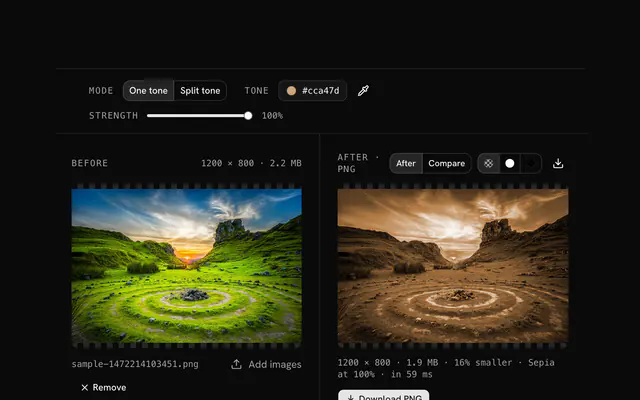
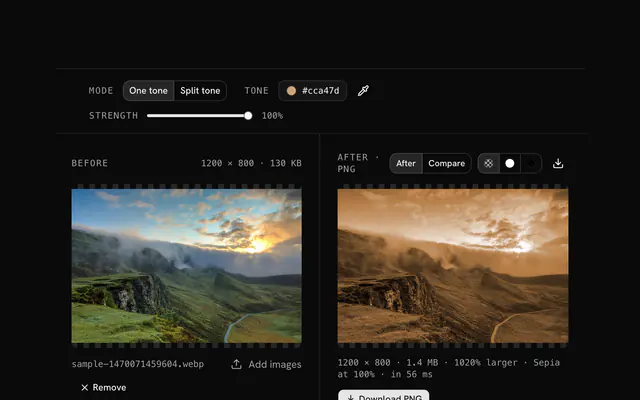
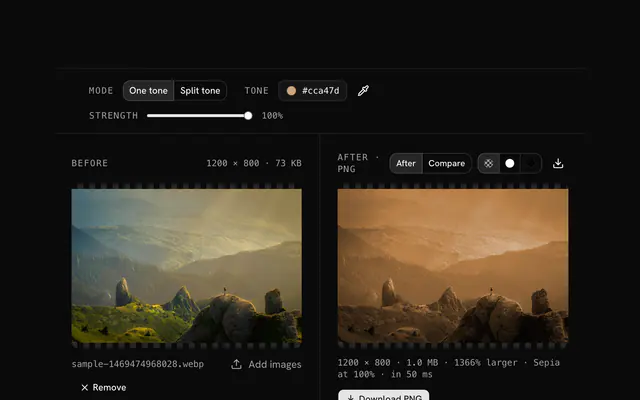
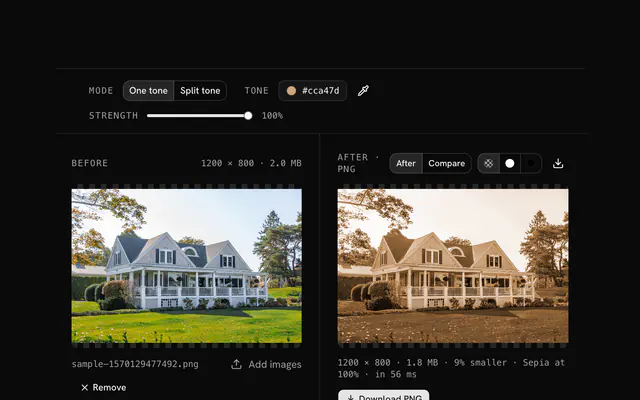
Tint an image to a brand color and keep its detail. The hue and saturation of every pixel become the overlay color, the lightness stays, and the strength slider sets how far it goes.
Image color overlay.
Need the UI around it? With Pro, your AI agent builds the form, the result card and the rest of the page from a prompt.
Get ProHow it works
4 steps, no account. It runs in your browser and nothing is uploaded.
Drop an image
Drop the photo or graphic to tint.
Enter the brand color
Type the brand's hex code into the picker, or pick a preset.
Set the strength
Set the strength: 100 for a full overlay, less to let the original color through.
Download
Download the PNG and repeat with the same code for the rest of the set.
Related tools
More PNG tools. Every one free, in the browser.
Pricing
Build it with Pro
The tool is free. Pro adds 6,000+ blocks, premium templates and the MCP server, so your AI editor builds the product around it.
4.9/5 out of 5 · 150+ reviewsfrom 150+ founders and developers.
- Secure checkout via Stripe
- Code lives in your repo
- Keep what you've shipped if you cancel
- License terms
Questions and answers
Before you trust the result: what to know about the format, the limits, your data and the tools next to it.
A flat overlay paints a translucent color over the image and washes the detail out. This tool replaces each pixel's hue and saturation and keeps its lightness, so shadows stay dark and highlights stay bright. The image reads as the brand color with its depth intact.
Yes. The picker has a hex field, so a brand color such as #1da1f2 can be typed in exactly and the whole image takes that hue and saturation. Note the code and apply it to every image in a set for a consistent look.
Pure white and pure black have no room for color, since their lightness is 100 or 0, so they stay white and black. Mid-tones take the tone fully. A very light or very dark image will therefore look only faintly tinted; it is the image, not the tool.
Apply the same hex code at the same strength to each image. The tone changer is deterministic, so every photo takes the same hue and saturation, and a set of stock photos comes out as one consistent series for a site, a deck or a social feed.
Fully transparent pixels are skipped and stay transparent. Partly transparent pixels get the new tone and keep their alpha value, so a logo or icon with a transparent background comes out toned on the same transparent background.
The picker opens with eight swatches: Sepia (#cca47d), Slate (#6b7280), Ocean (#2563eb), Teal (#0d9488), Forest (#15803d), Sunset (#ea580c), Rose (#e11d48) and Violet (#7c3aed). Any of them is a starting point; drag in the picker or type a hex code for your own tone.
Strength blends the toned pixels with the original ones. At 100 the image is fully toned; at 50 half the original color shows through, which reads as a tint rather than a monochrome; at 0 nothing changes. Lower it for a subtle cast, raise it for a full single-color image.
Each pixel is converted to hue, saturation and lightness. The tool keeps the pixel's lightness and replaces its hue and saturation with the tone color's, so dark areas stay dark, bright areas stay bright and everything shifts to one color. That is why the result keeps its depth instead of looking like a flat wash of color.
No. Your browser decodes the file and does the pixel work with its Canvas API, and the page makes no request with it. You can load the page, go offline and keep working; the download is written from memory on your device.
No. The Image color overlay is free and opens without a sign-in, an account or an install.
Nothing. The Image color overlay holds your input in the page's memory, so closing or reloading the tab clears it, and it saves nothing in this browser.
Up to 100 MB per file, the limit the tool states under its drop area. A larger file is refused with a plain message instead of being decoded.
No, it takes one file at a time. If you drop or choose several, only the first is used; run the tool again for the next one.
The edit is written as a PNG because PNG stores every pixel exactly, with a full alpha channel, so the result can be edited again without a second round of loss.
No. The browser decodes the image and the tool writes a new file from its pixels, so camera EXIF, GPS position and text chunks in the original are not copied into the result. Keep the original file if you need them.
No. The result has the same width and height in pixels as the source.
Closest to the Image color overlay: PNG color tone changer, Hero image color effects, Website image color styling, Monochrome image maker. Each opens on its own page, free and in the browser.
The Image color overlay is one of 47 in its group. The group's page, /tools/png, lists them all.
The tool is free. Its interface is built from shadcn.io's own components (Button, Input, Slider and the rest of the registry under /ui), which come in React, Vue, Svelte and Solid. Pro adds the blocks and templates for the product around it.
4.9 out of 5 from 150+ developers


Build the product around it
Every block, template and icon, installed by your AI agent in your theme. The tools stay free.
Get Pro