Make your AI a shadcn expert

MIT Technology Review Design System

MIT Technology Review's design system as a DESIGN.md file.

About MIT Technology Review DESIGN.md

Curated by Dov AzencotUpdated Source technologyreview.com

  • News & Publishing
  • Education & Learning

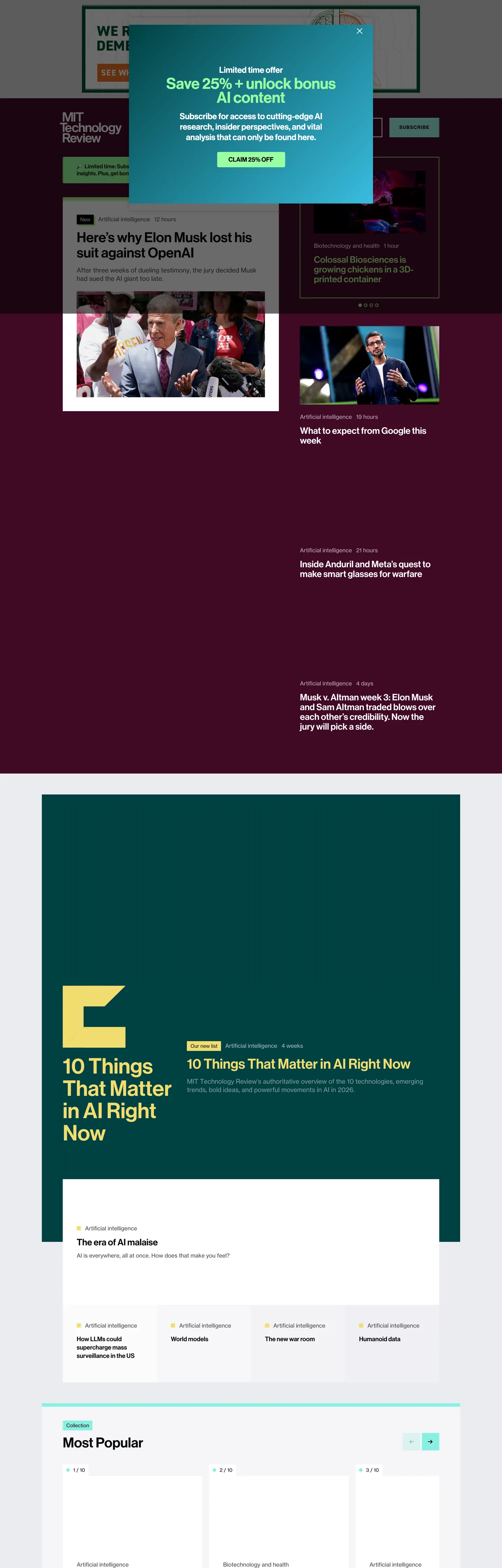
MIT Technology Review's homepage opens with a near-black canvas, a 62px golden-yellow headline, and a mint-aqua subscribe button at 0px radius. It is the most deliberately academic-looking home page in technology journalism. Where Wired leans into neon-saturated tech-bro energy and The Verge uses a system-level rounded-corner grammar, MIT Technology Review stays flat and compositional — sharp edges throughout, pastel-neon accents filling section card backgrounds rather than appearing on CTAs or nav chrome, and a monospace face (TRMono) reserved for the smallest section-identifier labels.

The DESIGN.md file packages the system into a machine-readable spec for React and AI tools. Inside: 18 color tokens — a near-black structural layer for the dark hero, a white canvas for editorial content below the fold, six pastel-neon section-category accent fills (mint aqua, chartreuse, sage green, lavender, peach, sky blue), and dark counterpart fills for each section's inverted card variant. Twelve typography tokens span NeueHaas in three display sizes at weight 600, NeueHaasText in two body and label tiers at weight 400, and TRMono at 10px for the single monospace-identifier moment. The radius scale has one value: effectively zero. Sixteen components cover the sharp-cornered CTA, the colored-fill section cards, the TRMono section labels, and the newsletter input module.

Feed this file to an AI coding tool and it reproduces MIT Technology Review's specific moves: near-black hero with pastel-neon colored-fill section cards, NeueHaas 600 as the single display weight, sharp corners everywhere, golden-yellow display headline, and TRMono for the section-identifier label tier only. The discipline worth borrowing for academic or research publications: using color as a section-classifier rather than as a brand accent creates a navigational system that lets readers identify content categories at a glance — a UX choice driven by editorial function rather than brand marketing.

What makes it distinct

  1. Pastel-neon section palettesix distinct accent colors (mint aqua, chartreuse, sage green, lavender, peach, sky blue) fill section-category card backgrounds rather than appearing as brand chrome
  2. Yellow display headline on near-blackthe hero h2 runs in golden yellow on a dark canvas, a pairing closer to a scientific journal cover than to consumer tech publishing
  3. NeueHaas weight 600 across all displaythe system never goes to 400 or 700 for headings; a single semibold weight handles every editorial hierarchy tier
  4. TRMono at 10px for section identifiersa custom monospace face appears only in the smallest label tier, adding academic-register texture without committing to a full mono voice
  5. Zero border-radius throughoutevery card, input, button, and panel in the system runs at 0px or approximately 1px; there is no pill or rounded-corner treatment anywhere on the editorial surface

Live at technologyreview.com

A snapshot of the brand in production. Hover the frame to scroll the page; click to visit.

Screenshot of MIT Technology Review's website at technologyreview.comtechnologyreview.com

Explore MIT Technology Review

Pick what you want to see — mockups, colors, typography, layout, or the full component list.

Brand & Accent

Sparing, CTA-only voltage.

Surface

Page and card backgrounds.

Text

Headlines, body, captions, muted.

Borders & Hairlines

Dividers, outlines, structural rules.

Other

Specialty colors.

MIT Technology Review design system FAQ

Common questions about MIT Technology Review's tokens, components, and how to use this DESIGN.md in your project.

Specs, directories, and component libraries that pair with this design system.

Use MIT Technology Review in your project

One machine-readable file. Drop it into Claude, Cursor, or any AI tool that reads DESIGN.md.

Download DESIGN.md