Make your AI a shadcn expert

Substack Design System

Substack's homepage as a DESIGN.md file.

About Substack DESIGN.md

Curated by Dov AzencotUpdated Source substack.com

  • News & Publishing

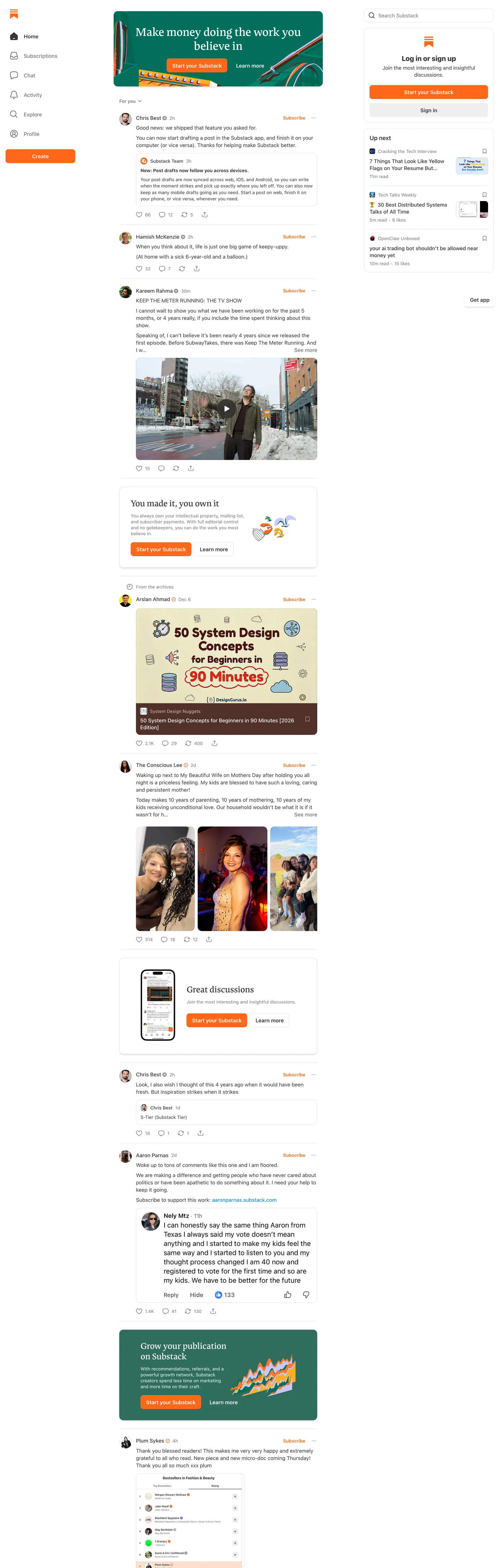
Substack's homepage is a feed of posts dressed as a marketing page. The canvas is pure white, the ink is a warm near-black ("#363737"), and the entire identity hangs on a single warm orange ("#ff6719") that does the work of wordmark, primary button fill, accent border, and the kicker chip beneath the hero. There is no gradient mesh, no dark hero section, no abstract product illustration loop — the page below the fold is the platform itself, rendered as a vertical column of real posts with avatars, reply threads, and emoji reactions. The marketing surface and the product surface are the same surface.

This DESIGN.md file packages the homepage system into a structured spec: 19 color tokens covering the orange voltage, the four-step gray ladder from `#363737` ink down to `#eeeeee` hairline, and the single sky-blue link color, 10 typography tokens spanning Cahuenga serif (20–32px) and system-ui (13–17px), a four-step radius scale where the pill (`9999px`), the 12px card, the 8px button, and the 4px detail each own a distinct surface class, an 8-step spacing scale built on a strict 4px-and-8px unit, and 18 component specifications covering the top nav, hero cluster, primary orange button, post card, comment thread row, and the publication-detail mini-cards. The format follows the Google Labs DESIGN.md specification.

Feed the file to Claude, Cursor, or any agent that reads structured tokens and it reproduces Substack's exact voice — white reading-feed canvas, warm orange voltage held to one role, near-black ink at weight 500 for serif display, system-ui sans for every UI label. Where most subscription brands lean on a chromatic hero gradient and a 64px display headline, Substack commits the homepage to a vertical post-stream rendered at reading-body type sizes — that decision to show the product instead of describing it is the design. Reference the tokens directly in Tailwind config, paste the hex values into CSS variables, or use the spec as an audit checklist when reviewing whether a publishing surface looks like a marketing page or a feed.

What makes it distinct

  1. Single orange voltage#ff6719 used as the only saturated brand color, carrying the wordmark, primary CTA fill, and orange chip surfaces with zero gradient extension
  2. Cahuenga serif at 24–32px weight 500a literary serif treated at subhead scale rather than the 80px+ billboard most subscription platforms reach for
  3. Near-black ink #363737 over pure whitenot pure black, a warm dark gray that sits 8 points off black to soften the ink against long reading sessions
  4. Pill-and-card binary9999px chips for tags and primary buttons sit alongside 8px and 12px cards, with no 16px or 20px middle radius
  5. Hairline-only elevationa 1px #eeeeee divider carries every section break in place of shadows, with zero gradient surfaces anywhere on the page

Live at substack.com

A snapshot of the brand in production. Hover the frame to scroll the page; click to visit.

Screenshot of Substack's website at substack.comsubstack.com

Explore Substack

Pick what you want to see — mockups, colors, typography, layout, or the full component list.

Brand & Accent

Sparing, CTA-only voltage.

Surface

Page and card backgrounds.

Text

Headlines, body, captions, muted.

Borders & Hairlines

Dividers, outlines, structural rules.

Other

Specialty colors.

Substack design system FAQ

Common questions about Substack's tokens, components, and how to use this DESIGN.md in your project.

Specs, directories, and component libraries that pair with this design system.

Use Substack in your project

One machine-readable file. Drop it into Claude, Cursor, or any AI tool that reads DESIGN.md.

Download DESIGN.md