Vector art mood effects.
Change how your vector art feels: warm and inviting, cool and professional, vintage and nostalgic, from one SVG. Nothing is uploaded.
Vector art mood effects.
Need the UI around it? With Pro, your AI agent builds the form, the result card and the rest of the page from a prompt.
Get ProHow it works
4 steps, no account. It runs in your browser and nothing is uploaded.
Drop an SVG
Drop an SVG; the browser draws it at the size it declares.
Choose the tone
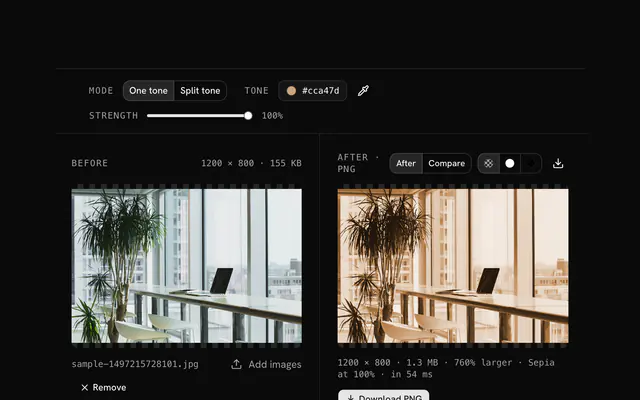
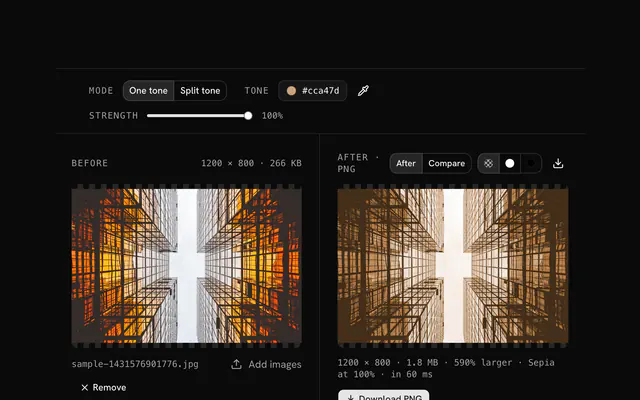
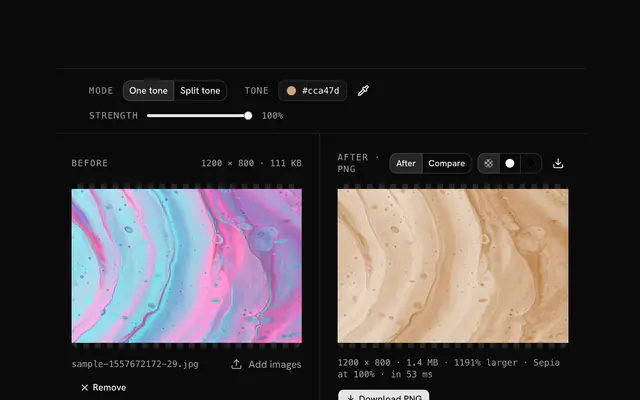
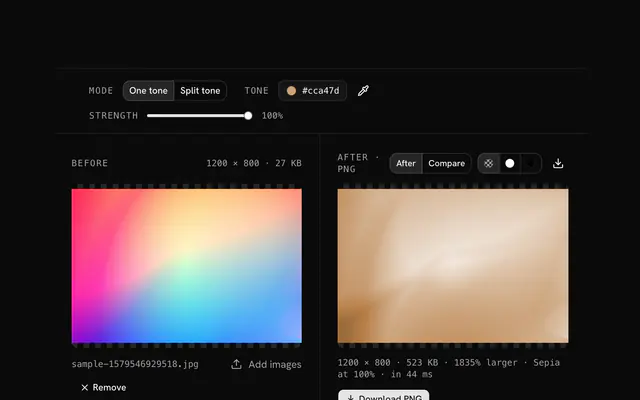
Pick a preset, from sepia to slate to cool blue, or type a hex, and set how strongly it takes.
Read the preview
Every color moves toward the tone while its brightness stays, so lines, shading and highlights keep their depth.
Download the PNG
The result is a PNG with the transparency kept.
Related tools
More SVG tools. Every one free, in the browser.
Pricing
Build it with Pro
The tool is free. Pro adds 6,000+ blocks, premium templates and the MCP server, so your AI editor builds the product around it.
4.9/5 out of 5 · 150+ reviewsfrom 150+ founders and developers.
- Secure checkout via Stripe
- Code lives in your repo
- Keep what you've shipped if you cancel
- License terms
Questions and answers
Before you trust the result: what to know about the format, the limits, your data and the tools next to it.
Color carries feeling. Warm tones (sepia, orange) read as friendly and nostalgic; cool tones (blue, teal) as calm and professional. The same drawing tells a different story in each.
Nostalgia, warmth, age. Sepia makes modern vector art feel established and vintage; it suits heritage brands and retro themes.
Trust, calm, competence. Cool tones suit corporate, technical, healthcare and financial themes.
Creativity, luxury, a little mystery. Purple suits artistic, premium and inventive brands.
Yes. Pick a tone from the site's own palette and the art looks intentional and finished.
Think of the audience and the message: warm, saturated tones for playful content, cool and desaturated for serious, deep and rich for luxury.
Yes. Note the hex and apply it to every piece; they share one emotional color language.
The browser draws the SVG to pixels at the size it declares (its width and height, or its viewBox), and the tool works on those pixels. The result is a PNG, not an SVG: for a larger output, set a larger width and height on the SVG first, with the SVG editor.
No. The file is read and drawn by your browser, and the page makes no request with it. You can load the page, go offline and keep working; nothing is stored either, so reload and it is gone.
No. The "Vector art mood effects" tool is free and opens without a sign-in, an account or an install.
No, it takes one file at a time. If you drop or choose several, only the first is used; run the tool again for the next one.
The edit is written as a PNG because PNG stores every pixel exactly, with a full alpha channel, so the result can be edited again without a second round of loss.
No. The browser decodes the image and the tool writes a new file from its pixels, so camera EXIF, GPS position and text chunks in the original are not copied into the result. Keep the original file if you need them.
No. The result has the same width and height in pixels as the source.
Closest to the "Vector art mood effects" tool: SVG color tone changer, SVG illustration toning, JPEG mood color editor, Vector fade effect converter. Each opens on its own page, free and in the browser.
The "Vector art mood effects" tool is one of 45 in its group. The group's page, /tools/svg, lists them all.
The tool is free. Its interface is built from shadcn.io's own components (Button, Input, Slider and the rest of the registry under /ui), which come in React, Vue, Svelte and Solid. Pro adds the blocks and templates for the product around it.
4.9 out of 5 from 150+ developers


Build the product around it
Every block, template and icon, installed by your AI agent in your theme. The tools stay free.
Get Pro