WebP to Base64 encoder.
Encode a WebP as a raw Base64 string for an API body, a JSON field or a database column. No prefix, nothing uploaded.
WebP to Base64 encoder.
Need the UI around it? With Pro, your AI agent builds the form, the result card and the rest of the page from a prompt.
Get ProHow it works
3 steps, no account. It runs in your browser and nothing is uploaded.
Drop the WebP
Drop a WebP on the pane or choose it from your device.
Read the size
The bytes are encoded at once and the string's size is shown.
Copy or download
Copy the Base64 to the clipboard or download it as text.
Related tools
More WebP tools. Every one free, in the browser.
Pricing
Build it with Pro
The tool is free. Pro adds 6,000+ blocks, premium templates and the MCP server, so your AI editor builds the product around it.
4.9/5 out of 5 · 150+ reviewsfrom 150+ founders and developers.
- Secure checkout via Stripe
- Code lives in your repo
- Keep what you've shipped if you cancel
- License terms
Questions and answers
Before you trust the result: what to know about the format, the limits, your data and the tools next to it.
A WebP is 25 to 35% smaller than a PNG or JPG of the same quality, and Base64 adds a third to whatever it encodes, so a WebP gives the shortest string. If the system that receives it can decode WebP, you move and store less.
Yes. Lambda takes a 6 MB payload and edge functions less, so a shorter string matters. Keep in mind the string is a third larger than the file; for anything past a few hundred kilobytes, store the file in object storage and send its URL.
They store it like any text. The question is whether the client that reads it back can decode WebP: every current browser can, so a web app is fine. For an older native app, encode a PNG or JPG instead.
In JavaScript, decode with atob or Buffer.from(text, "base64") and wrap the bytes in a Blob of type image/webp. In Python, base64.b64decode and write the bytes to a .webp file. Every language has a Base64 decoder built in.
No. The browser decodes the file, a canvas does the work and the result is built on your device; the page makes no request with your image. You can load it, go offline and keep working.
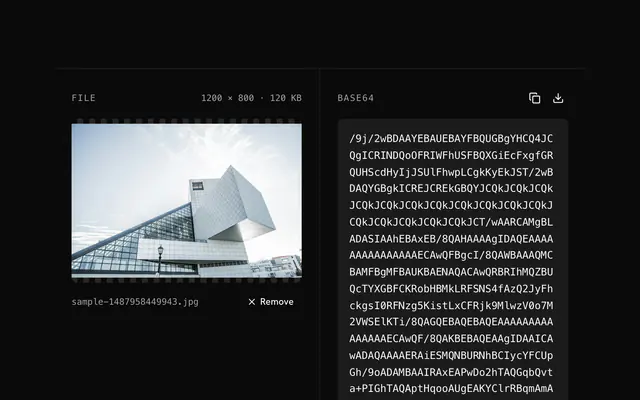
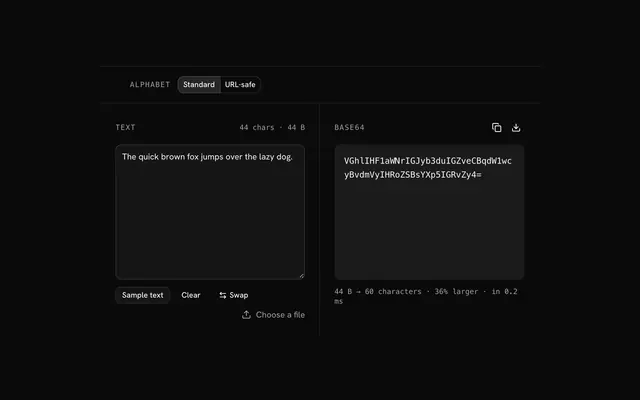
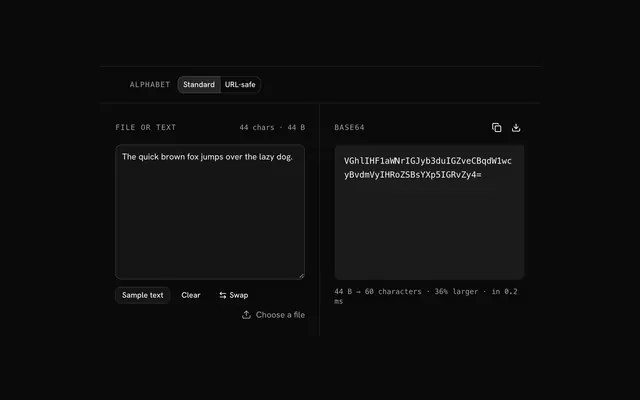
Drop the file and the Base64 appears beside it with its length and how much larger it is than the file. Copy it with the button or download it as a text file. Long results are shortened on the page; the copy carries the whole string.
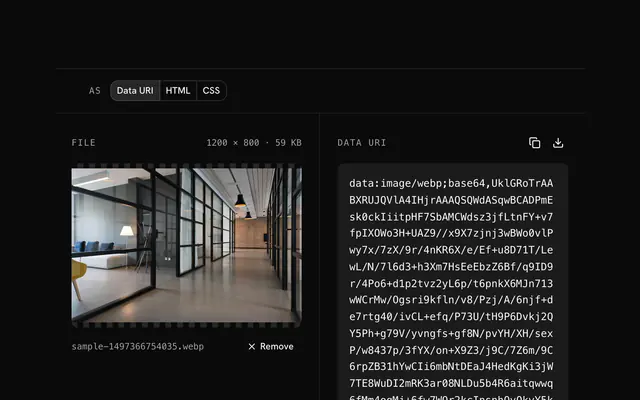
This page gives the bare string, which is what an API field or a database column wants. The WebP to data URI tool adds the data:image/webp;base64, prefix for an img src or a CSS url().
No. The WebP to Base64 encoder is free and opens without a sign-in, an account or an install.
Up to 25 MB per file, the limit the tool states under its drop area. A larger file is refused with a plain message instead of being decoded.
No, it takes one file at a time. If you drop or choose several, only the first is used; run the tool again for the next one.
No. The text is made from the file's own bytes, unchanged, so EXIF and every other metadata field stay inside it. Nothing is re-encoded or resized.
About a third longer: Base64 writes every three bytes as four characters. The status line shows the exact character count and the overhead for your file.
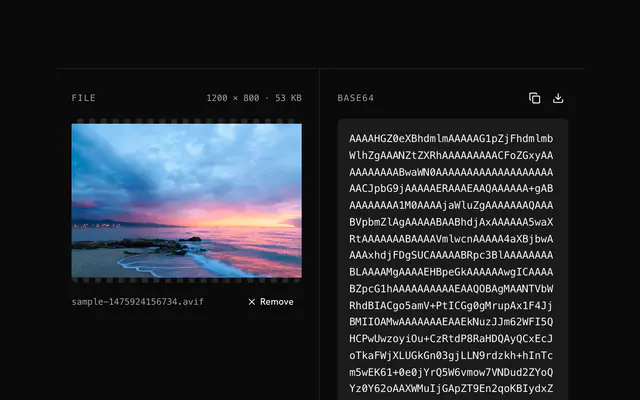
Closest to the WebP to Base64 encoder: WebP to data URI converter, WebP compressor, JPG to Base64 encoder, AVIF to Base64 encoder. Each opens on its own page, free and in the browser.
The WebP to Base64 encoder is one of 44 in its group. The group's page, /tools/webp, lists them all.
The tool is free. Its interface is built from shadcn.io's own components (Button, Input, Slider and the rest of the registry under /ui), which come in React, Vue, Svelte and Solid. Pro adds the blocks and templates for the product around it.
4.9 out of 5 from 150+ developers


Build the product around it
Every block, template and icon, installed by your AI agent in your theme. The tools stay free.
Get Pro